
Where to get an apostille in Türkiye depends on who signed the document. For administrative documents, such as those issued by a notary, a civil registry office, a school or another public body, the apostille comes from the governorship (valilik) in a provincial centre or the district governorship (kaymakamlık) in a district. For judicial documents, such as court decisions or criminal record certificates, the competent authority is the justice commission (adalet komisyonu) at a courthouse that has a high criminal court.
Some documents don't need a trip to an office at all. A criminal record certificate or an e-signed court decision can get an e-Apostille through e-Devlet, Türkiye's government portal. An apostille only works in countries that are party to the Apostille Convention; for other countries the route runs through the Ministry of Foreign Affairs.
This guide explains which office handles which document, how the e-Apostille works, and whether the apostille belongs on the original or on its notarised translation.
What is an apostille, and what does it certify?
An apostille is a one-page certificate introduced by the Hague Convention of 5 October 1961. Türkiye has been a party to the Convention since 1985. A document carrying an apostille can be used in any other member country without further consular legalisation.
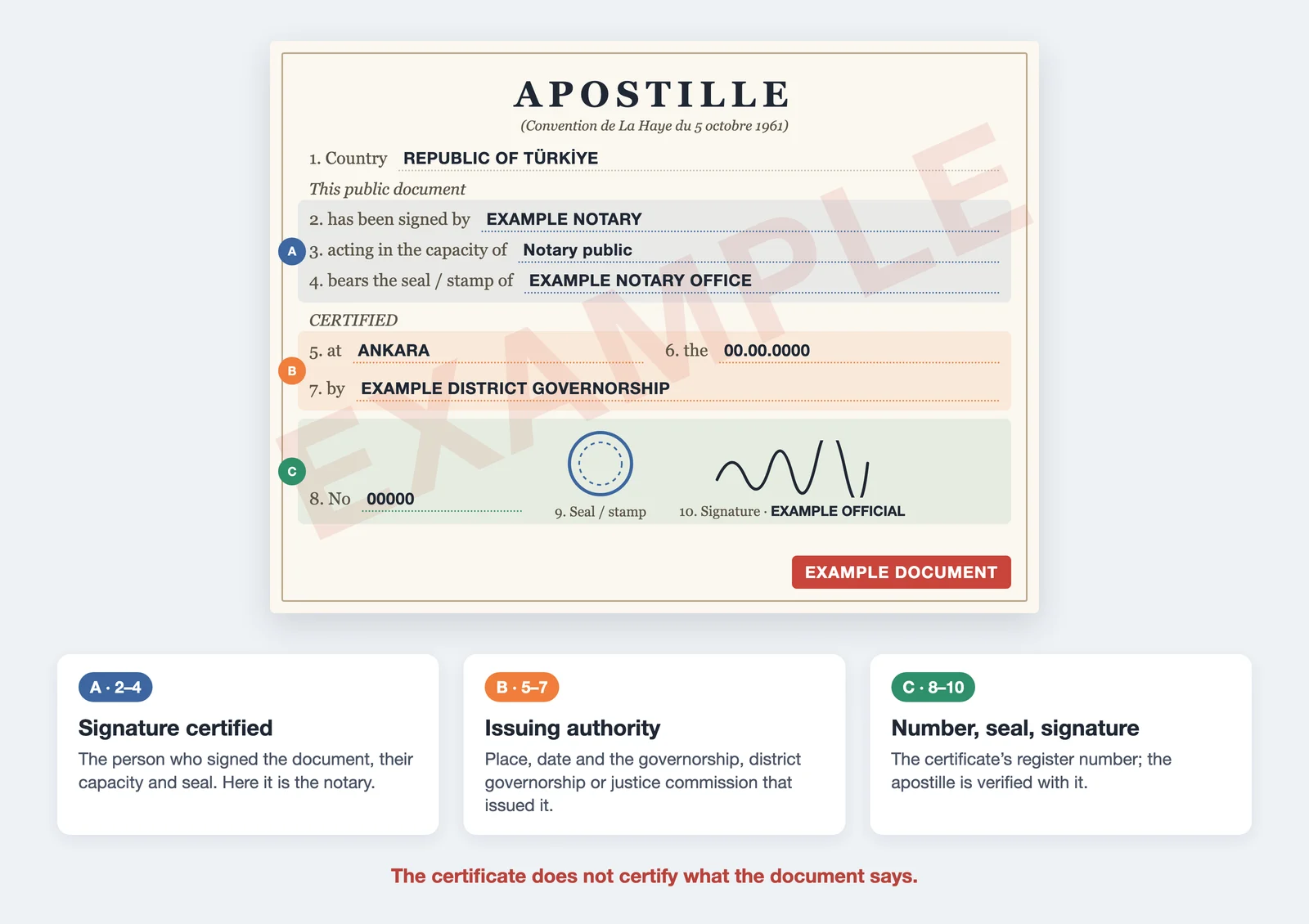
An apostille does not certify what a document says. It confirms the signature of the person who signed it, the capacity in which they signed, and the seal or stamp where there is one. That detail decides which page the apostille goes on.
Under Article 1 of the Convention, apostilles are issued for these public documents:
Documents from courts, public prosecutors or other judicial officials
Administrative documents: civil registry records, diplomas, letters from public bodies
Notarial acts: powers of attorney, notarised translations, notarised copies
Official certificates placed on privately signed documents, such as a notary's authentication of a signature
Where to get an apostille in Türkiye: the competent authority for each document
According to the Ministry of Foreign Affairs' legalisation guide, the governorships and district governorships are the authorities that issue apostilles in Türkiye. The Hague Conference page for Türkiye names a separate authority for judicial documents: the presidencies of the justice commissions where high criminal courts sit. Which door you knock on depends on who signed the document.
Signed by | Typical documents | Apostille issued by |
|---|---|---|
Notary | Power of attorney, notarised translation, notarised copy | Governorship or district governorship where the notary is based |
Civil registry office | Population register extract, birth or marriage record | Governorship or district governorship |
School, university, public body | Diploma, transcript, official letter | Governorship or district governorship |
Court, public prosecutor | Court decision, criminal record certificate | Justice commission at the courthouse |
e-signed e-Devlet document | Criminal record certificate, e-signed court decision | e-Apostille via e-Devlet and PTT |
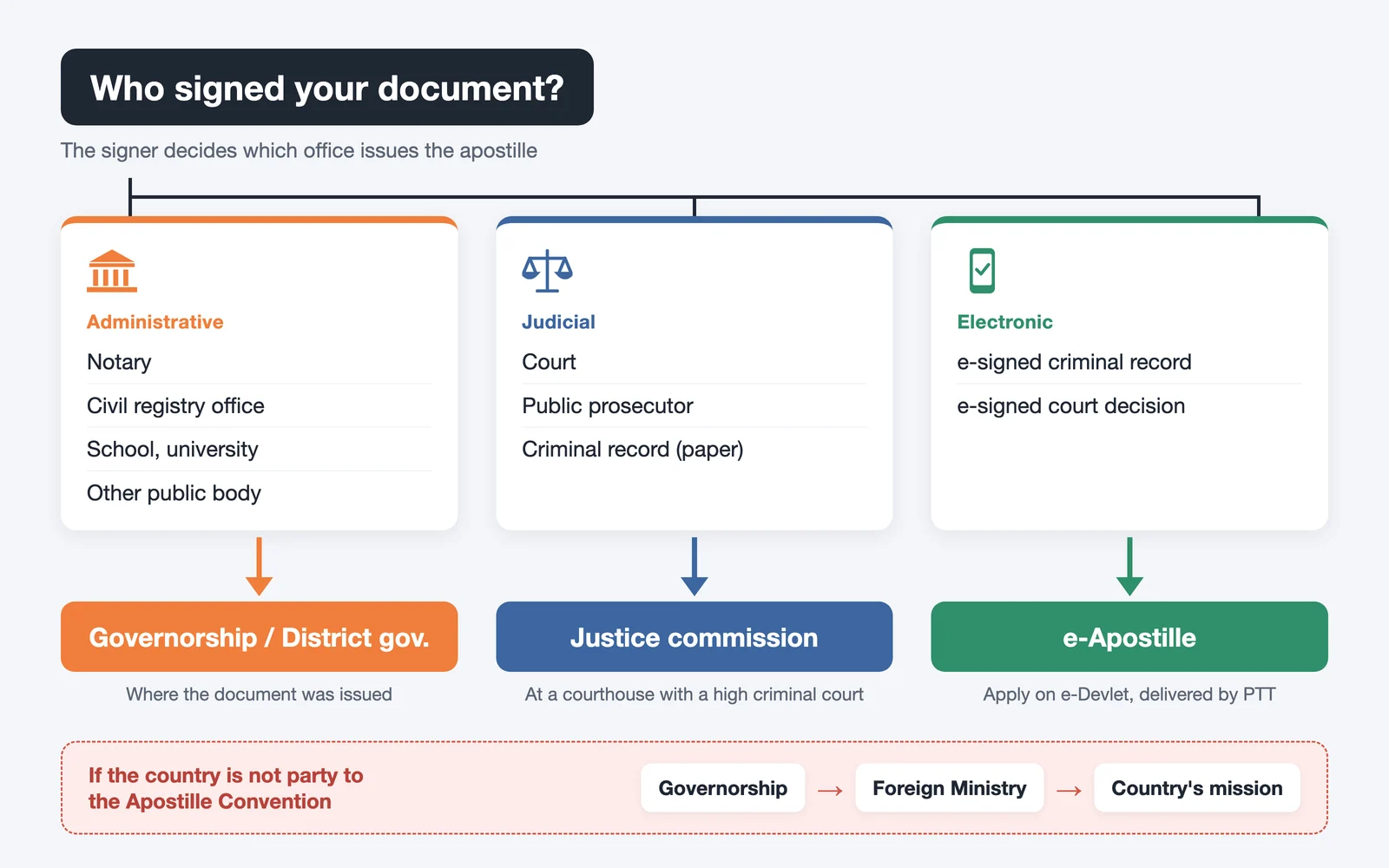
Administrative documents: governorship or district governorship
In provincial centres the governorship issues the apostille; in districts the district governorship does. The document goes to the authority for the place where it was issued. For notarial documents that means the province or district where the notary's office is.
Because an apostille certifies a signature, the office needs the original document with its handwritten or electronic signature. A plain photocopy carries no signature to certify. If a notarised copy is used in place of a one-off original such as a diploma, the apostille then certifies the notary's signature.
Judicial documents: the justice commission
Court decisions, prosecutors' letters or criminal record certificates go to the courthouse, not the governorship. The competent unit is the presidency of the justice commission at a courthouse with a high criminal court. A decision has to be final: requests for decisions that are not yet final are turned down.
e-Apostille: getting an apostille through e-Devlet and PTT
On e-Devlet, PTT (the Turkish postal service) offers two services: an e-Apostille application for criminal record certificates and a general e-Apostille application. Your request reaches the relevant justice commission through PTT. The commission president signs the apostille electronically, and PTT delivers the document back to you.
According to the Ministry of Justice's e-Apostille guide, the process works like this:
- 1
You log in to e-Devlet and open PTT's e-Apostille service.
- 2
You choose the document type and the country the document is going to.
- 3
The request goes to the justice commission responsible for the document.
- 4
The commission president approves the e-signed apostille, and PTT sends the document to you.
The e-Apostille only works for documents created in the system with an electronic signature. Older decisions that exist only on paper are not sent as e-Apostilles; for those you apply to the commission in person. The guide lists requests for another person's record, decisions that are not final, or scanned documents among the reasons for refusal.
Turkish consulates have announced that some population documents generated on e-Devlet are covered by the e-Apostille too. You can check an apostilled document through the "Apostil Belge Doğrulama" (apostille verification) service on e-Devlet.
Does the apostille go on the original or on the translation?
An apostille only certifies the signature on the document it is attached to. An apostille on the original population register extract confirms the registry official's signature. A translation made later is not covered by that apostille.
An apostille on a notarised translation certifies the notary's signature instead. Since the notary has certified the sworn translator's signature, the translation becomes part of the chain. Some countries ask for two apostilles: one on the original, one on the notarised translation.
Apostille on the original | Apostille on the notarised translation | |
|---|---|---|
Signature certified | The official or judge who issued the document | The notary who certified the translation |
Issued by | Governorship, district governorship or justice commission, by document type | Governorship or district governorship where the notary is based |
Covers the translation | No | Yes |
When | The country wants the certified original | The country wants a certified translation |
The rules of the destination country decide which route is needed. When you order an apostille translation from Languvi, the sworn translation, notary approval and apostille are prepared in one order.
When an apostille is not used
An apostille is not the answer for every document or every country. The Ministry of Foreign Affairs' guide and the Convention itself set out these cases:
The country is not a party to the Convention: an apostille has no effect there. After certification by the governorship or district governorship, the document goes to the Ministry of Foreign Affairs and then to that country's mission. Our guide to consular legalisation covers this route.
The document already has an apostille: the Ministry does not legalise apostilled documents. If the document is going to a non-member country, the apostille is cancelled and the document follows the legalisation route.
The document is for a foreign embassy in Türkiye: an apostille is not used here either; the route is a notarised copy, the governorship or district governorship, then the Ministry's Legalisation Unit.
Documents outside the Convention: documents issued by diplomatic or consular officers, along with administrative documents dealing directly with commercial or customs operations, cannot be apostilled.
Foreign documents: a document issued abroad gets its apostille in the country that issued it, not in Türkiye. Our guide to using foreign documents in Türkiye explains the rest.
Apostille translation with Languvi
With Languvi you upload your document online. You see the price with the estimated delivery date within seconds, before you pay. Sworn translation, notary approval, apostille and consular legalisation are handled on one platform. Official documents carry the sworn translator's stamp and signature.
Every document goes to a translator who knows the subject and is checked before delivery. If you live abroad, you only need to upload the document; the notarised translation is prepared in Türkiye. You receive it through your account, the mobile app, e-mail or WhatsApp. Signed, stamped originals are sent by courier when needed. You can follow your order on the order tracking page.
Frequently Asked Questions
Do I get an apostille from the governorship or the district governorship?
Both are competent. The governorship issues apostilles in provincial centres, the district governorship in districts; the document goes to the authority for the place where it was issued. Judicial documents such as court decisions or criminal records go to the justice commission at the courthouse.
How do I get an apostille on a Turkish criminal record certificate?
The quickest route is the criminal record e-Apostille service on e-Devlet. Your request reaches the justice commission through PTT, and the e-signed apostilled document comes back to you through PTT. You can also apply in person to the justice commission at a courthouse with a high criminal court.
Does an apostilled document also need Ministry of Foreign Affairs legalisation?
It does not. An apostilled document is used directly by the authorities of member countries. The Ministry does not legalise apostilled documents at all; legalisation is only for countries outside the Convention.
I live abroad. How do I get an apostilled translation of my Turkish document?
Languvi handles the whole process for you. You upload your document online; the sworn translation, notary approval and apostille are then prepared in Türkiye. Signed and stamped originals are sent to your address by courier when needed.
Can a foreign document get an apostille in Türkiye?
The apostille comes from the competent authority of the country that issued the document. A foreign document first gets its apostille in its own country, then its notarised Turkish translation is made in Türkiye. Languvi prepares that translation through its sworn translators.
Conclusion: Where to get an apostille in Türkiye comes down to who signed your document. Administrative and notarial documents get their apostille from a governorship or district governorship, while judicial documents go to a justice commission. For e-signed documents such as a criminal record certificate, the e-Apostille on e-Devlet is enough. Upload your document on our order page to see the price with the delivery date for the sworn translation, notary approval and apostille within seconds.