Using foreign documents in Türkiye almost always follows the same chain, whatever the office. A birth certificate, diploma, marriage certificate or criminal record issued abroad is first approved in the country that issued it. It is then translated into Turkish by a sworn translator in Türkiye, and a notary approves the translation.
This guide explains that chain step by step: when an apostille is enough, what happens for countries outside the Apostille Convention, and how the notarised Turkish translation works. It then goes through the offices that most often ask for foreign documents, with links to our pages for each application. The receiving office's own list always has the final word, but the logic behind most lists is the same.
Step one: approval in the issuing country
A foreign document has to be approved in the country that issued it before a Turkish office will accept it. Which approval depends on whether that country is a party to the Apostille Convention.
Countries in the Apostille Convention
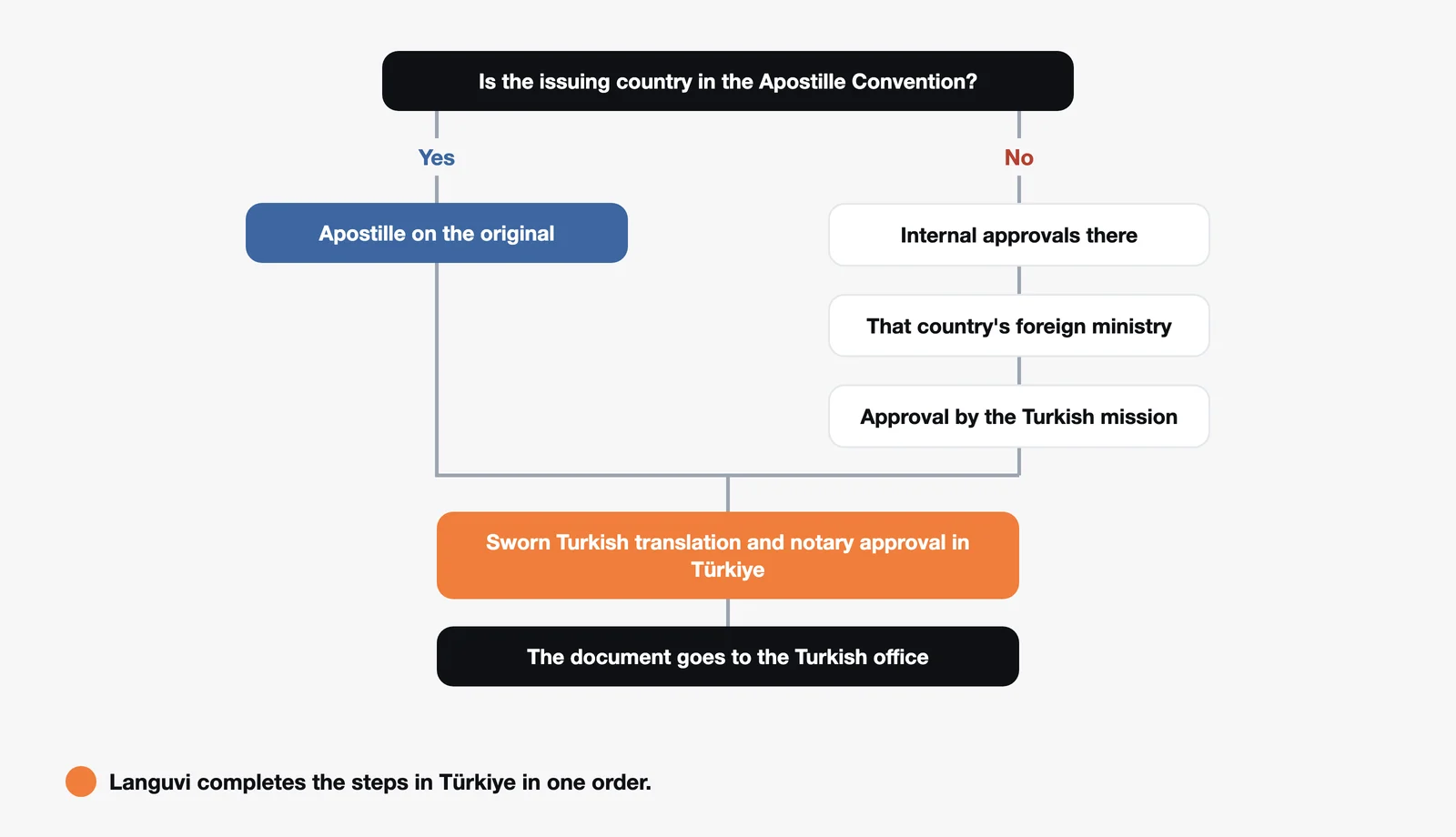
If the issuing country is a party to the convention, its competent authority puts an apostille on the original. According to Türkiye's Ministry of Foreign Affairs, an apostille is enough on its own: no further approval by Turkish authorities is needed. The ministry also states that it does not approve documents that have already been apostilled.
The apostille has to come from the country that issued the document. A document from abroad cannot be apostilled in Türkiye, so it is worth getting the apostille before you move. Some documents, such as those issued by diplomatic or consular officers, cannot be apostilled at all.
Countries outside the Apostille Convention
If the issuing country is not a party, a longer chain of approvals applies. According to Türkiye's Ministry of Foreign Affairs, you first complete the internal approval steps in that country and then have the document approved by its foreign ministry. The document is then approved by the Turkish embassy or consulate in that country, or by the authorised Turkish authorities.
Issuing country | Step on the original | Step in Türkiye |
|---|---|---|
Apostille Convention country | Apostille from the competent authority | Notarised Turkish translation |
Non-convention country | Internal approvals, foreign ministry, then Turkish mission | Notarised Turkish translation |
Document already in Turkish | Approval as the office requires | No translation needed |
Step two: the notarised Turkish translation
Once the original is approved, it is translated into Turkish. In Türkiye, this is done by a sworn translator registered with a notary. The notary then approves the translation by confirming the sworn translator's signature.
The translation covers the whole document, including stamps, signatures, notes on the back and the apostille itself. Leaving out the apostille or the back of a page can lead to the translation being sent back. If you are applying from abroad, you can upload your documents to Languvi online; the notarised Turkish translation is prepared in Türkiye.
Which offices ask for foreign documents?
Most procedures where foreigners, or Turkish citizens with documents from abroad, deal with Turkish offices follow this chain. Each office then adds its own list.
Migration authority (residence permits)
The Presidency of Migration Management's document lists say that documents obtained abroad, such as marriage or birth certificates, need an apostille and a notarised Turkish translation. Our page on residence permit translation in Türkiye covers these applications.
Civil registry directorates (citizenship, marriages, driving licences)
Civil registry directorates handle citizenship applications, civil status registrations, and driving licence exchanges. Birth certificates, divorce decisions and foreign driving licences are common examples. See our pages on translation for Turkish citizenship applications and foreign driving licence translation for Türkiye.
Municipal marriage offices
Foreigners marrying in Türkiye bring a certificate of no impediment, a birth certificate and a translated passport to the marriage office. Our page on translation for marrying in Türkiye explains what they need.
YÖK and MEB (education)
University degrees from abroad are recognised by YÖK, while school diplomas are handled by the Ministry of National Education (MEB). Both ask for apostilled originals, and MEB lists some languages that need no translation. See our pages on YÖK equivalence translation and MEB equivalence translation in Türkiye.
Ministry of Labour (work permits)
Work permit applications ask for the diploma with a Turkish translation approved by a sworn translator or an official authority. Our page on work permit translation in Türkiye covers the process.
Notaries, land registry offices and banks
Notary transactions, property purchases and bank procedures often ask for a notarised Turkish translation of the passport. Powers of attorney issued abroad are also translated into Turkish before they are used here.
Courts and other official bodies
The same chain applies to foreign documents used in Turkish courts or submitted to other official bodies. Having a foreign court decision recognised in Türkiye is a separate legal procedure, so we recommend consulting a lawyer about it.
Exceptions and office-specific rules
Not every foreign document needs the full chain. Some offices accept multilingual civil status extracts without extra approval, and some list languages that need no translation. For example, the İstanbul directorate of national education does not ask for translations of documents in English, Arabic, Persian, German or Russian.
These exceptions vary by office and sometimes by province. Just state in your order which office the document is for. Languvi prepares the translation with the approvals that office expects.
Checks before you start
Find out which office will receive the document and get its current list.
Get the apostille, or start the legalisation chain, before you leave the issuing country.
Have the whole document translated, including the apostille, stamps and the back.
Keep your name spelt the same way in your passport, residence permit and every translation.
Check how recent each document must be, since some offices refuse older documents.
Keep the originals with their translations, because offices often ask to see the originals.
Frequently Asked Questions
Can a foreign document be apostilled in Türkiye?
No. The apostille is issued by the country that issued the document. Turkish authorities apostille only documents issued in Türkiye, for use abroad.
Does an apostilled document also need Turkish Foreign Ministry approval?
No. According to Türkiye's Ministry of Foreign Affairs, an apostille is enough on its own, and the ministry does not approve apostilled documents. The document still needs a notarised Turkish translation.
What if the issuing country is not part of the Apostille Convention?
The document goes through that country's internal approvals and its foreign ministry. It is then approved by the Turkish mission in that country or by the authorised Turkish authorities. After that, it is translated into Turkish with notary approval.
Who can translate a foreign document into Turkish?
In Türkiye, the translation is made by a sworn translator registered with a notary, and the notary approves it. You can also upload your documents to Languvi from abroad.
Is a translation made abroad valid in Türkiye?
A translation made abroad usually needs approval from a Turkish consulate to be used in Türkiye. Foreign translations without consular approval are not accepted by most offices. To skip those steps, upload your document to Languvi; the notarised Turkish translation is prepared in Türkiye.
Which languages can be translated into Turkish?
Documents can be translated into Turkish from more than 180 languages. Each translation goes to a translator who knows the subject and is checked before delivery.
Conclusion: Using foreign documents in Türkiye comes down to two steps: approval in the issuing country, then a notarised Turkish translation in Türkiye. An apostille is enough for Apostille Convention countries, while other countries need a legalisation chain. On Languvi you upload your documents, and the sworn Turkish translation with notary approval is prepared on one platform. See our page on notarised Turkish translation for Türkiye applications, or upload your documents now on the order page.