
What is consular legalisation? It is the chain of certifications a Turkish document needs before it counts as an official document in a country that has not joined the Apostille Convention. The final link is the embassy or consulate of that country in Türkiye, which certifies the stamp of the Turkish Ministry of Foreign Affairs. Once it has done so, the authorities of that country can rely on the document.
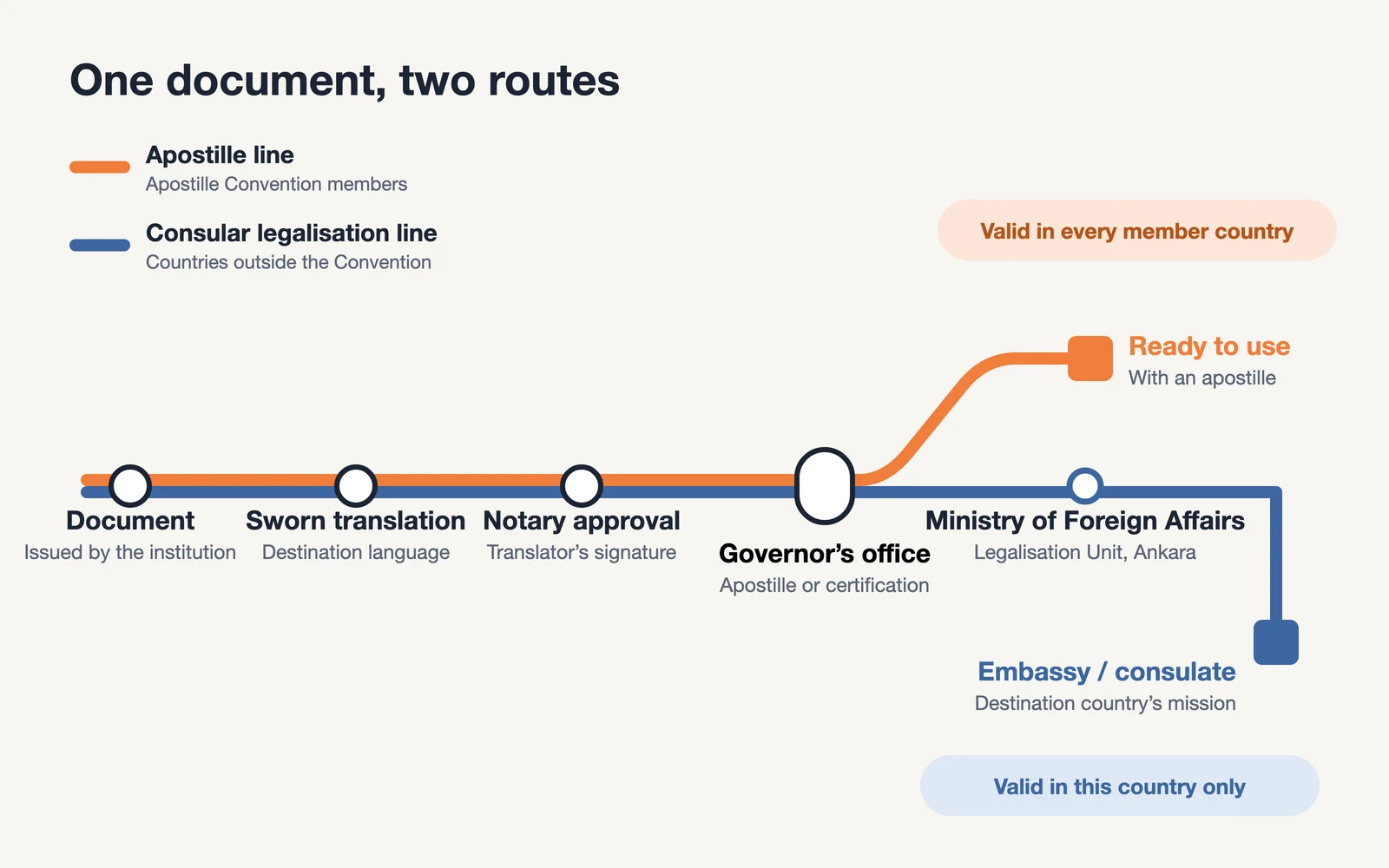
With an apostille, one certificate does the job. Consular legalisation takes longer: the document passes through a notary, the governor's office, the Ministry of Foreign Affairs and finally the foreign mission. The United Arab Emirates, Qatar, Kuwait, Iraq, Egypt and Jordan are among the countries that still work this way.
This guide explains how consular legalisation differs from an apostille, which countries need it and what each step involves. It is written for Turkish citizens sending papers abroad, and for foreign residents of Türkiye who need Turkish documents recognised at home.
What is consular legalisation, and why is it needed?
The authorities of one country cannot check a signature or seal made in another. A document therefore passes through a verification chain before it travels. The Turkish Ministry of Foreign Affairs describes this as confirming that the signature and seal on an official document are genuine, without vouching for the text itself.
The logic is simple. Each authority certifies only the signature and seal of the authority that signed just before it. The notary certifies the sworn translator, the governor's office certifies the notary, and the Ministry certifies the governor's office. The foreign mission then certifies the Ministry's stamp. That last step is the consular legalisation.
None of these stamps confirms what the document says; they confirm who signed it. Getting the content right is the job of the translation. That is why the sworn translation at the start of the chain matters so much.
Apostille or consular legalisation: the difference
Türkiye is a party to the 1961 Apostille Convention. For member countries, the governor's office (valilik) or district governor's office (kaymakamlık) adds an apostille; for court documents, the courthouse does. An apostilled document does not go to the Ministry or to a consulate.
Apostille | Consular legalisation | |
|---|---|---|
For which countries? | Members of the Apostille Convention | Countries outside the Convention |
Governor's office | Adds the apostille | Adds a certification (tasdik şerhi) |
Ministry of Foreign Affairs | Not needed | The Legalisation Unit certifies |
Foreign mission | Not needed | Embassy or consulate certifies |
Where it is valid | Every member country | Only the country that legalised it |
The last row matters most. An apostilled document can be used in any member country. A consular legalisation, by contrast, is valid only for the country whose mission gave it. If you need the same document in two non-member countries, each one gets its own legalised set.
Which countries require consular legalisation?
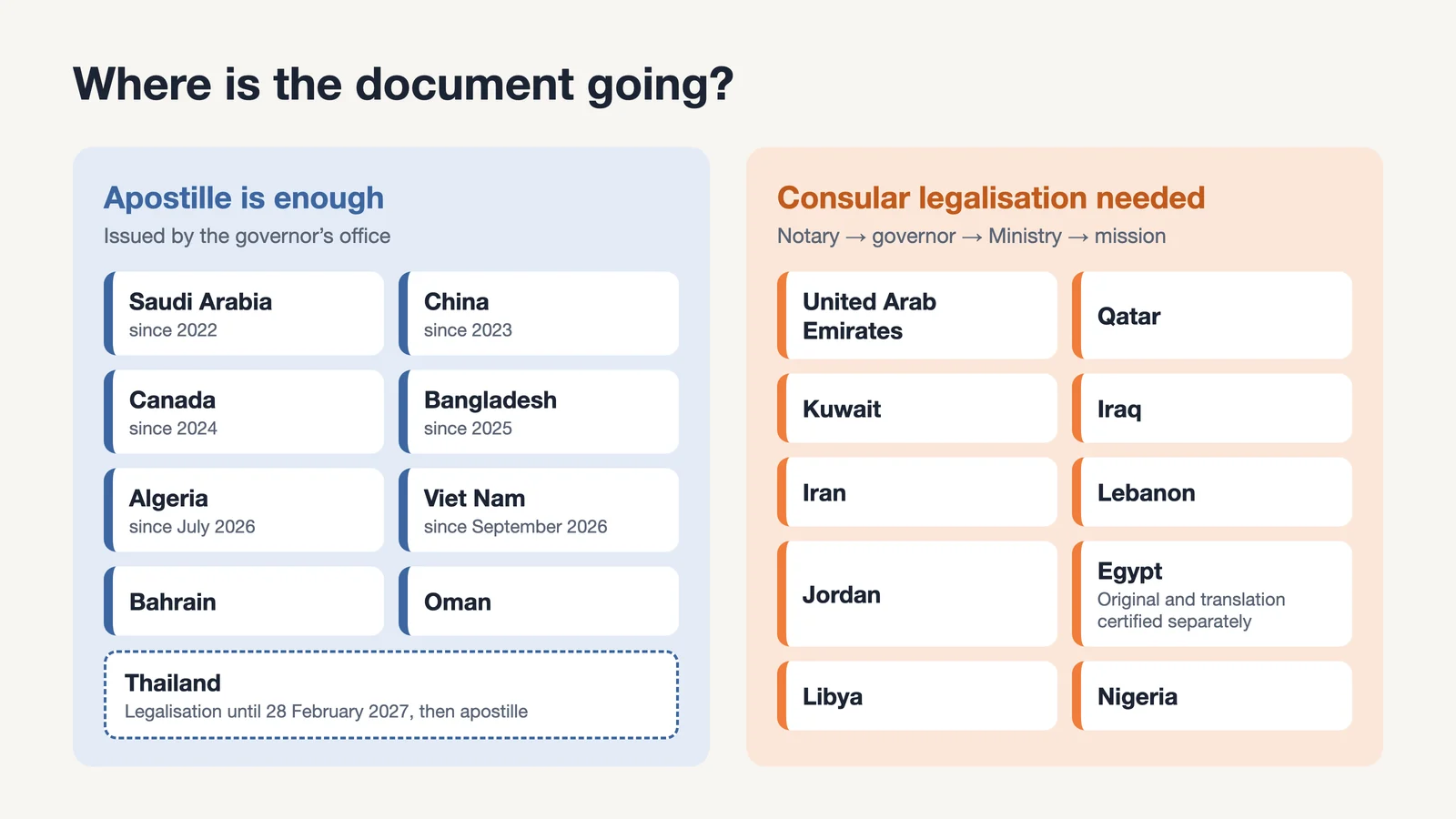
The Hague Conference keeps the official status table of the Apostille Convention, which lists 130 parties. Countries missing from the table need consular legalisation. Among those that receive many documents from Türkiye are:
the United Arab Emirates, Qatar, Kuwait
Iraq, Iran, Lebanon, Jordan
Egypt, Libya, Nigeria
The list changes over time. In recent years Saudi Arabia (2022), China (2023), Canada (2024) and Bangladesh (2025) joined the Convention. Apostilles have been valid for Algeria since July 2026 and for Viet Nam since September 2026. For Thailand, the Convention enters into force on 28 February 2027.
Choosing the wrong route costs time. According to the Ministry, an apostille issued for a non-member country is cancelled before the document can go through legalisation. The same applies to a document handed to a foreign embassy in Türkiye.
Consular legalisation step by step
Under the Ministry's own guidance, a document issued in Türkiye becomes usable in a non-member country in this order:
- 1
Obtain the document from the institution that issues it, such as a diploma, civil registry record or criminal record certificate.
- 2
Sworn translation into the language of the destination country, when its authorities ask for one.
- 3
Notary approval: the notary certifies the sworn translator's signature, and the original and translation are sealed together.
- 4
Governor's office: the valilik or kaymakamlık where the notary is based certifies the notary's signature.
- 5
Ministry of Foreign Affairs: the Consular Legalisation Unit in Ankara certifies the governor's office. It works by appointment only.
- 6
Consular legalisation: the embassy or consulate of the destination country in Türkiye certifies the Ministry's stamp.
In some countries the chain has one more link after the document arrives. In the United Arab Emirates, for example, the UAE Ministry of Foreign Affairs adds its own attestation. We cover that in our guide to translating documents for Dubai.
Diplomas, transcripts and company documents
For diplomas and transcripts, the Ministry accepts two routes. The document can be approved by the Ministry of National Education first and then go to the Ministry of Foreign Affairs. Alternatively, a notarised copy is made, certified by the governor's office, then certified by the Ministry.
Company documents add a chamber of commerce to the chain. A certificate of authority, an activity certificate or a certificate of origin is first approved by the chamber where the company is registered. The governor's office, the Ministry and the destination country's mission in Ankara follow.
Practical points to watch
The Ministry's Legalisation Unit lists a few rules that stop documents getting stuck halfway:
Age of the document: the unit does not certify documents older than six months. Each document needs a current date, the issuing authority's seal and the signer's name stamp.
No photocopies: certification is made on the original or on a notary's certified copy. A notarised copy must first be certified by the governor's office.
Identity documents: ID cards, marriage booklets and passports are not certified directly. A notarised copy or a notarised translation is prepared instead.
Multi-page documents: all pages are folded at the corner or tied together and sealed as one, so no page can be swapped.
Countries asking for both versions: according to the Ministry, Egypt and Thailand require separate certification of the Turkish original and its translation.
Each of these rules affects every later link. An expired date or a missing seal can mean starting again from the first step.
Using a foreign document in Türkiye
The chain also works in reverse. A document issued in a non-member country is first certified by that country's foreign ministry. Then either the Turkish embassy or consulate there, or that country's mission in Türkiye, legalises it.
Before Turkish institutions accept it, the document is translated into Turkish by a sworn translator, and the translation is notarised. Our guide to using foreign documents in Türkiye walks through this direction.
Consular legalisation with Languvi
On Languvi, sworn translation, notary approval, the governor's certification, the Ministry's certification and consular legalisation are handled on one platform. You do not need to visit each office in turn.
- 1
Upload your document on our order page.
- 2
Choose the target language, consular legalisation and the country where the document will be used. You see the price and the estimated delivery date within seconds, before you pay.
- 3
The document goes to a sworn translator who knows the subject, and the translation is checked before delivery.
- 4
The translation carries the sworn translator's stamp and signature. The notary, governor's office, Ministry and consulate steps follow in order.
- 5
The legalised documents are sent by courier when needed. You can follow each step of your order from your account.
Languvi works in more than 180 languages. It is certified to ISO 17100 and ISO 9001. If you live abroad, uploading your document online is all it takes; the notarised translation is prepared in Türkiye.
Frequently Asked Questions
Is consular legalisation the same as Ministry of Foreign Affairs certification?
They are two consecutive links in the same chain. The Turkish Ministry of Foreign Affairs certifies the signatures of Turkish authorities. Consular legalisation is then given by the mission of the destination country in Türkiye.
Can an apostilled document be legalised by a consulate?
The Turkish Ministry does not certify apostilled documents. If the document is going to a non-member country, the apostille is cancelled and the document goes through the legalisation route instead. Knowing the destination country from the start saves time.
I need my document in two countries. Is one legalisation enough?
Consular legalisation is valid only for the country that gave it. If the document will be used in two countries, a separate legalised copy is prepared for each. Languvi prepares a separate set of approvals for every country you choose in your order.
Can I get consular legalisation without being in Türkiye?
Yes. The Ministry does not require the applicant to attend in person, although documents must be brought by hand. With Languvi you upload your document online. The translation and approval steps are then completed in Türkiye.
Which documents typically need consular legalisation?
Any Turkish document used for an official purpose in a non-member country can go through this route. The most common are diplomas, transcripts, civil registry records, marriage certificates, criminal record certificates, powers of attorney and company documents. The institution asking for the documents lists them in its application requirements.
Conclusion: Consular legalisation takes the place of an apostille for countries outside the Apostille Convention. The document passes through a notary, the governor's office, the Ministry of Foreign Affairs and the destination country's mission, in that order. Languvi handles the whole chain together with the sworn translation in a single order. Upload your document on our order page to see the price and delivery date within seconds.