
Translating documents for Dubai is part of almost every move to the emirate: residence visas, family sponsorship, the Golden Visa, job offers, degree recognition and school places for children. The United Arab Emirates (UAE) is not a party to the Hague Apostille Convention. Documents issued in Türkiye therefore reach the UAE through the legalisation chain rather than with an apostille.
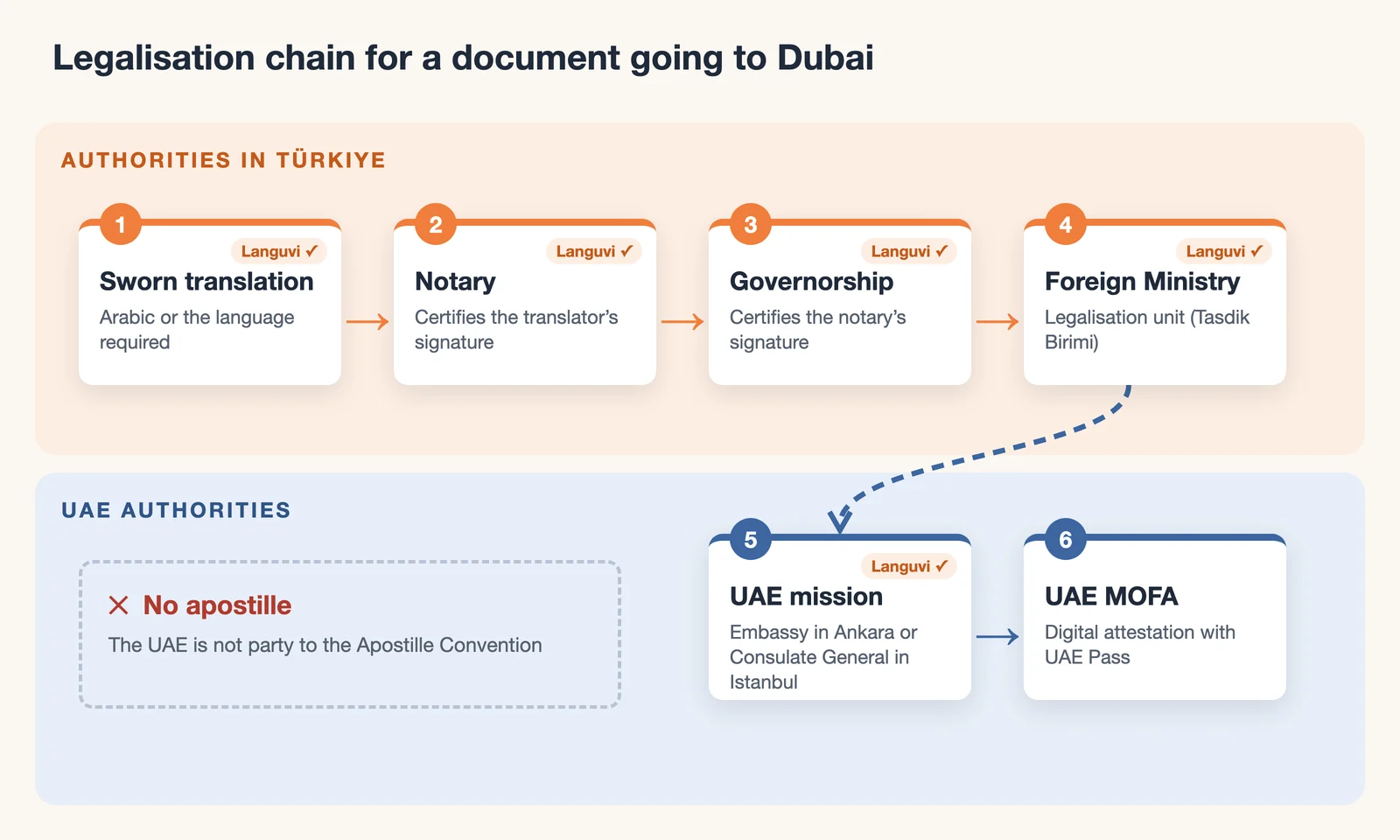
The chain has four stages: a sworn translation with notarisation, certification by the governorship or district governorship, legalisation by the Turkish Ministry of Foreign Affairs, and finally the approval of the UAE authorities. Arabic is the official language of the UAE, so courts, notaries and civil registry offices ask for an Arabic translation.
This guide gives an overview of applications in Dubai and the wider UAE. It explains which documents each application usually needs, the order of the approvals, and where an Arabic translation is required.
When is translating documents for Dubai necessary?
Anyone who plans to live, work or study in Dubai submits documents issued in Türkiye to UAE authorities. Each application has its own document list, yet the approval chain is the same for all of them.
Employment residence visa
For people joining an employer in Dubai, the residence visa is processed through the employer. Employers and free zone authorities often ask for a legalised degree certificate. Once the residence visa is issued, the holder applies for the Emirates ID card.
Family sponsorship
A UAE resident can sponsor a spouse and children. The federal identity and residency authority (ICP) asks for an attested marriage certificate for a spouse. For children, it asks for their birth certificates. Dubai's residency authority (GDRFA) asks for these documents with an attested Arabic translation.
The Golden Visa
The Golden Visa is a five- or ten-year residence permit for investors, entrepreneurs, exceptional talent and outstanding students. Applicants who qualify through their profession submit legalised degree certificates. Those who add family members submit marriage and birth certificates in the same legalised form.
School places and degree recognition
Children joining a UAE secondary school need their earlier school certificates recognised. According to the UAE government portal, school certificates issued abroad in languages other than Arabic or English must be legally translated and duly attested.
University degrees are recognised by the UAE Ministry of Education through its "University Certificates Recognition" system. When the ministry introduced it in 2023, it removed several earlier conditions, and the requirements now depend on the university's ranking. For the degree certificate and transcript that employers ask for, see our guide on how to get a diploma translated.
Exchanging a driving licence
Dubai's Roads and Transport Authority (RTA) lists Türkiye among the countries whose licences can be exchanged. For a licence from Türkiye, the RTA asks for a driving licence data certificate from the consulate, certified by the Ministry of Foreign Affairs.
Does the UAE accept apostilles?
No, the UAE is outside the apostille system. It does not appear in the Hague Conference status table for the Apostille Convention. The Turkish Ministry of Foreign Affairs also cannot legalise a document that already carries an apostille, so documents for the UAE are never apostilled.
The legalisation chain applies instead. Each authority confirms the signature and seal of the authority before it; it verifies the chain of approvals, not the content of the document.
The legalisation chain step by step
A document issued in Türkiye becomes usable in Dubai in this order:
- 1
Obtain the original document from the issuing body (e-Devlet documents, a degree certificate, a marriage or birth certificate).
- 2
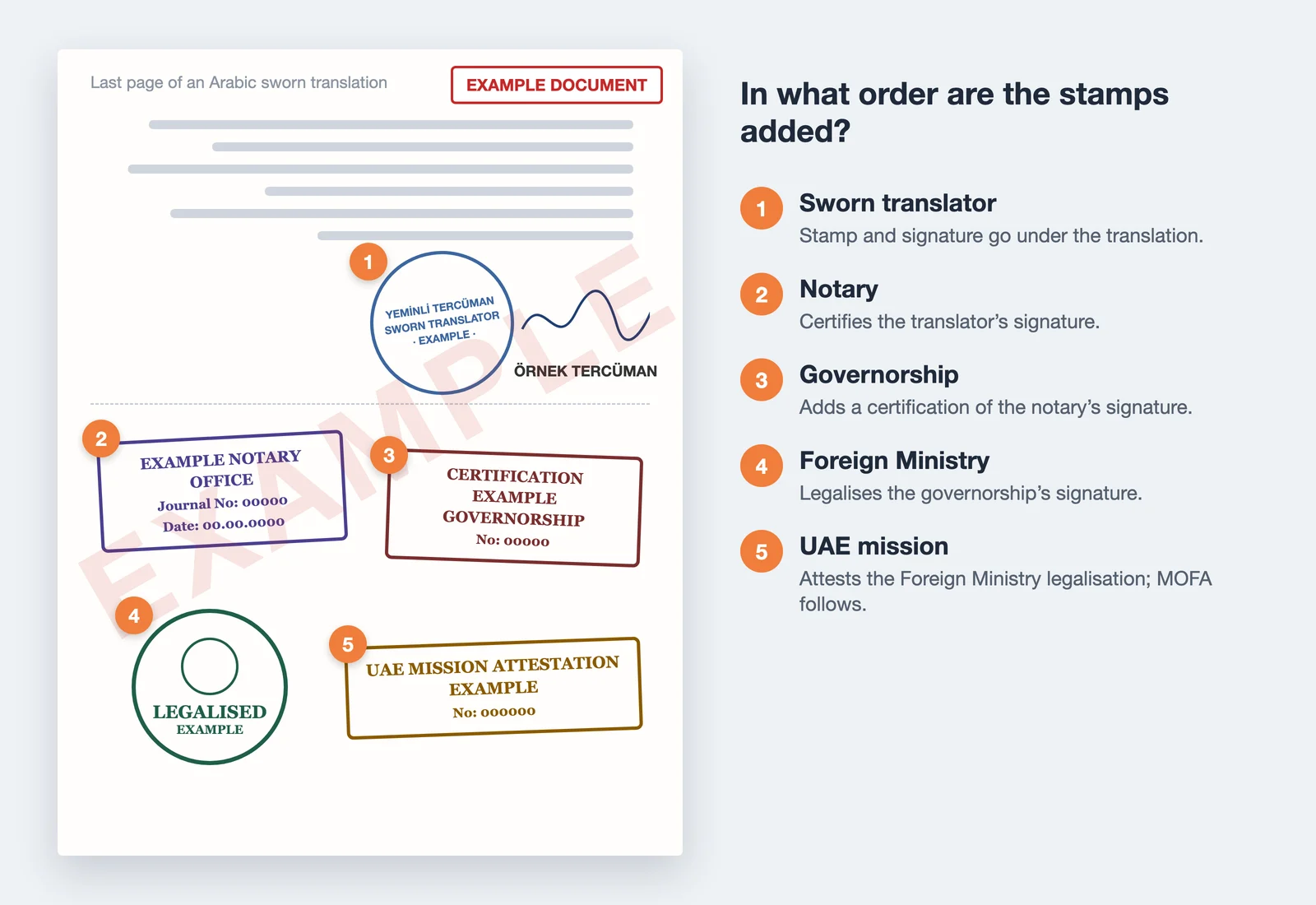
A sworn translator translates it into Arabic or the language required; a notary then certifies the translation.
- 3
The governorship or district governorship where the document was issued certifies the notary's signature.
- 4
The Tasdik Birimi (legalisation unit) of the Turkish Ministry of Foreign Affairs legalises the document.
- 5
The UAE Embassy in Ankara or the UAE Consulate General in Istanbul attests it.
- 6
Finally, the UAE Ministry of Foreign Affairs (MOFA) attests the document.
The UAE Ministry of Foreign Affairs offers digital attestation through its missions abroad. Applications are made with UAE Pass; the attested document arrives by e-mail in digital form and is legally recognised within the UAE.
Languvi prepares the Türkiye part of the chain in one order. It covers the sworn translation, the notarisation, Foreign Ministry legalisation as well as embassy and consulate legalisation. When you upload your document, you see the price and the estimated delivery date within seconds, before you pay.
Arabic or English?
Arabic is the official language of the UAE. Documents filed with UAE courts must be in Arabic or translated by a legal translator registered with the UAE Ministry of Justice. Civil registry matters such as registering a birth also call for an attested Arabic translation of documents in other languages.
For school certificates, the UAE government portal treats Arabic and English as languages that need no translation. Employers and free zones often work with English documents as well. Telling us in your order where the document will be used lets us prepare the translation in the right language.
If a matter in the UAE calls for a translation by a legal translator registered with the Ministry of Justice, Languvi prepares it through its authorised translators; just write to us through the contact form.
Which application needs what?
Application | Documents often requested | Translation language | Approvals |
|---|---|---|---|
Employment visa | Degree certificate, transcript | Arabic or English | Notary, governorship, Foreign Ministry, UAE mission, MOFA |
Family sponsorship | Marriage certificate, birth certificates | Arabic | Notary, governorship, Foreign Ministry, UAE mission, MOFA |
Golden Visa | Degree, marriage and birth certificates | Arabic or English | Notary, governorship, Foreign Ministry, UAE mission, MOFA |
School enrolment | School reports, certificates | Arabic or English | Education authority and the legalisation chain |
Courts and notaries | Powers of attorney, company documents | Arabic | Legalisation chain, then legal translation in the UAE |
Points to check before you apply
Applications for Dubai are most often returned because an approval is missing or the steps were taken in the wrong order. Keep these points in mind:
Collect the approvals in order; if one step is skipped, the next authority will not sign.
Spell your name exactly as it appears in your passport; every translation uses the same spelling.
Obtain time-sensitive documents, such as a criminal record certificate, close to your application date.
Keep your originals; the UAE mission attests the original document.
Do not laminate documents, because UAE authorities do not attest laminated papers.
Order the degree certificate and transcript together, so both use the same terminology.
Frequently Asked Questions
Do I need an apostille for Dubai?
You don't. Since the UAE is outside the apostille system, documents go through the legalisation chain. An apostilled document cannot be legalised by the Turkish Ministry of Foreign Affairs, so an apostille would cause problems in the chain.
Which language should my documents be translated into?
Family sponsorship, civil registry and court matters call for an Arabic translation. English is also accepted for school certificates and in many job applications. If you note in your order where the document will be used, we prepare the translation in the right language.
Does Languvi complete the legalisation chain?
Yes. Languvi completes the sworn translation, the notarisation, the Foreign Ministry legalisation and the consular legalisation in one order. You can follow every stage of your order on the order tracking page.
I live in Dubai. How do I get a document from Türkiye legalised?
You can upload your document to Languvi online. The notarised translation and the approvals are prepared in Türkiye; where the original is needed, it is sent to you by courier.
Is an Arabic translation of my marriage certificate enough?
Alongside the Arabic translation, the notary, governorship, Foreign Ministry and UAE mission approvals are needed. Mentioning in your order that the certificate is for family sponsorship ensures the full chain is prepared.
Conclusion: When translating documents for Dubai, there is no apostille; documents pass through a legalisation chain of notary, governorship, Foreign Ministry and UAE approvals. Family, court and civil registry matters call for an Arabic translation. Languvi completes the Türkiye part of the chain in a single order. For details, see our page on Arabic translation with consular legalisation for Dubai, or upload your document on the order page right away.