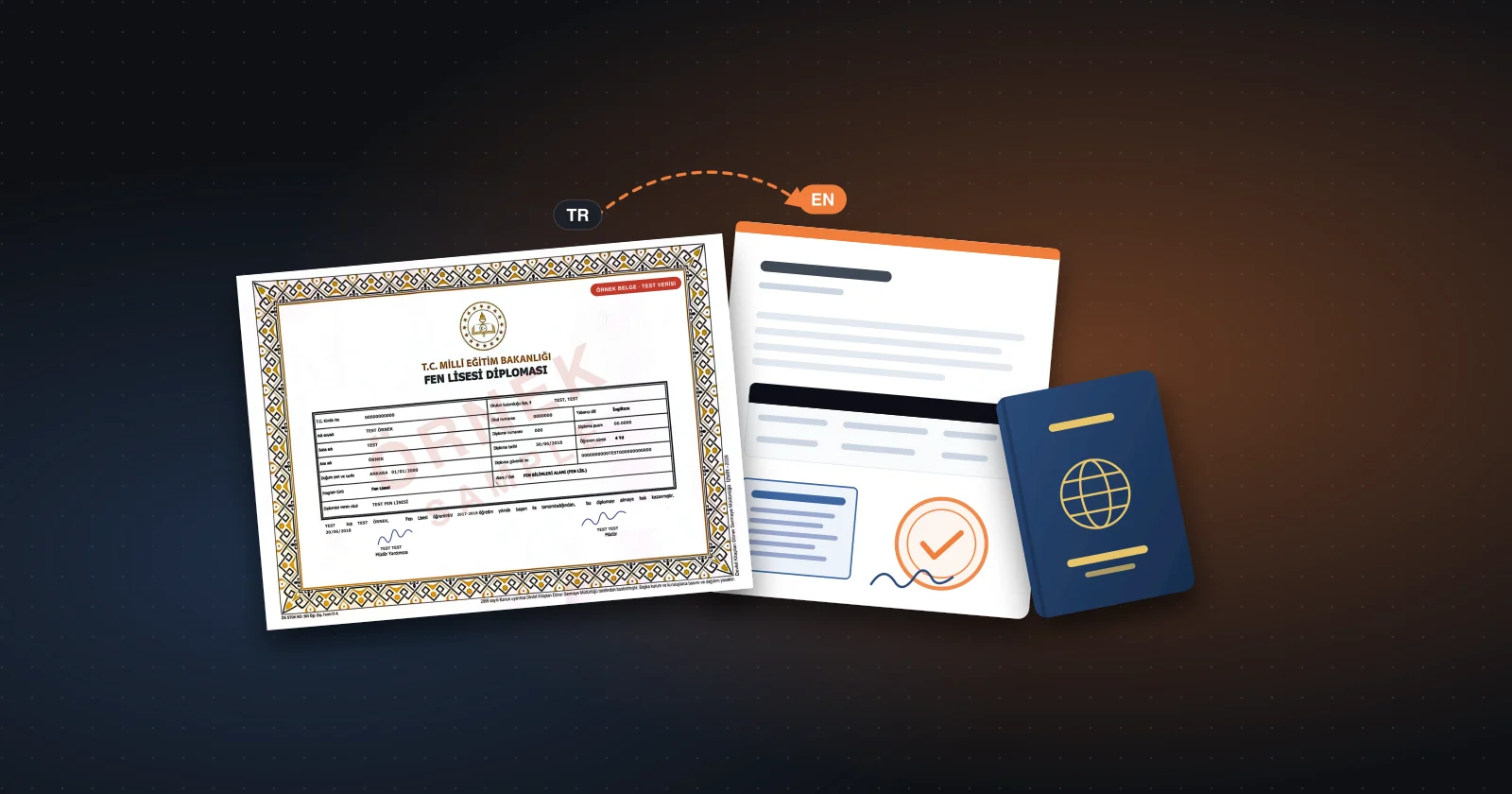
Diploma translation is usually the first piece of paperwork for anyone with a Turkish degree who wants to study, work or have their qualification recognised abroad. If you are wondering how to get a diploma translated, the short answer is this: official bodies expect your diploma to be translated by a sworn translator. Depending on where it is going, the translation may also need to be notarised and, for use abroad, apostilled.
What decides which steps you need is not the type of diploma but the institution receiving it. A German university, a UK employer and a consulate can each ask for something different for the same bachelor's degree. This guide explains which documents are translated for which purpose, how the levels of certification differ, and how to avoid an application being sent back because of something as small as the spelling of your name.
How to get a diploma translated, step by step
- 1
Find out what the institution wants. Ask the institution you are applying to, in writing, which document it needs (the original diploma, an e-Devlet certificate, a transcript), in which language and with which approval.
- 2
Gather your documents. Put together your diploma and, if needed, your transcript, diploma supplement and passport.
- 3
Have the sworn translation done. A sworn translator translates the document and delivers it with their stamp and signature. Ask for your name to be spelled exactly as in your passport.
- 4
Add notarisation if required. A notary certifies the sworn translator's signature.
- 5
Add an apostille or consular legalisation for use abroad. Countries that are party to the Hague Apostille Convention accept an apostille; other countries require consular legalisation.
The sections below explain each step in more detail.
Which documents does diploma translation cover?
Any education document issued in Türkiye can be translated. These are the ones requested most often:
High school diploma (lise diploması) and high school graduation certificate
Associate and bachelor's degree diplomas (ön lisans, lisans)
Master's and doctoral diplomas (yüksek lisans, doktora)
Transcript of records (transkript)
Diploma Supplement
Temporary graduation certificate and student certificate
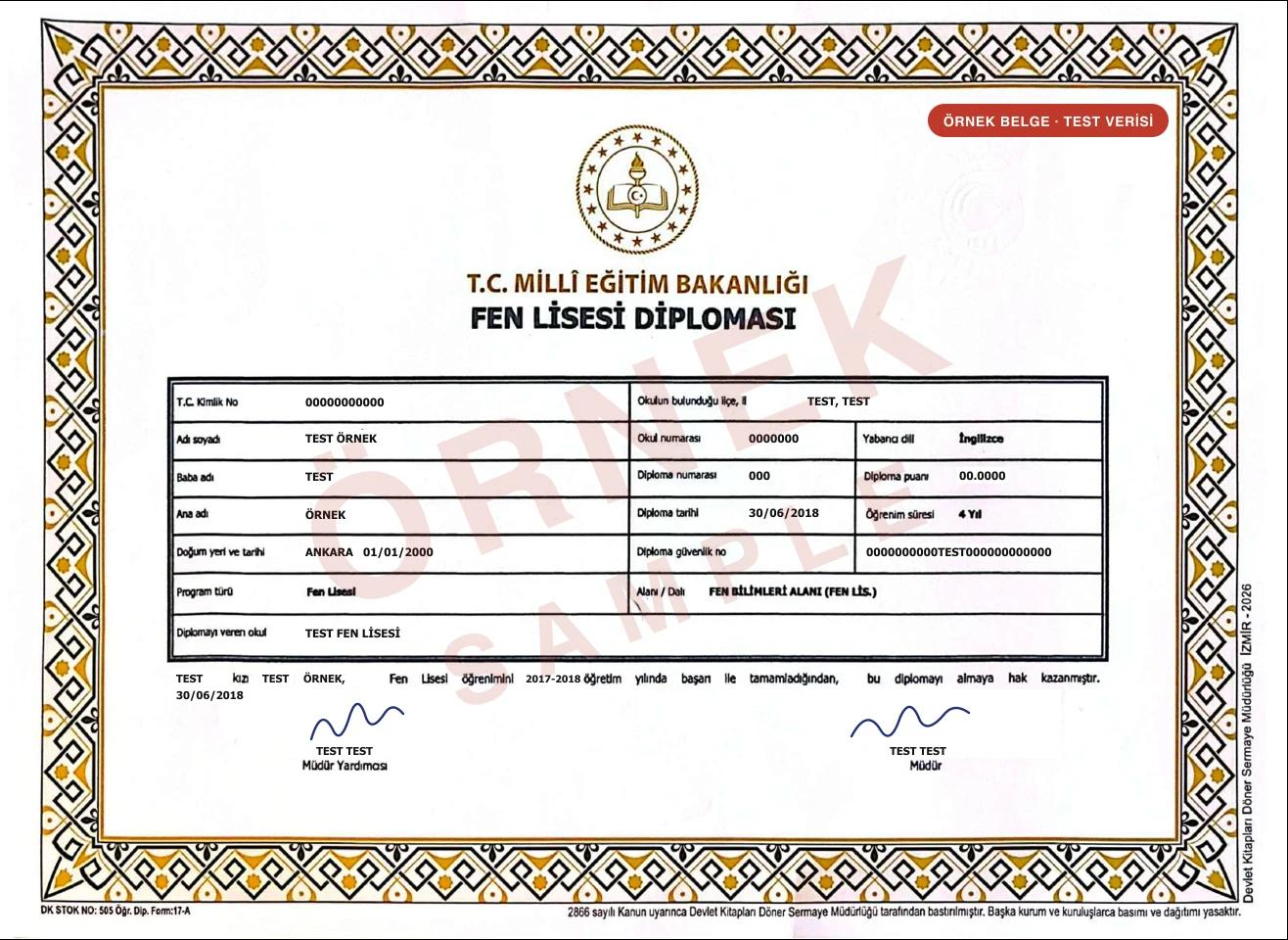
In most applications, the diploma alone is not enough. Universities and recognition bodies usually ask for the transcript as well, because that is where they see the modules and credits you completed. A master's application normally needs your bachelor's diploma and transcript, while a doctoral application may need the documents from both earlier degrees.
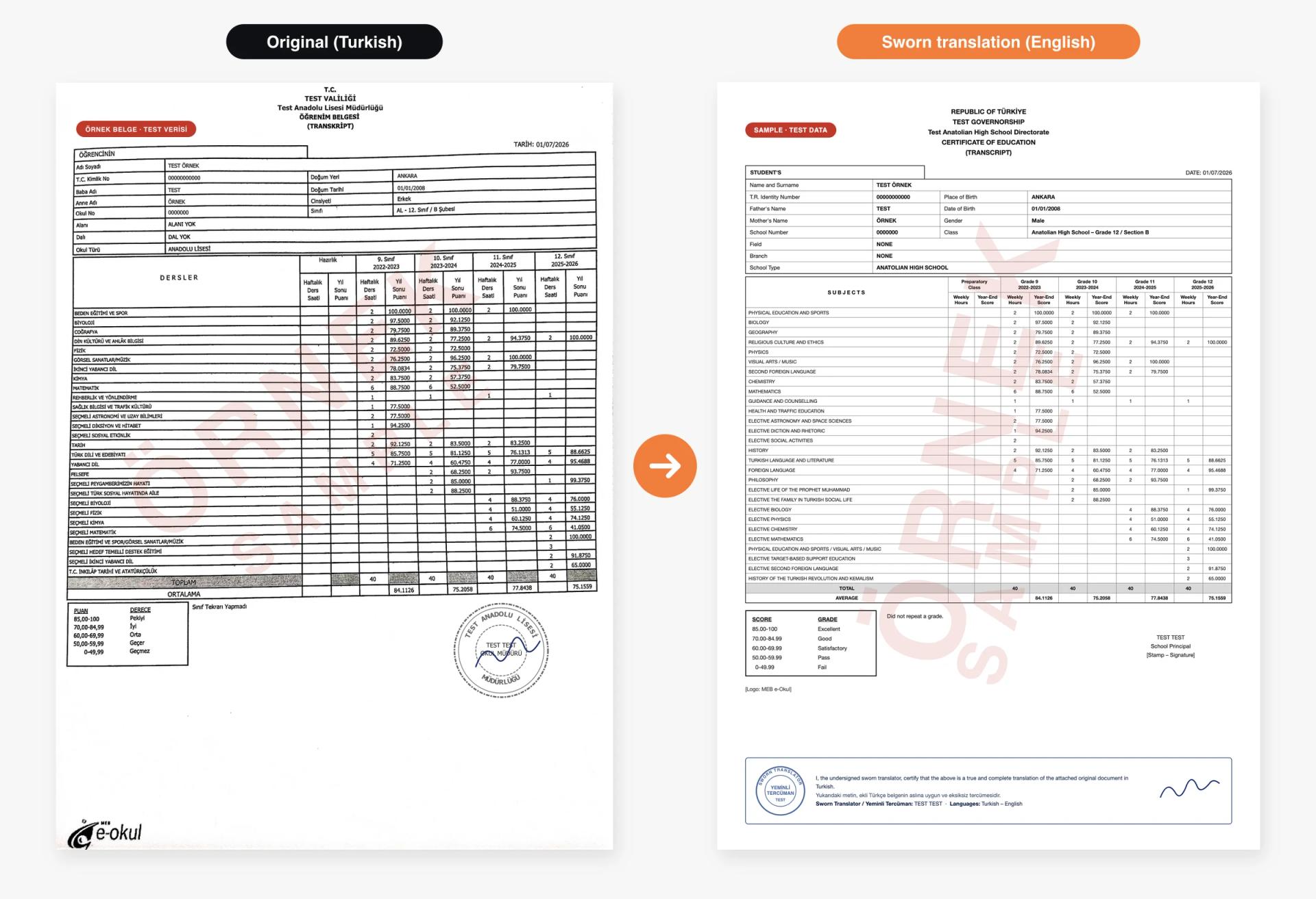
The most time is lost when a missing document is spotted close to a deadline. Reading the institution's document list first and having everything translated in one order avoids this, and it keeps names, dates and terms consistent across all the translations.
e-Devlet barcoded certificate or the original diploma?
Graduates of Turkish universities can download a barcoded graduation certificate through the Higher Education Graduation Certificate Inquiry service on e-Devlet. A similar service exists for high school graduates under the Ministry of National Education. Many institutions in Türkiye can check these certificates using the barcode number.
Abroad, it is a different story. A foreign institution cannot check an e-Devlet barcode, so most universities, employers and authorities ask for the original diploma, a certified copy of it, or a translation of one of these. Some accept the barcoded certificate as a supporting document, but whether it can replace the diploma is always the receiving institution's decision.
A practical rule: if the application asks for your "diploma", have the diploma itself translated. If the institution states clearly that it accepts the e-Devlet certificate, you can have that translated too. If you are unsure, asking the institution in writing is the safest route.
Sworn, notarised and apostilled diploma translation compared
There are three levels of certification for a translated diploma, and each one builds on the previous step. A fourth route applies to countries outside the apostille system.
Level | What it means | Where it is usually required |
|---|---|---|
Sworn translation | Delivered with the sworn translator's stamp and signature | Institutions in Türkiye, many university applications abroad |
Notarised translation | A Turkish notary certifies the sworn translator's signature | Official procedures in Türkiye, the step before an apostille |
Apostilled translation | A competent Turkish authority adds an apostille | Official use in countries party to the Hague Apostille Convention |
Consular legalisation | Foreign Ministry and consulate chain instead of an apostille | Countries that are not party to the Convention |
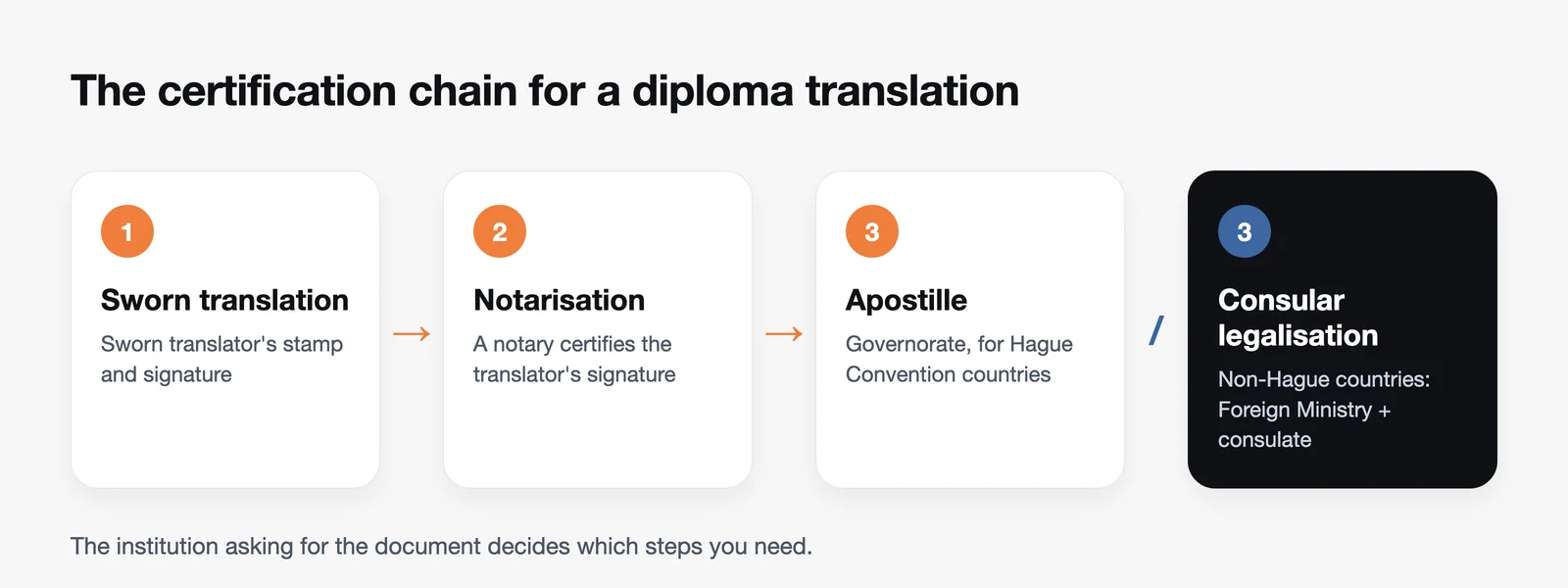
Sworn translation
A sworn translation is done by a translator who has taken an oath before a Turkish notary and who stamps and signs the translation. Many universities abroad accept a sworn translation on its own at the application stage.
Notarisation
When a translation is notarised, the notary certifies the identity and signature of the sworn translator rather than the content. If the document is for an official procedure in Türkiye, or if it will be apostilled later, notarisation is usually a required step in between. You can read more on our notarised translation page.
Apostille
Türkiye has been party to the 1961 Hague Apostille Convention since 1985. For a diploma used in another party country, a single apostille replaces the longer consular chain. In Türkiye, apostilles for administrative documents are issued by provincial and district governorates (valilik and kaymakamlık). Whether the apostille goes on the original diploma or on the notarised translation is decided by the institution asking for the document.
Some governorates may ask the school or university to confirm the signature on the diploma before they issue an apostille. For high school diplomas, you may be referred to the district directorate of national education for this. Calling the office before you go, and asking which document to bring, saves a wasted trip.
Which diploma translation do you need for your purpose?
The same diploma is prepared differently depending on where it will be used. The table below is a general guide; the exact requirements are always in the receiving institution's own instructions.
Purpose | Usually requested | What to check |
|---|---|---|
Applying for a degree abroad | Sworn translation, sometimes an apostille | The university's or application portal's document rules |
Applying for a job abroad | Sworn translation | The employer or professional body may also want an apostille |
Recognition of a degree or profession abroad | Sworn translation, notarisation and apostille | The certification chain the recognition body specifies |
Visa or residence permit | Sworn translation, often with an apostille | The consulate's current document checklist |
Recognition of a foreign degree in Türkiye | Sworn translation of the foreign diploma into Turkish | YÖK's document list |
Having a foreign degree recognised in Türkiye (YÖK denklik) is a separate procedure with its own list. If that is your situation, check YÖK's requirements before ordering, because the documents and certification it asks for depend on the country that issued your degree.
Name spelling and other details
The detail that causes the most trouble in diploma translations is the spelling of names. The Turkish letters ç, ğ, ı, ö, ş and ü can be written in several ways in other languages. The name in your translated diploma should match the spelling in your passport exactly.
Before you order, check the following:
- 1
Give your first name and surname as they appear in your passport.
- 2
If your surname changed after marriage, mention it; some institutions ask for an additional document.
- 3
Use the official English (or other language) name of your university and department, which most universities publish on their own website.
- 4
Make sure the grade, graduation date and diploma number match your transcript.
- 5
Ask the receiving institution how Turkish degree titles such as "Lisans" or "Yüksek Lisans" should be rendered.
Department names and degree titles do not always have an exact equivalent. In those cases the translator chooses a rendering that keeps the official name and its meaning. If you know the institution expects a particular term, adding it to your order notes makes the work easier.
Frequently Asked Questions
Do I need the original diploma for the translation?
For the translation itself, a clear scan or photo of your diploma is enough. Some later steps, such as an apostille, may require the authority to see the original. If you need an apostille or consular legalisation, find out in advance which document you should take with you.
Is the e-Devlet graduation certificate valid abroad?
That depends entirely on the institution you are applying to. Foreign institutions cannot check the barcode, so they usually ask for the diploma itself or a certified copy. If the institution states that it accepts the e-Devlet certificate, you can have that translated as well.
Do I need my transcript translated too?
University applications and recognition procedures almost always ask for the transcript. For job applications the diploma is usually enough. If you are not sure, having both translated in the same order saves time and keeps the terminology consistent.
Is the apostille added to the diploma or to the translation?
This varies by country and institution. Some want the apostille on the original diploma, others on the notarised translation. Getting a written answer from the receiving institution prevents you from doing the process twice.
Which languages can my diploma be translated into?
On Languvi you can order diploma translation in more than 180 languages. Whichever language you choose, your document goes to a translator who works in that language and knows the subject. Choose the target language based on what the receiving institution asks for.
Conclusion: The right diploma translation depends on where you will use the document: for procedures in Türkiye a sworn or notarised translation is often enough, while institutions abroad may ask for an apostille or consular legalisation. Before you apply, ask the institution in writing which document and which approval it wants, and make sure your name is spelled exactly as in your passport. On Languvi you can choose sworn translation, notarisation, apostille and consular legalisation in a single order and see the price and estimated delivery date within seconds, before you pay. See our diploma translation page for details, or upload your document now on the order page.