
Here is how to get Foreign Ministry legalisation in Türkiye. First, the governor's office (valilik) or district governor's office (kaymakamlık) where the document was issued certifies it. Then the document is taken by hand, with an appointment, to the Consular Legalisation Unit of the Ministry of Foreign Affairs in Ankara. The unit confirms that the governor's signature and seal on the document are genuine.
This step is needed for documents going to countries outside the Apostille Convention. The Ministry checks the signature and seal, not what the document says. It also never legalises a document that already carries an apostille.
This guide explains where the Ministry step sits in the chain, whose signatures the unit accepts and which route each type of document takes.
What is Foreign Ministry legalisation?
The Ministry describes legalisation as confirming that the signature and seal on an official document are genuine, without any statement about its content. Each authority in the chain certifies only the authority that signed before it. That is why the order of the steps never changes.
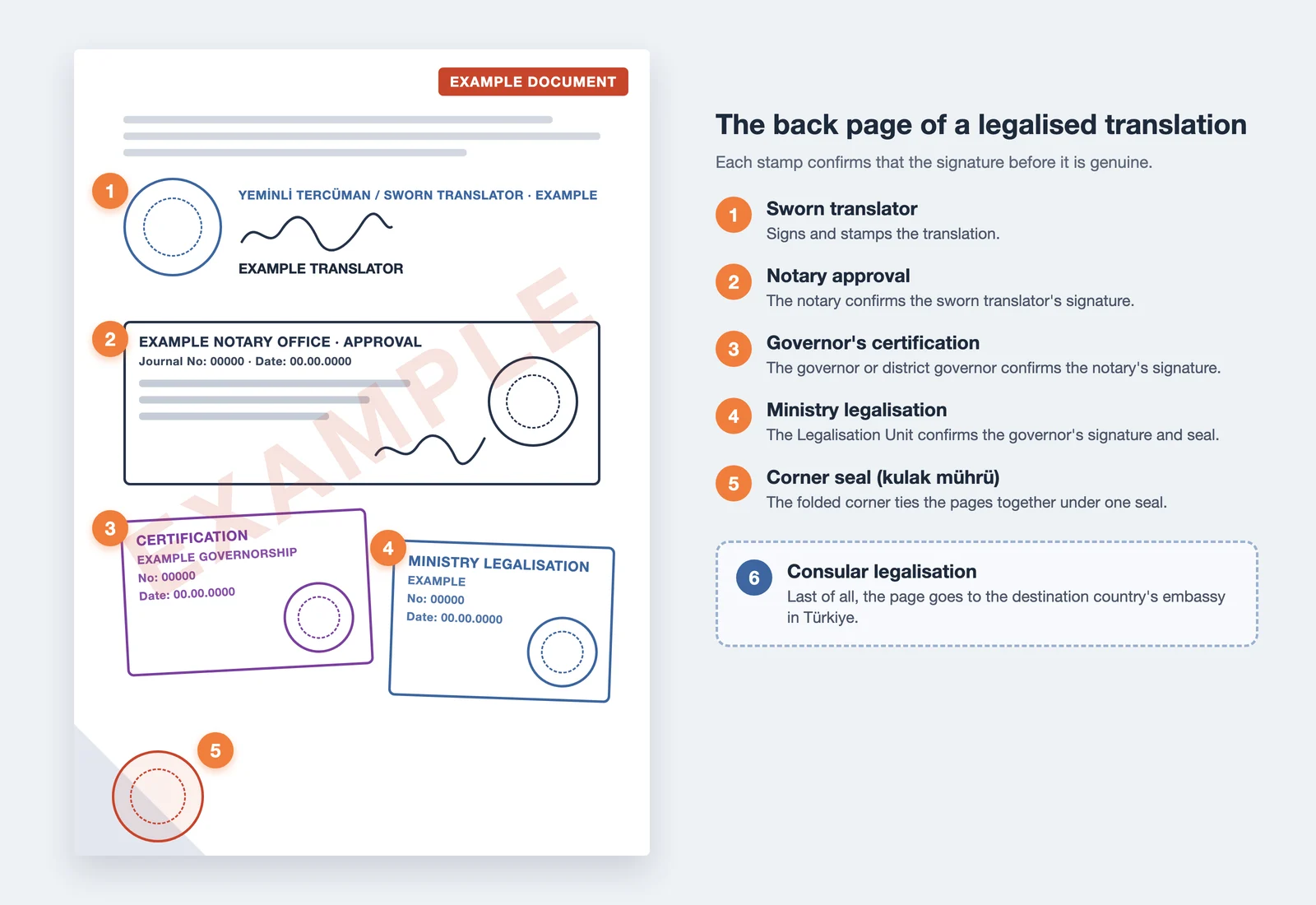
For a Turkish document going abroad, the order is: the document itself, a sworn translation with notary approval where needed, the governor's certification, then the Ministry. The final link is the embassy or consulate in Türkiye of the country where the document will be used. We cover that last step in our guide to consular legalisation.
Whose signatures does the Legalisation Unit accept?
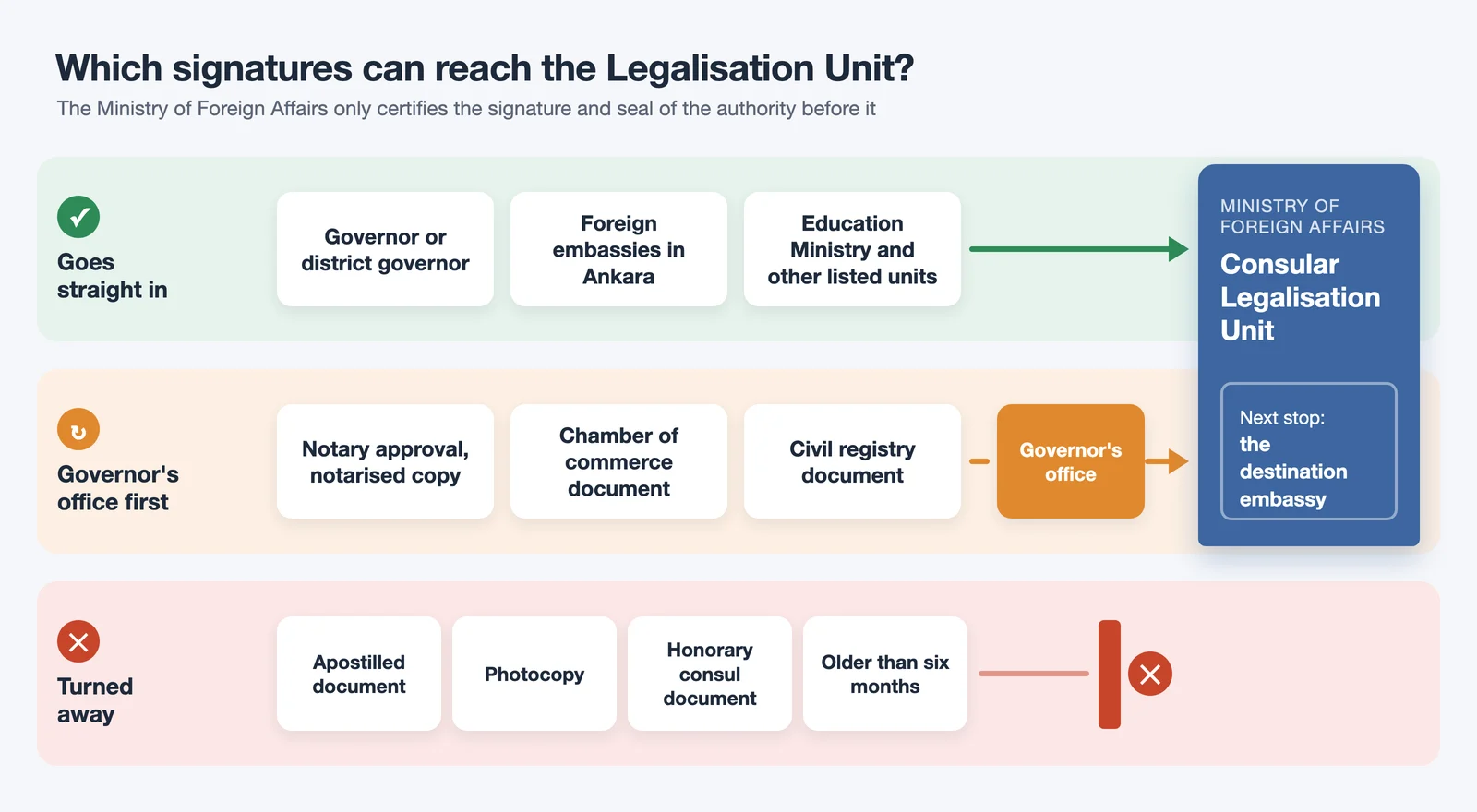
According to the Ministry's own guidance, the unit certifies the signature and seal of these authorities only:
Governors' offices (valilik) and district governors' offices (kaymakamlık)
Foreign embassies in Ankara
Some departments whose specimen signatures the Ministry holds: the Ministry of National Education (Higher Education Unit), the Ministry of Health (Medicines Unit), the Ministry of National Defence, the Presidency of Defence Industries
A notary's document, a chamber of commerce certificate or a civil registry extract never goes straight to the Ministry. Each of them passes through the governor's office first. The Ministry then adds its own certification on top of that one.
How to get Foreign Ministry legalisation in Türkiye, step by step
Following the Ministry's question-and-answer guide, a document issued in Türkiye is prepared in this order:
- 1
Check the country: If the destination country appears on the Hague Conference's Apostille status table, you do not need the Ministry. The governor's office issues the apostille, or the courthouse for court documents.
- 2
Get a current document: It must carry a recent date, the issuing authority's seal and the signer's name stamp. The unit does not legalise documents older than six months.
- 3
Translation with notary approval: If the foreign authority wants the document in its own language, a sworn translator translates it. The notary folds the corner of the original and the translation together and seals them as one; this is called a kulak mührü.
- 4
Governor's certification: The governor or district governor where the notary sits certifies the notary's signature. For documents with several pages, the seal must cover every page.
- 5
Book an appointment: The unit works by appointment only. Applicants show ID, and the booking is made by the document owner or by someone holding their power of attorney.
- 6
Hand the documents in: The document owner does not have to attend in person. Postal applications are not accepted, and posted papers are sent back unprocessed.
After the Ministry, the document goes to the embassy or consulate in Türkiye of the country where it will be used. The Ministry adds as many certifications as the governor's office made on the document.
Which route does each document take?
The Ministry asks for different earlier steps depending on the document. For the ones people ask about most, the route looks like this:
Document | Before the Ministry | Note |
|---|---|---|
Diploma, transcript, student certificate | Ministry of National Education approval, or a notarised copy plus the governor | Either route is enough |
Civil registry extract, birth or marriage record | Governor or district governor | Must not be older than six months |
ID card, passport, marriage booklet | Notarised copy or notarised translation, then the governor | These originals are never legalised directly |
Criminal record, court decision | Notarised copy, then the governor | An apostille is not valid on this route |
Power of attorney, consent letter | Governor of the province where the notary sits | Its translation can be legalised with it |
Authority certificate, activity certificate, certificate of origin | Chamber of commerce, then the governor | For translations, the notary and chamber come in between |
Wherever a translation is needed, the first step is a sworn translation approved by a notary. According to the Ministry, Egypt and Thailand want the Turkish original legalised separately from its English translation. For Thailand, the Apostille Convention enters into force on 28 February 2027.
Documents the Ministry will not legalise
Knowing what the unit turns away saves you from getting stuck halfway:
Apostilled documents: A document with an apostille gets no Ministry legalisation. If it is going to a non-member country, the apostille is cancelled and the document goes down the legalisation route.
Photocopies: Neither a copy of the original nor a copy of a notarised copy is accepted.
Notary documents on their own: Even a notary's certified true copy must be certified by the governor first.
Honorary consul documents: Papers issued by honorary consuls are not legalised.
Visa invitations: A notarised undertaking for a visa application is not legalised by the Ministry.
The unit certifies signatures and seals only. It does not issue any statement about content, such as a note that a document is in due form.
Foreign Ministry legalisation for foreign documents
The chain also runs the other way. A document issued in a country outside the Apostille Convention is first legalised by that country's own foreign ministry. After that, there are two routes.
On the first route, the Turkish embassy or consulate in that country legalises the document. In that case, no further Ministry legalisation is needed in Türkiye. On the second route, the country's embassy in Ankara certifies it, and the document goes to the Legalisation Unit together with its notarised Turkish translation. If the foreign mission is a consulate in another city, the governor of that province gives the final certification; the document is then valid across Türkiye without the Ministry.
Foreign applicants book with their passport number or foreigner ID number. Anyone who does not speak Turkish should come with someone who can interpret. You will find every step of this direction in our guide to using foreign documents in Türkiye.
Foreign Ministry legalisation with Languvi
On Languvi, sworn translation, notary approval, the governor's certification and Foreign Ministry legalisation are handled on one platform. Consular legalisation can be added to the same order where needed.
- 1
You upload your document on our order page.
- 2
You choose the target language, the type of approval and the destination country. You see the price and the estimated delivery date within seconds, before paying.
- 3
The document goes to a sworn translator who knows the subject. The translation is checked before delivery.
- 4
The translation carries the sworn translator's stamp and signature. The notary, governor and Ministry steps follow in order.
- 5
Legalised documents are sent by courier when needed. You can follow each step of your order in your account.
Languvi works in more than 180 languages. It is certified to ISO 17100 and ISO 9001. If you live abroad, you simply upload your document online; the certified translation is prepared in Türkiye.
Frequently Asked Questions
Do I have to go to Ankara for Foreign Ministry legalisation?
The Ministry does not require the document owner to attend in person. The documents must be handed in with an appointment, and postal applications are not accepted. On Languvi orders, this step is handled for you.
Is Foreign Ministry legalisation the same as an apostille?
They are separate procedures for different groups of countries. An apostille is a single step at the governor's office for countries in the convention. Ministry legalisation follows the governor's certification for countries outside it.
Does the Ministry check what my document says?
The Ministry only confirms that the previous authority's signature and seal are genuine. Carrying the content accurately into another language is the sworn translator's job. A sound chain therefore depends on the translation at its start.
How recent does my document need to be?
The Legalisation Unit does not accept documents older than six months. The Ministry notes that for birth, marriage or single-status certificates, the receiving authority may also look at the date of the first signature. It is best to complete the chain as soon as possible after the document is issued.
I have a document from a foreign consulate in İstanbul. Does it need Ministry legalisation?
According to the Ministry, the governor or district governor of the province where the consulate sits certifies it. After that, the document is valid across Türkiye without Ministry legalisation. If it is in a foreign language, its notarised Turkish translation is attached.
Conclusion: Foreign Ministry legalisation is the step that follows the governor's certification for documents going to countries outside the Apostille Convention. The Ministry only certifies signatures from governors, district governors or embassies in Ankara, so the order of the steps matters. Languvi handles the translation, notary approval, governor and Ministry steps in a single order. Upload your document on our order page to see the price and delivery date within seconds.