
This MEB equivalence guide is for anyone who completed primary or secondary school abroad and now needs that schooling recognised in Türkiye. A Turkish citizen who studied abroad needs an equivalence certificate to continue school in Türkiye, apply to a Turkish university or use a school-leaving diploma for a job. The same applies to foreign students who live in Türkiye and continue their education here.
This guide explains what equivalence from the Ministry of National Education (MEB) is and how the application works through the e-Denklik system. It also covers which documents are needed, which approvals they need, and when a notarised Turkish translation is required. University degrees are a different matter: their equivalence falls under the Council of Higher Education (YÖK), not MEB.
What MEB equivalence is and who applies
MEB equivalence is the official procedure that shows which grade or diploma in Türkiye your schooling abroad corresponds to. The resulting equivalence certificate is used by schools and institutions in Türkiye. The ministry handles equivalence under its current Equivalence Regulation, which came into force in July 2024.
Applicants usually belong to one of these groups:
Students who studied abroad and will continue in a grade at a school in Türkiye
Graduates who finished secondary school abroad and will apply to universities in Türkiye
People who will use their school-leaving diploma for a job or an official procedure in Türkiye
Foreign students who live in Türkiye and will continue their education here
The equivalence certificate is used for school enrolment, university applications and some job applications. For students continuing in a grade, it sets the grade they enrol in. For graduates, it shows what the school-leaving diploma corresponds to in Türkiye.
For a university degree obtained abroad, the application goes to YÖK instead. Our page on YÖK equivalence translation covers that process.
Where and how to apply
Applications are made through MEB's e-Denklik system. In Türkiye, provincial directorates of national education, along with designated district directorates, act as equivalence centres. Abroad, applications can be made to Türkiye's education counsellor or attaché offices.
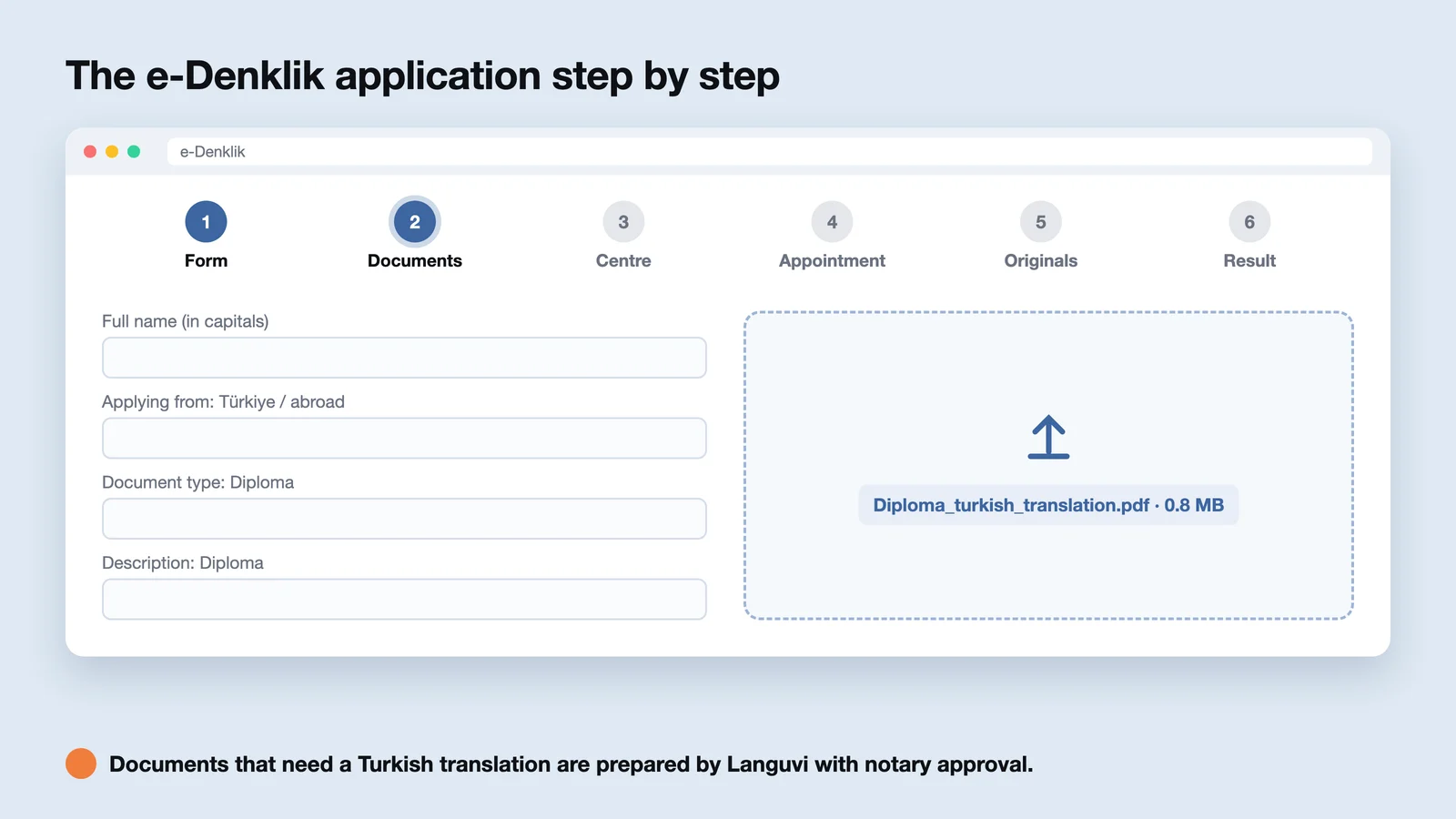
The application steps published by the İstanbul Provincial Directorate of National Education can be summed up as follows:
- 1
Fill in the application form on the e-Denklik site; you need an e-Devlet password, and the form is completed in capital letters.
- 2
Choose "Yurtiçinde" if you are applying from Türkiye or "Yurtdışında" if you are applying from abroad.
- 3
Upload your scanned documents one by one, writing what each document is in the description field.
- 4
Choose the province and district you will apply in, and select the equivalence centre.
- 5
If anything is missing, you are told by text message and e-mail; once the documents are complete, you book an appointment.
- 6
At the appointment, show the originals of every document you uploaded.
Once the procedure is complete, the equivalence certificate is downloaded from the application search screen on the e-Denklik site. You need the registration number sent to you during the application; results cannot be found by ID or passport number.
Which documents are needed?
The list depends on whether the applicant is a Turkish citizen and whether they are continuing in a grade or have graduated. The documents that stand out on the İstanbul directorate's list are:
Applicant | Main documents |
|---|---|
Turkish citizen continuing in a grade | Application form, report cards or transcript for recent years, ID, passport |
Turkish citizen who has graduated | Application form, original diploma, transcript for the last three years, ID, passport |
Foreign student | Application form, report cards or diploma, an ID such as a residence permit, passport |
The passport should cover the years of study; if it does not, an old passport or an official entry-exit record is accepted. If your name is spelt differently across documents, a name equivalence document or a detailed civil registry record may also be needed.
Apostille and notarised Turkish translation
According to the İstanbul directorate's list, diplomas from countries that are party to the Apostille Convention must carry an apostille. If there is no apostille, or the country is not a party, the diploma must be sealed by that country's foreign ministry, embassy, consulate or ministry of education. Documents with a missing signature or seal are not accepted. The order matters too: the original is apostilled first, then the document is translated into Turkish together with its apostille.
On translations, the same list says that every document except the passport that is not in Turkish, English, Arabic, Persian, German or Russian needs a notarised translation. For example, a diploma in French, Italian, Dutch or Japanese needs a notarised Turkish translation. This language list is İstanbul's; if another province asks for a translation, Languvi translates your document into Turkish with notary approval.
The Equivalence Regulation also accepts translations approved by a notary or by Türkiye's missions abroad. If you are applying from abroad, you can upload your documents to Languvi online; the notarised Turkish translation is prepared in Türkiye.
Report cards, transcripts and grades
For students continuing in a grade, report cards for recent years are requested; graduates provide the transcript for the last three years. These documents list courses, grades and the grading scale. If a translation is needed, each year's courses and grades are translated in the document's own table layout.
MEB decides how your diploma grade is reflected in the Turkish system; the translator does not convert grades but carries them over exactly as written. If the document explains its grading scale, that explanation is translated too. Our transcript translation guide goes into the details.
Checks before you apply
Take the originals of your documents to the appointment; scanned copies alone are not enough.
Get the apostille on your diploma before you leave the country that issued it.
If your document's language is not on the exemption list, have a notarised Turkish translation prepared.
Make sure every scanned file is under 1 MB and easy to read.
Keep your registration number, since you need it to look up the result.
Frequently Asked Questions
Where do I apply for MEB equivalence?
Applications are made through the e-Denklik system. In Türkiye, provincial directorates of national education and designated district directorates act as equivalence centres. Abroad, education counsellor and attaché offices accept applications.
Does my English diploma need a translation?
According to the İstanbul directorate's list, documents in English need no translation. The same exemption applies to documents in Arabic, Persian, German and Russian. If another province asks for a translation, Languvi prepares the notarised Turkish translation.
Does my diploma need an apostille?
If the diploma comes from a country that is party to the Apostille Convention, it needs an apostille. For countries outside the convention, or where there is no apostille, the seal of that country's foreign ministry, embassy, consulate or education ministry is required.
Do I apply to MEB for a university degree?
No. MEB handles equivalence for primary and secondary schooling. Equivalence for university degrees obtained abroad falls under YÖK.
Who signs the application form?
According to the İstanbul directorate's list, applicants aged 18 or over sign the form themselves. For applicants under 18, a parent or guardian signs it. The form must be filled in completely.
How do I get the equivalence certificate?
Once the procedure is complete, the certificate is downloaded from the application search screen on the e-Denklik site. You need the registration number sent by text message and e-mail during the application.
Conclusion: An MEB equivalence application is made through the e-Denklik system and completed with the original documents at the appointment. A diploma from abroad needs an apostille or the approval of the relevant authority, and documents in languages outside the exemption list need a notarised Turkish translation. On Languvi you upload your documents, and the sworn Turkish translation with notary approval is prepared on one platform. See our page on MEB equivalence translation in Türkiye, or upload your documents now on the order page.