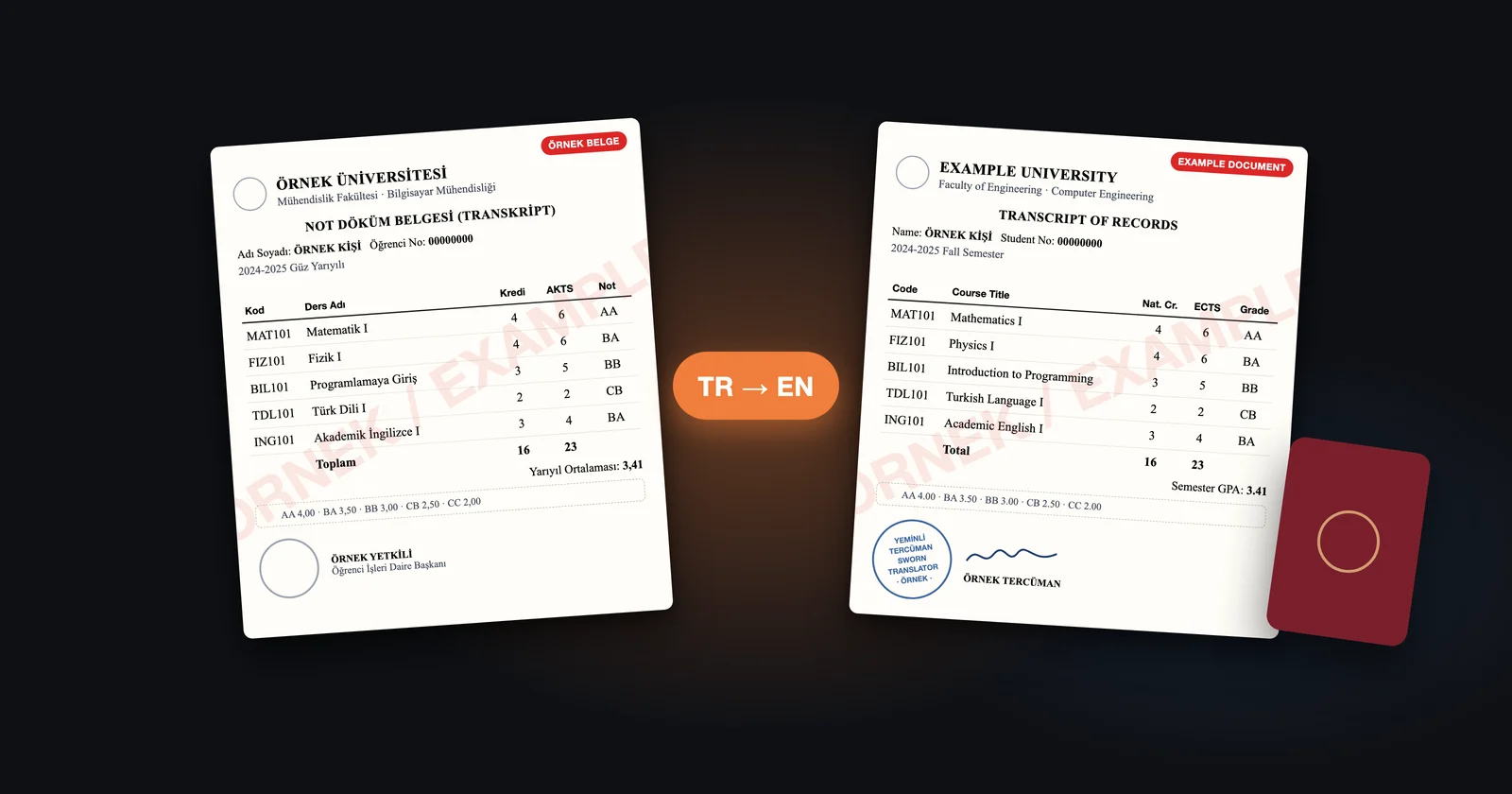
A transcript translation is one of the documents most often requested from students and graduates applying abroad for a master's degree, an exchange programme, recognition of their qualification or a job. Your transcript of records lists every course you took, its credits and your grades. That is why universities and recognition bodies abroad usually ask for a sworn translation of your transcript alongside your diploma.
A transcript carries far more detail than a diploma. If course titles, credit systems or the grading scale are rendered carelessly, the person assessing your application may read your studies differently from how they really were. This guide explains what a translator looks at in a transcript, including how ECTS credits and grades are handled. It also covers when to translate the transcript alongside your diploma, and when the English transcript your university issues is enough on its own.
What a transcript translation covers
A transcript translation is a translation of the record of studies issued by your school or university, made by a sworn translator. It reproduces every entry in the same order and layout as the original. The translation is delivered with the sworn translator's stamp and signature.
A university transcript from Türkiye usually contains:
The student's name, student number and identity details
The faculty, department, programme, language of instruction and enrolment date
Each semester's courses with their codes and titles
The national credits and the ECTS credits for every course
Letter or numerical grades, the semester average and the cumulative grade point average
A key to the grading scale, the graduation date, the official stamp and signatures
A high school transcript (öğrenim belgesi) lists the courses year by year, the weekly hours, the year-end grades and the final diploma score. In both cases the translator's job is not to interpret the record but to carry it over completely and consistently.
How course titles, credits and grades are translated
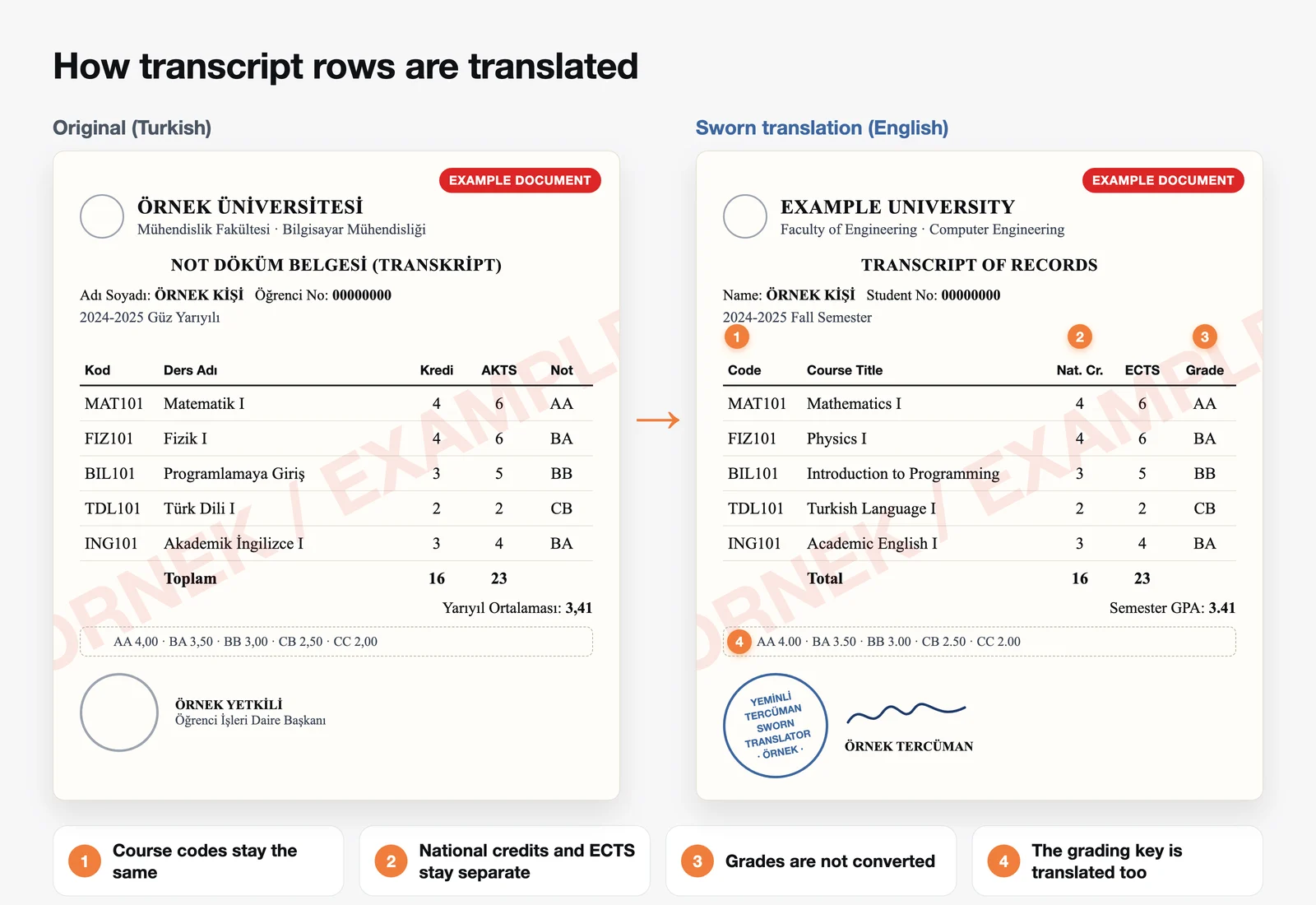
The course list is the most demanding part of any transcript translation. Every title, credit value and grade has to stay in the right column, matching the totals printed on the document.
Course titles
Many universities in Türkiye publish the official English titles of their courses in their course catalogue (often called the information package). Using those official titles lets the assessor compare your courses with the catalogue directly. Where no official title exists, the translator chooses an established term that reflects the course content and leaves the course code unchanged.
ECTS and national credits
Universities in Türkiye use the European Credit Transfer and Accumulation System (ECTS, known in Turkish as AKTS). The European Commission states that 60 ECTS credits equal a full year of study, and YÖK, the Turkish Council of Higher Education, counts 25 to 30 hours of student workload as one ECTS credit. Many Turkish transcripts also show a separate column of national (local) credits.
A careful translation keeps the two credit types in separate columns with separate headings. Labelling the national "Kredi" column as ECTS, or merging the two columns, makes your total credits look different from what they are. This matters most for master's and exchange applications that set a minimum number of credits.
Grades and the grading scale
Turkish universities generally use a 4.0 scale with letter grades such as AA, BA and BB, although the score range behind each letter can differ from one university to the next. High schools use a 100-point scale. In a sworn translation the grades are reproduced exactly as they appear; the translator does not convert them into another system.
If an institution abroad wants your average expressed in its own system, it either converts it itself or asks you for a conversion document. If your transcript has a key to the grading scale on the back or at the bottom, that key belongs in the translation too, because it is what tells the assessor what your grades mean.
Should the transcript, diploma and Diploma Supplement be translated together?
Most applications abroad do not ask for the transcript on its own. Universities, like recognition bodies, usually review the diploma alongside the transcript and any Diploma Supplement. Translating all three in one order keeps your name, your department and every date written the same way across the translations.
Document | What it shows | When it is usually requested |
|---|---|---|
Diploma | That you graduated and the degree you hold | In almost every application |
Transcript | Your courses, credits and grades | University, exchange and recognition applications |
Diploma Supplement | The level and content of the programme and the national higher education system | Often for recognition and admissions in Europe |
The Diploma Supplement is a standard document used across the European Higher Education Area. According to the European Commission, it is issued by the institution where you studied and does not replace the original qualification. Many universities in Türkiye issue it in English together with the diploma, in which case it may not need translating at all.
Our guide on how to get a diploma translated explains which approvals a diploma translation may need. The same logic applies to your transcript: the institution receiving it decides whether it wants a sworn translation, a notarised translation or an apostille.
University-issued English transcript or sworn translation?
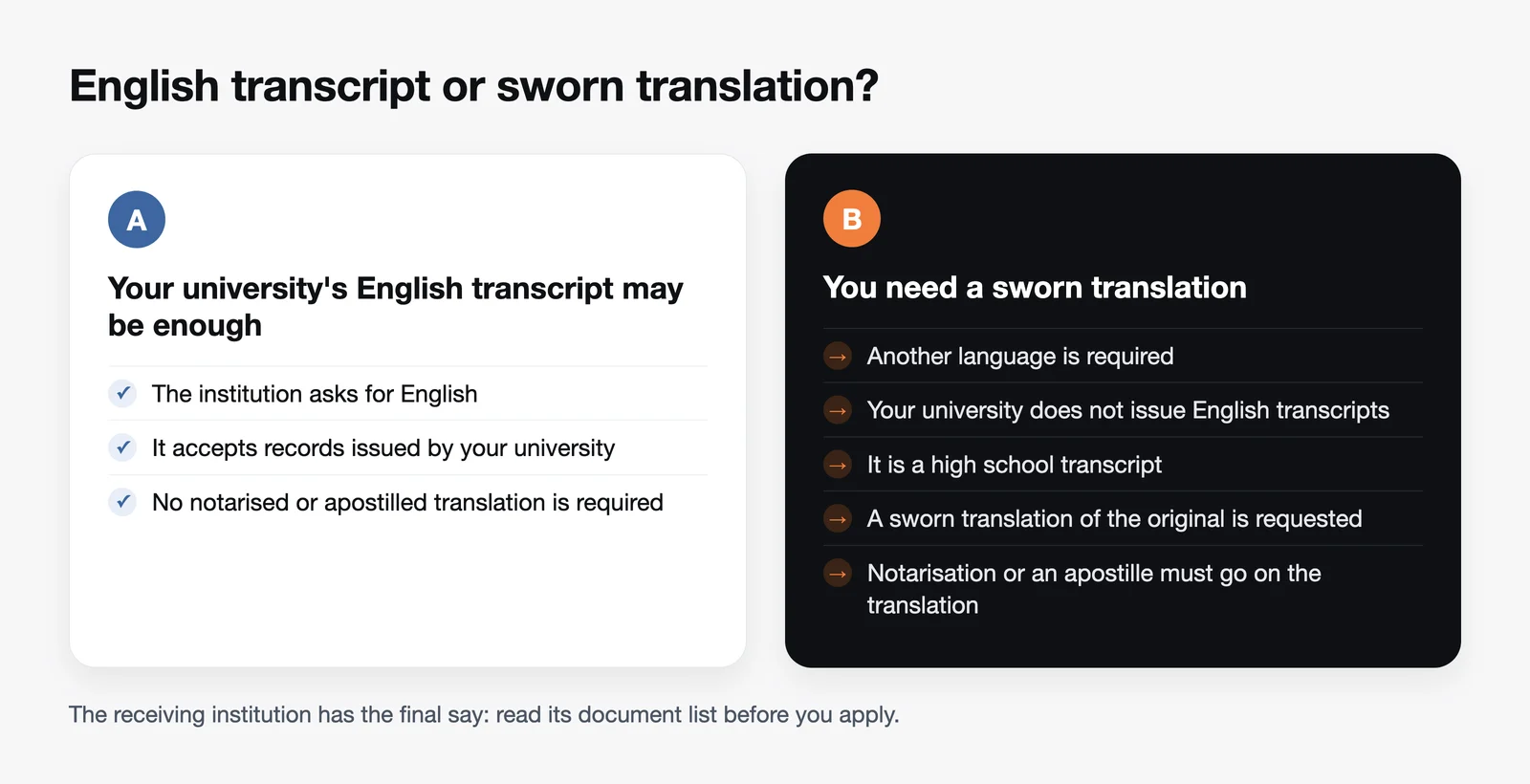
Many universities in Türkiye let you request an English transcript from the student affairs office. This is not a translation but an official document issued by the university itself. If the institution you are applying to asks for documents in English and accepts records issued directly by your university, you may not need a translation at all.
You will usually need a sworn translation when:
- 1
The institution asks for a language other than English, such as German, Italian or French.
- 2
Your university does not issue English transcripts, or the document is a high school transcript.
- 3
The institution explicitly asks for a sworn translation of the original document.
- 4
The document needs notarisation or an apostille and the institution wants it on the translation.
On e-Devlet, Türkiye's government portal, YÖK offers a Transcript Certificate service, and institutions in Türkiye can check that document through its verification service. Institutions abroad rarely use e-Devlet barcodes, so they usually ask for the stamped and signed transcript issued by the university, or a translation of it. If your record does not appear on e-Devlet, you can get the transcript straight from your university's student affairs office.
Details to check before you order
Delays with transcript translations usually come from small inconsistencies rather than big mistakes. Checking these points before you order saves time later:
Give the spelling of your name exactly as it appears in your passport, so every translation uses the same spelling.
Use the official English name of your university, faculty and department, which most universities publish on their website.
Upload every page of the transcript, including the back and the grading scale key.
Make sure the grade point average and graduation date on your diploma match those on your transcript.
If the receiving institution wants a particular term, language or format, add it to your order notes.
If you are going the other way and need a transcript from abroad recognised in Türkiye, Turkish authorities generally ask for a sworn translation into Turkish. Check the document list of the authority concerned, such as YÖK for higher education, before you order.
Frequently Asked Questions
Do I need the original transcript for the translation?
A clear scan or photo of your transcript is enough for the translation itself. If the document is going to be notarised or apostilled, the authority concerned may want to see the original. If you need those steps, find out in advance which document you should bring.
Will my grades be converted in the translation?
No. In a sworn translation the grades are reproduced exactly as they appear, and the key to the grading scale is translated as well. Any conversion is done by the institution you are applying to, or by an evaluation body it refers you to.
Is the English transcript from my university enough?
That depends on the institution you are applying to. If it asks for documents in English and accepts records issued directly by your university, it usually is. If it asks for a sworn translation, notarisation or another language, you will need a translation as well.
Can the Diploma Supplement replace the transcript?
The Diploma Supplement can include details of your courses and results, but whether it replaces the transcript is up to the institution that receives it. Many applications still ask for the transcript separately. If the institution's document list names both, you need to prepare both.
Which languages can my transcript be translated into?
On Languvi you can order a transcript translation into more than 180 languages. Your document goes to a translator experienced in academic records and is checked before delivery. Simply choose the language the receiving institution asks for.
Conclusion: A good transcript translation carries every course title, credit and grade across completely. Before you apply, find out which documents the institution wants, in which language, with which approvals; then translate your diploma, your transcript and, if needed, your Diploma Supplement in one order. On Languvi you upload your document, then choose sworn translation, notarisation, apostille or consular legalisation on one platform. Before you pay, you see the price with an estimated delivery date within seconds. See our diploma and transcript translation page for details, or upload your document now on the order page.