
This Turkish residence permit guide is for foreigners who plan to stay in Türkiye longer than their visa or visa-free period allows. Anyone staying beyond that period, or extending a current permit, has to apply for one of the residence permits set out in Law No. 6458 on Foreigners and International Protection. The application starts online and ends with an appointment, where the documents must be handed in complete.
This guide covers the permit types, how the application works and which documents are usually asked for. It pays particular attention to documents issued abroad, because those are where most applications get stuck. The Presidency of Migration Management (Göç İdaresi) publishes the official document list for each permit type, and that list always has the final word.
Residence permit types in Türkiye
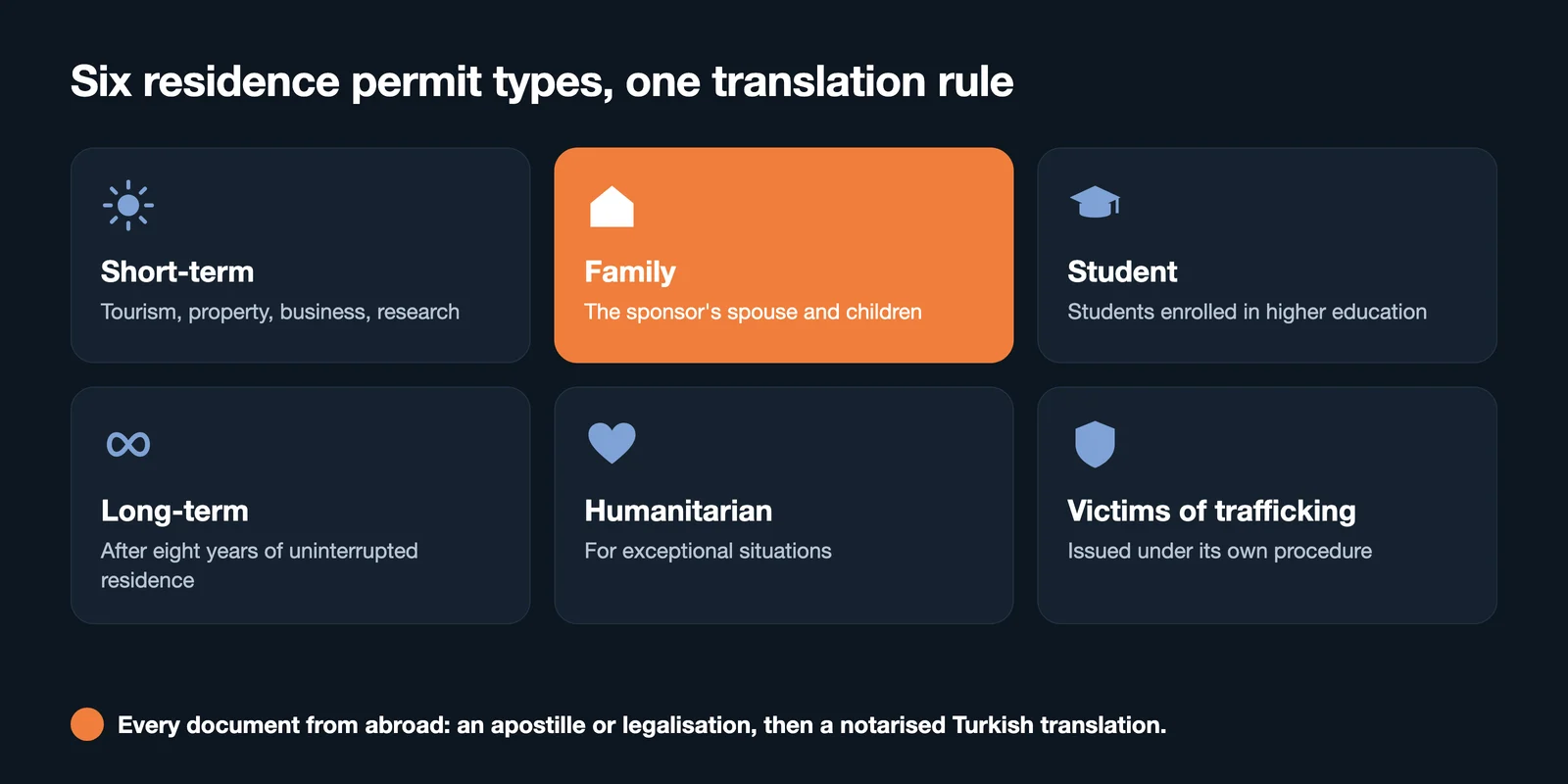
Law No. 6458 lists six types of residence permit. Each one is tied to the purpose of your stay, so choosing the type that matches your situation is the first step.
Short-term residence permit
The short-term permit covers a range of purposes, such as tourism, owning property in Türkiye, business connections, scientific research or on-the-job training. It is the type most foreigners apply for first. The documents depend on the purpose you give, so the evidence must match it.
Family residence permit
The family permit is for the foreign spouse and children of a Turkish citizen or of a foreigner who holds a residence permit. The person already in Türkiye is called the sponsor. Both the applicant and the sponsor provide documents. This is the permit where foreign civil status documents matter most.
Student residence permit
Foreigners enrolled in higher education in Türkiye apply for a student permit. A student certificate from the university, health insurance and proof of address are central. Universities usually guide their international students through the process.
Long-term residence permit
The long-term permit is for foreigners who have lived in Türkiye on residence permits for at least eight years without interruption, along with other conditions in the law. It is granted for an indefinite period. A criminal record and proof that no social assistance was received are among the documents asked for.
Humanitarian permit and permit for victims of trafficking
The law also provides a humanitarian residence permit for exceptional situations and a permit for victims of human trafficking. These follow their own procedures, and the provincial migration office decides on them.
Permit type | Typical situation | Documents from abroad |
|---|---|---|
Short-term | Tourism, property, business, research | Sometimes, depending on the purpose |
Family | Spouse or child of a sponsor in Türkiye | Marriage and birth certificates, custody papers |
Student | Enrolled at a university in Türkiye | Rarely, apart from the passport |
Long-term | Eight years of uninterrupted residence | Criminal record, if issued abroad |
How the application works
Applications start on the official e-ikamet site, where you fill in the form and get an appointment at the provincial migration office. Göç İdaresi states that these appointments are free of charge, so ignore anyone who asks for money to book one. Your application is only assessed if all documents are handed in complete on the day and time of the appointment.
In general, the application runs through these steps:
- 1
Choose the permit type on e-ikamet and fill in the application form.
- 2
Note the appointment date and the provincial migration office you will go to.
- 3
Download the document list for your permit type and prepare the documents.
- 4
Pay the permit fee and the card fee, and keep the receipts.
- 5
Attend the appointment with the originals of your documents.
The office can ask for extra information or documents while it reviews your file. Once a first permit is approved, the address has to be registered within 20 working days. For extensions and transfers, you also need a national e-notification (UETS) address, which PTT branches provide. If you are extending a permit, apply before it expires. The same apostille and translation rule applies to foreign documents in extension applications.
Keep in mind that a residence permit does not give the right to work in Türkiye. Working requires a separate work permit, which our page on work permit translation in Türkiye covers.
Documents issued abroad: apostille and notarised translation
Göç İdaresi's own document lists set a clear rule for documents obtained abroad, such as a marriage certificate or a child's birth certificate. If the issuing country is a party to the Apostille Convention, the document needs an apostille and a Turkish translation approved by a notary. If the country is not a party, or the document has no apostille, it must be approved by that country's authorities with consular or embassy legalisation, and it still needs a notarised Turkish translation.
The same rule covers the documents filed for a child: the birth certificate, custody documents, the other parent's consent and, where relevant, a death certificate. The translation is made by a sworn translator registered with a Turkish notary, and the notary then approves it. The apostille on the document is translated as part of it.
Other documents that often involve a notary
Some residence permit documents are prepared in Türkiye but still go through a notary. If you rent your home, a notarised copy of the rental contract showing the landlord's details is one of the accepted proofs of address. If you stay with someone else, that person gives a notarised undertaking, and their spouse does too if they are married.
A notarised Turkish translation of the passport is not part of every residence permit list. It often comes up in related procedures, though, such as notary transactions, buying property or opening a bank account. Having one ready can save time once you have settled in.
Checks before your appointment
Residence permit files are assessed only if they are complete, so preparation pays off. Run through these points before the appointment:
Choose the permit type that matches the real purpose of your stay.
Bring the originals of your passport and of documents you submit as copies.
Get the apostille in the issuing country before you travel, because it cannot be added in Türkiye.
Have every foreign document translated into Turkish and approved by a notary.
Keep your name spelt the same way in your passport, application form and translations.
Make sure your health insurance covers the whole period you are applying for.
Frequently Asked Questions
Which foreign documents need a Turkish translation?
Any document obtained abroad, such as a marriage certificate, a birth certificate or custody papers, needs a Turkish translation approved by a notary. It also needs an apostille, or consular legalisation if the issuing country is not part of the Apostille Convention. Documents issued by Turkish offices need no translation.
Can the apostille be added in Türkiye?
No. The apostille is issued by the country that issued the document. For a foreign marriage certificate, for example, it comes from the competent authority in that country. Only the translation and the notary approval are done in Türkiye.
Does a residence permit let me work?
No. Göç İdaresi states that a residence permit does not give the right to work in Türkiye. Working requires a separate work permit or a recognised exemption.
Is the passport translation always required?
It is not on every residence permit list. However, notaries, land registry offices and banks often ask for a notarised Turkish translation of the passport. Many people prepare it once and use it for several procedures.
Should the translation be made in Türkiye?
Because the notary approval is given by a Turkish notary, the translation is usually made by a sworn translator in Türkiye. You can also upload your documents to Languvi from abroad. The notarised Turkish translation is prepared in Türkiye and delivered ready for your application.
Do I have to pay to get an appointment?
No. Göç İdaresi states that appointments made through the official e-ikamet site are free of charge. Fees for the permit itself are paid separately, as the official list explains.
Conclusion: A Turkish residence permit application succeeds when the right permit type is chosen and every document is complete on the day of the appointment. Documents from abroad need an apostille or legalisation in the issuing country, followed by a notarised Turkish translation in Türkiye. On Languvi you upload your documents, and the sworn Turkish translation with notary approval is prepared on one platform. See our page on residence permit translation in Türkiye, or upload your documents now on the order page.