
This Turkish citizenship application guide is for anyone who lives in Türkiye, is married to a Turkish citizen or is otherwise thinking about becoming a Turkish citizen. Citizenship is not granted automatically: you apply to the authorities, they review your file, and the decision rests with them. Most of the work is in preparing the file, and for foreign applicants that means documents from abroad.
This guide gives the general picture. It covers the main routes set out in Turkish Citizenship Law No. 5901, where applications are made and which documents are usually asked for. It also explains how documents issued abroad are made ready for Turkish authorities with an apostille and a notarised Turkish translation. It is general information, not legal advice; for your own case, especially the investment route, consult a lawyer.
The main routes to Turkish citizenship
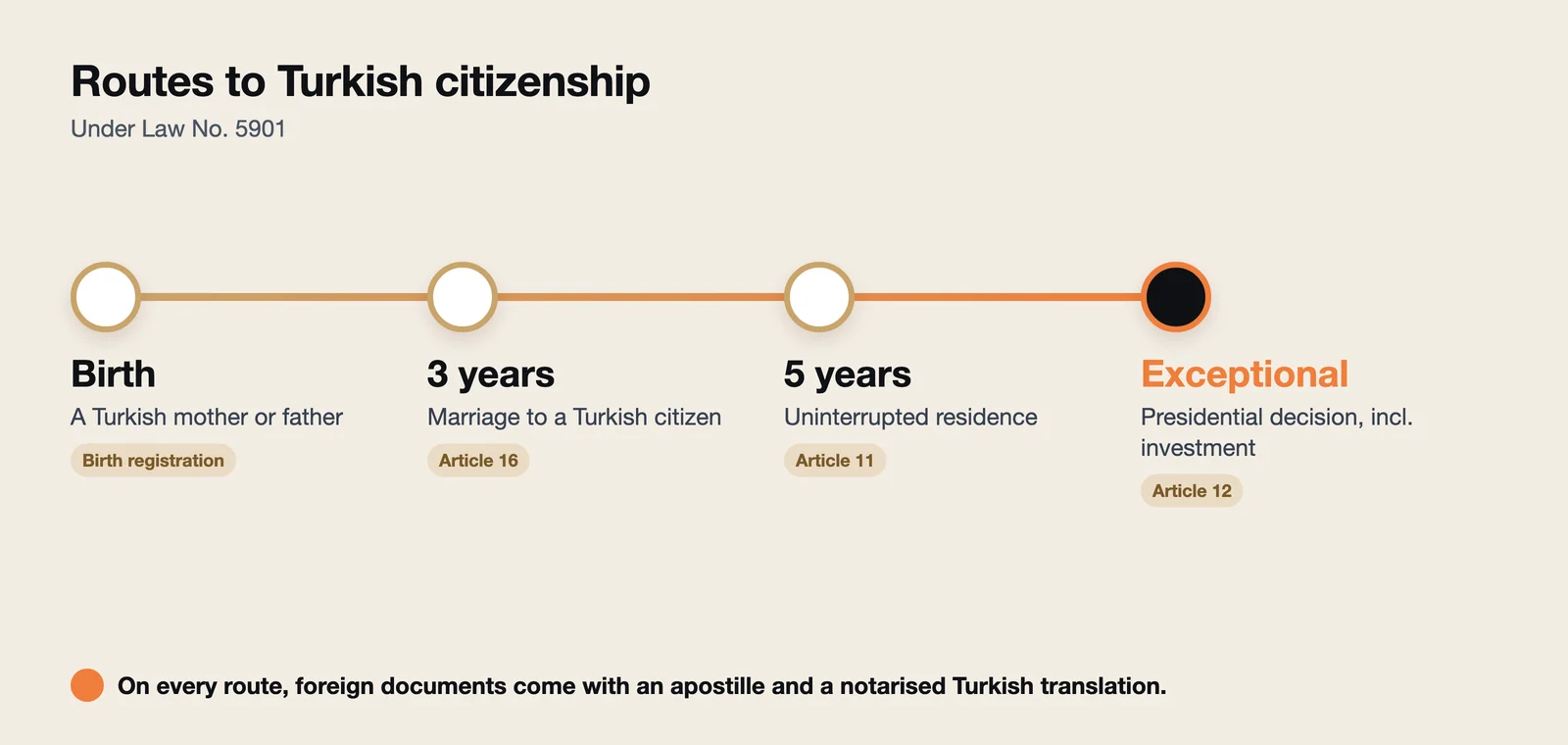
Turkish law distinguishes between citizenship acquired by birth and citizenship acquired later by a decision of the authorities. Most readers of this guide fall into the second group.
By birth
A child born to a Turkish mother or father is a Turkish citizen from birth, whether the child is born in Türkiye or abroad. No citizenship application is needed in this case. What is needed is to register the birth with the Turkish civil registry, either in Türkiye or at a Turkish consulate abroad, and the foreign birth certificate is usually translated for that.
The general route after five years
Under Article 11 of Law No. 5901, a foreigner can apply after living in Türkiye without interruption for five years before the application date. The law adds other conditions, such as the intention to settle, enough Turkish to get by, and an income or profession that supports the applicant. Meeting the conditions does not give an automatic right to citizenship. The five years must be uninterrupted, and long stays abroad can count as a break. If you are unsure whether you have reached five years, ask the office before you apply.
Through marriage
Marrying a Turkish citizen does not make you a Turkish citizen by itself. Under Article 16, a foreigner who has been married to a Turkish citizen for at least three years, and whose marriage is ongoing, may apply. The couple must live together as a family, and there must be no obstacle on grounds of national security or public order.
Exceptional cases, including investment
Article 12 allows citizenship to be granted by presidential decision in certain exceptional cases. The investment route falls under this article. Its details are set by regulation, which changes over time. Since the figures and conditions move, confirm the current rules with the authorities before committing to an investment; a lawyer can help here.
Route | Main condition | Legal basis |
|---|---|---|
By birth | A Turkish mother or father | Registration of the birth |
General route | Five years of uninterrupted residence, plus other conditions | Article 11 |
Marriage | At least three years of ongoing marriage to a Turkish citizen | Article 16 |
Exceptional cases | Presidential decision, including investment | Article 12 |
Where to apply
Applicants living in Türkiye usually apply to the provincial civil registry directorate (il nüfus ve vatandaşlık müdürlüğü) where they live. Applicants abroad apply through a Turkish consulate. The office that takes your application gives you its current document list, and that list is the one to follow.
Ask for the list in writing if you can, because requirements can differ slightly from one route to another. Some offices also tell you how recent certain documents must be. Starting with the list saves you from collecting documents twice.
Which foreign documents are usually needed?
Most routes ask for proof of your identity, your civil status and your record. For foreign applicants, several of these documents come from abroad.
Birth certificate: a full certificate showing both parents' names.
Marriage certificate: if you are married, including for the marriage route.
Divorce decision: if you were married before, with the note showing that the decision is final.
Criminal record certificates: from the countries you have lived in, when the office asks for them.
Passport: a notarised Turkish translation is often requested.
Civil status certificate: a document showing you are single, if it is asked for.
Apostille and notarised Turkish translation
A document issued abroad has to go through two stages before a Turkish office accepts it. The first stage happens in the country that issued the document. If that country is a party to the Apostille Convention, its competent authority puts an apostille on the original. If it is not, the document goes through consular legalisation instead, usually ending with the Turkish consulate.
The second stage happens in Türkiye. A sworn translator registered with a Turkish notary translates the document into Turkish, and the notary approves the translation. The apostille itself is translated as part of the document. If you are applying from abroad, you can upload your documents to Languvi online; the notarised Turkish translation is prepared in Türkiye. The same two stages apply to other offices in Türkiye too, as our page on notarised Turkish translation for Türkiye applications explains.
Common mistakes in the documents
Citizenship files are often sent back because of how documents were prepared, not because of the documents themselves. The most common problem is a translation that leaves out the apostille. The apostille is part of the document, so it has to be translated into Turkish as well.
The second common problem is a divorce decision submitted without the note showing it is final. The office wants to see that the decision can no longer be appealed. The third is a name spelt differently in different documents. Names written in another alphabet need the same Turkish spelling in every translation, which is easiest when all the documents are translated in one order.
Practical tips before you apply
Citizenship files are long, so small details matter. These checks help you avoid delays:
Keep the spelling of your name identical across your passport, residence permit and every translation.
If your name is written differently in two documents, raise it before you apply; the office may ask for an extra document.
Check how recent each document must be, especially criminal records and civil status certificates.
Get the apostille in the issuing country before you move, because it cannot be added in Türkiye.
Keep originals, apostilled copies and translations together, since offices may ask to see the originals.
Frequently Asked Questions
Does marrying a Turkish citizen give me citizenship?
No. Marriage alone does not grant Turkish citizenship. After at least three years of ongoing marriage you may apply, and the authorities decide on your application.
Which documents need a Turkish translation?
Every document issued in a language other than Turkish needs a Turkish translation, usually approved by a notary. This typically covers the birth certificate, marriage or divorce documents, and criminal records. The passport translation is often asked for as well.
Where does the apostille go?
The apostille goes on the original document, in the country that issued it. Countries outside the Apostille Convention use consular legalisation instead. The apostille is then translated into Turkish together with the document.
Can I apply from abroad?
Yes, applications can be made through Turkish consulates abroad. The consulate gives you its own document list. You can also have the notarised Turkish translations prepared from abroad by uploading your documents to Languvi.
Do I need to speak Turkish?
For the general route, speaking enough Turkish is one of the conditions listed in the law. For the other routes, follow the information given by the office that takes your application. A Turkish translation of your documents is needed on every route.
Do I need a lawyer?
The process does not require a lawyer, but legal advice is useful in complex cases. For the investment route in particular, conditions change, so a lawyer's help is worth considering.
Conclusion: A Turkish citizenship application rests on the route you use and on a complete set of documents. Foreign documents need an apostille or legalisation in the issuing country, followed by a notarised Turkish translation in Türkiye. On Languvi you upload your documents, and the sworn Turkish translation with notary approval is prepared on one platform. See our page on translation for Turkish citizenship applications, or upload your documents now on the order page.