Translating documents for Germany is the first step in almost every German application, from a visa or family reunification to university admission or the recognition of a profession. German authorities usually want documents issued in Türkiye translated into German. Which documents need translating, with which approvals, depends on the application and the office that receives it.
This guide maps out the whole picture. It covers which documents are translated for which application, where a sworn translation made in Türkiye is accepted, and when an apostille or notary approval comes in. If you are preparing one specific application, jump to its section and follow the links to our more detailed guides.
Where translating documents for Germany comes in
Applications for Germany are made in one of two places: at a German mission in Türkiye, or with an authority inside Germany. Both usually ask for documents in German, but the rules on which translations they accept can differ.
Visas at German missions
Short-stay Schengen visas and long-stay national visas are applied for at the German missions in Türkiye. The documents depend on the purpose of the stay, so the mission's own checklist always comes first. Bank statements, employer letters, the SGK social security record and the civil registry record are translated most often.
Family reunification
People joining a spouse or family member in Germany prove the family relationship with civil status documents. Marriage and birth certificates are the core of these applications. Spouses are generally also asked to show basic German at level A1, although some groups are exempt. Check the current exemptions on the German mission's page before you apply.
University admission
German universities ask for the school-leaving diploma, the transcript and any university records. Many of them take applications through a shared evaluation service rather than directly. If you are applying for a degree, our transcript translation guide explains how course titles, credits and grades are handled.
Recognition of degrees and professions (Anerkennung)
If you want to work in Germany, your degree or vocational qualification may need to be recognised. Recognition is compulsory for regulated professions such as doctors, teachers and nurses. For non-regulated professions, a statement comparing your university degree with German degrees may be requested instead. The search tool on anerkennung-in-deutschland.de tells you which authority is responsible for your profession.
Residence, marriage and citizenship in Germany
Documents from Türkiye are often needed after you have moved as well. Registering a marriage, extending a residence permit or applying for citizenship usually involves civil registry records, a police record and proof of income. These procedures are handled by local authorities in Germany.
Which documents are translated?
The table below sums up the most common applications. The receiving office's own list always has the final word.
Application | Documents often requested | What to watch |
|---|---|---|
Schengen visa | Bank statements, employer letter, SGK record | The mission's current checklist |
National visa (work, study) | Diploma, transcript, employment contract | Recognition or a comparability statement may be needed |
Family reunification | Marriage certificate, birth certificate, civil registry record | The language requirement for spouses |
University admission | School diploma, transcript, university records | The languages the university accepts |
Anerkennung | Diploma, transcript, Diploma Supplement, work references | The authority's rules on translations |
Procedures in Germany | Civil records, police record, proof of income | Whether translations made abroad are accepted |
Türkiye also issues multilingual civil status extracts that already carry German wording, such as Formül A for births and Formül B for marriages. Some German offices accept these without a separate translation. Ask the office first whether it does before you rely on them.
Which translations are accepted in Germany?
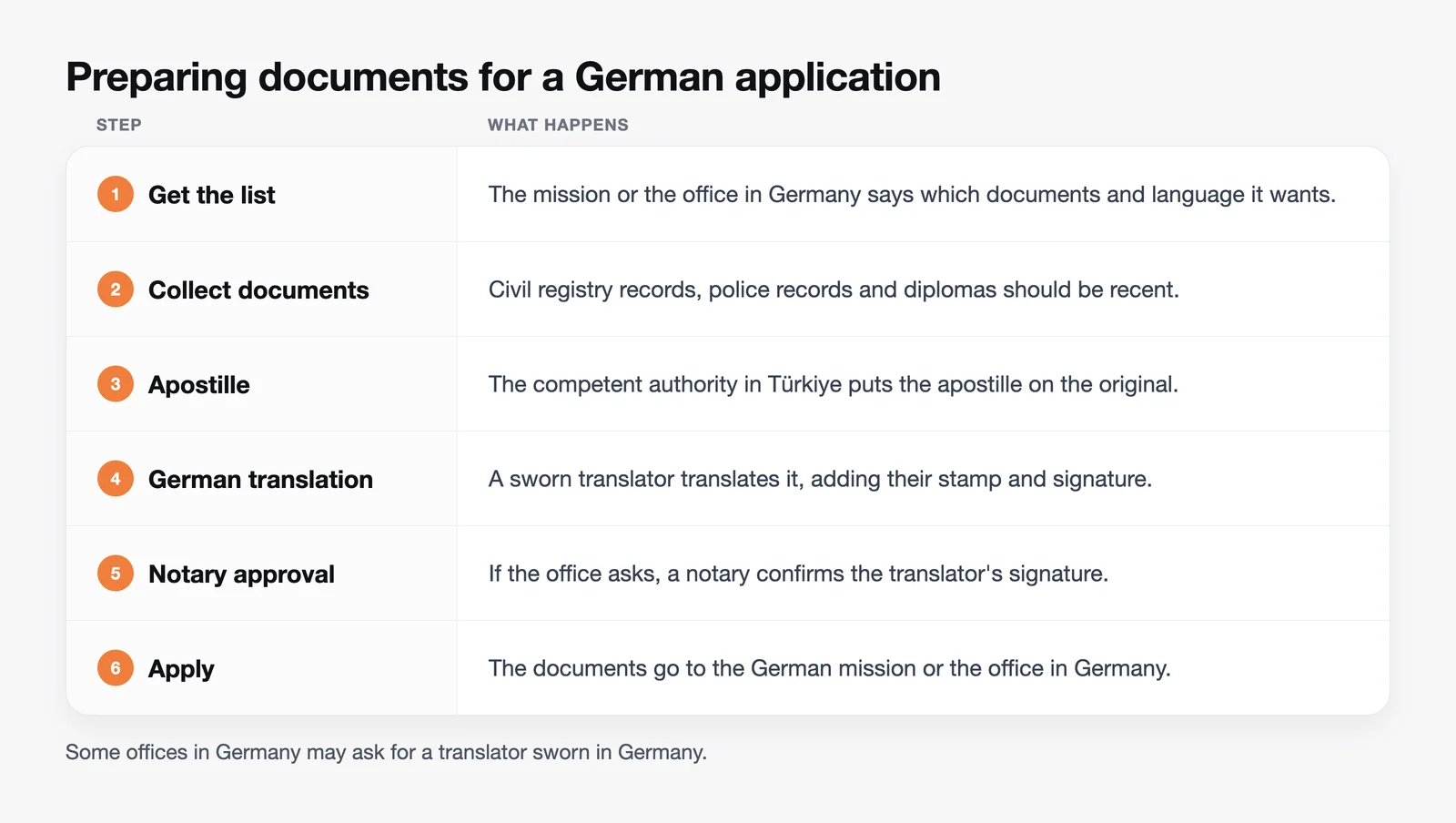
At German missions in Türkiye, German translations made by a sworn translator in Türkiye are widely used. Inside Germany the picture can change. According to the German Federal Foreign Office, each authority decides at its own discretion whether a translation made abroad can be used.
That makes it important to know where your document will end up. Some offices in Germany may insist on a translator sworn in Germany. Recognition authorities also say on their own pages whether they accept sworn translations made abroad. Asking the office in writing before you order saves you from translating the same document twice.
Some offices accept English as well as German. Universities and certain recognition authorities in particular may take documents in English. Check which languages the office accepts before you choose.
When an apostille or notary approval is needed
Türkiye and Germany are both parties to the Apostille Convention. A public document issued in Türkiye therefore usually gets an apostille on the original before it is used in Germany. The apostille confirms that the signature and seal on the document are genuine; it says nothing about the translation.
Notary approval works differently, because it confirms the signature of the sworn translator in Türkiye. Some offices ask for the translation itself to be notarised and apostilled too. The receiving office decides which of these steps you need. Our guide on how to get a diploma translated shows how these approvals build on each other.
Checks before you apply
Applications for Germany are most often delayed by small inconsistencies. Run through these points while you prepare:
Give the spelling of your name exactly as it is in your passport, so every translation uses it.
Have the whole document translated, including stamps, notes and the back of each page.
Make sure civil registry records and police records are recent, since some offices refuse documents older than a set period.
Find out the language, the type of approval and the number of copies the office wants.
Translate your diploma and transcript in one order, so course titles and grades stay consistent.
Frequently Asked Questions
Is a sworn translation made in Türkiye valid in Germany?
It is widely used for applications at German missions in Türkiye. Inside Germany, each office decides for itself whether to accept a translation made abroad. The safest route is to ask the office that will receive your document before you order.
Do translations for Germany need an apostille?
For public documents, the apostille usually goes on the original. Some offices also want the translation notarised and apostilled. Check the receiving office's list to see which documents need one.
Can I have documents translated into English instead of German?
Some universities and recognition authorities accept documents in English. Visa and civil status procedures usually ask for German. Check which language the office accepts before you choose.
Do multilingual civil status extracts replace a translation?
Multilingual extracts such as Formül A and Formül B already include German wording. Some German offices accept them without a separate translation. If the office does not, you will need a German translation of the document.
Can documents from Germany be translated into Turkish too?
Yes. Documents issued in Germany can be translated into Turkish for use in Türkiye. A notary approval can be added to these translations when it is required.
Conclusion: Translating documents for Germany comes down to where each document will be used. German missions in Türkiye widely use sworn translations made in Türkiye, while offices inside Germany may set their own rules. On Languvi you upload your document, then choose a sworn German translation, notary approval or an apostille on one platform. See our page on German translation for visa, Anerkennung, Uni-assist, or upload your document now on the order page.