Power of attorney translation is what lets a power of attorney (POA) signed in one country work in another. You need it when you live abroad but want someone in Türkiye to sell your flat, follow a court case or deal with your bank for you. The same applies the other way round, when a POA signed before a Turkish notary is used abroad.
If you're abroad and giving a POA for use in Türkiye, there are two main options. A POA drawn up in Turkish at a Turkish consulate can be used directly. A POA made before a foreign notary needs an apostille or consular legalisation, then a notarised Turkish translation.
This guide walks through both directions step by step. It also covers the stricter rules for title deed (tapu) transactions. Finally, it explains why names and ID numbers must match exactly in the translation.
When do you need a power of attorney translation?
A power of attorney is an official document in which one person (the principal) authorises another (the attorney) to act on their behalf. The authorities of the country where it's used must be able to read it, so translations are needed in two directions:
From abroad into Türkiye: someone living in Germany, the UK or the US appoints an attorney for a property sale, a bank account, a vehicle, an inheritance or a court case in Türkiye. If the POA is in a foreign language, the land registry, notary or court asks for its Turkish translation.
From Türkiye to another country: someone living in Türkiye appoints an attorney for a property, company, inheritance or official application abroad. The POA signed before a Turkish notary is translated into the language of that country.
A POA often carries as much legal wording as a contract, and its scope can turn on a single word. That's why a power of attorney translation should be done by sworn translators with legal translation experience.
From abroad into Türkiye: three routes
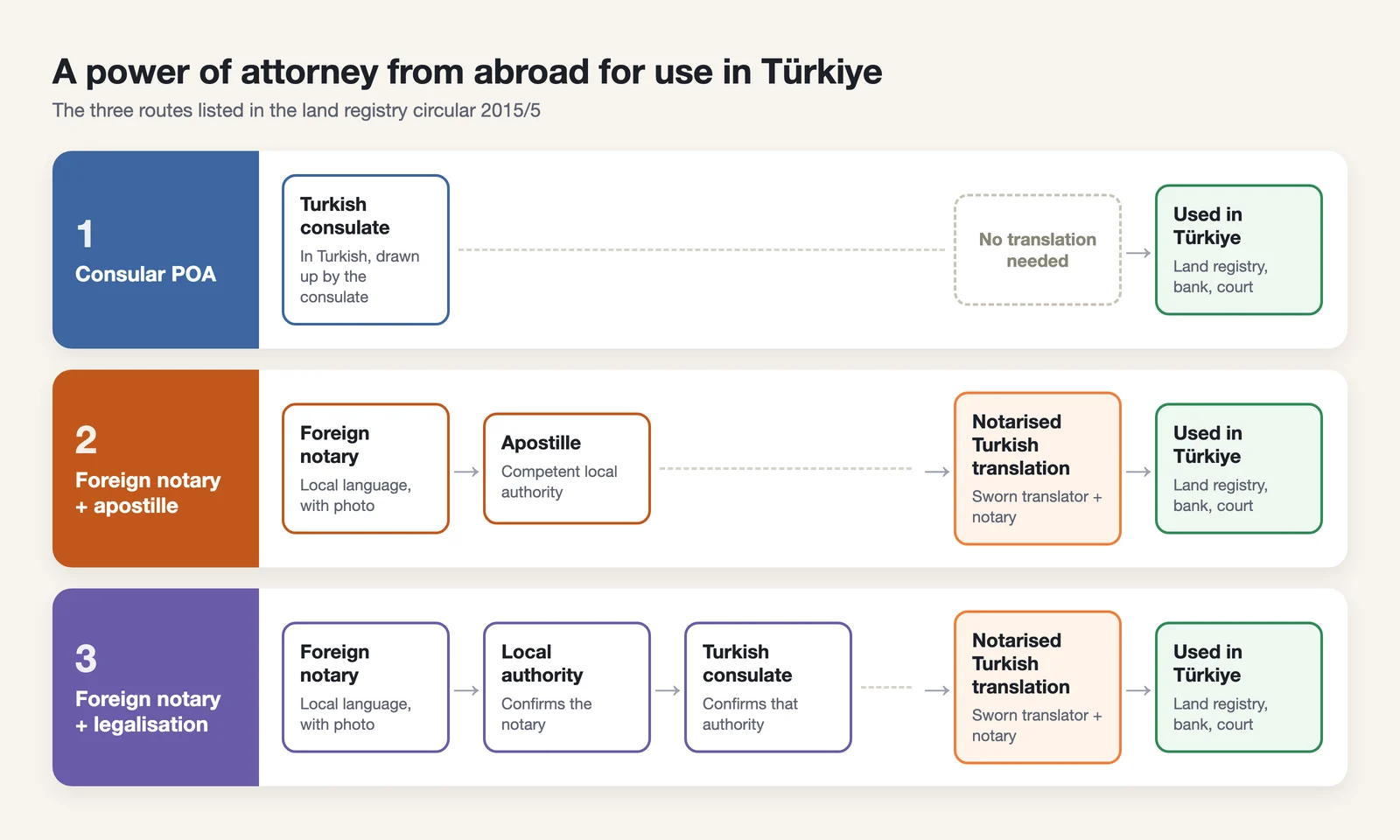
Circular 2015/5 of Türkiye's General Directorate of Land Registry and Cadastre (TKGM) lists the routes accepted for using a POA made abroad at a land registry office. The circular is written for property transactions.
Route | Where it's made | Language | Extra certification | Translation in Türkiye |
|---|---|---|---|---|
Consular POA | Turkish consulate | Turkish | None | None |
Foreign notary + apostille | Notary in a Hague Convention country | Local language | Apostille | Notarised Turkish translation |
Foreign notary + consular legalisation | Notary in any country | Local language | Local authority, then the Turkish consulate | Notarised Turkish translation |
At a Turkish consulate you apply in person, by appointment, booked through konsolosluk.gov.tr. You bring your ID, plus the attorney's full name and Turkish ID number. Applicants who aren't Turkish citizens attend with a sworn Turkish translator.
On the foreign notary route, the POA is drawn up in the local language and then receives an apostille or consular legalisation. Once it reaches Türkiye, a sworn translator translates it into Turkish, and a notary certifies the translation. Our guide to using foreign documents in Türkiye explains apostilles and legalisation in more detail.
Extra rules for property (tapu) transactions
A POA used at the land registry follows the strictest rules. Article 89 of Türkiye's Notaries Law requires these POAs to be drawn up by the notary ("düzenleme şeklinde"): the notary prepares the text, and you sign it in front of them. Under the TKGM circular the following also apply:
Photo: the principal's photo is part of the POA. Consulates ask for two passport photos for property POAs.
Authority: the POA states clearly that it covers the property transaction in question.
Language: a POA that a foreign authority has drawn up in Turkish isn't accepted at the land registry. It's made in the local language, then submitted with a notarised Turkish translation.
ID document: the POA must be based on the passport or national ID card of the principal's country of citizenship. A Blue Card (Mavi Kart) issued after 12 April 2013 is also accepted. POAs based on a driving licence or residence card can't be used at the land registry.
For other matters (banks, vehicles, court cases, inheritance) the rules depend on the institution involved. Asking a lawyer to review the scope and form of your POA saves trouble later.
Using a POA from Türkiye abroad
If you live in Türkiye and are appointing someone for a matter abroad, the process starts at a Turkish notary. According to the legalisation guide of Türkiye's Ministry of Foreign Affairs, the steps are:
- 1
Power of attorney: drawn up in Turkish before a Turkish notary.
- 2
Translation: a sworn translator translates it into the language of the destination country.
- 3
Notary certification: a notary certifies the translation.
- 4
Apostille: for Hague Convention countries, the governorship (valilik) or district governorship (kaymakamlık) adds the apostille. The apostilled document is then used directly in that country.
- 5
Consular legalisation: for countries outside the Hague Convention, the governorship certifies the document instead, followed by the Ministry of Foreign Affairs legalisation. Finally, that country's mission in Türkiye legalises it.
Languvi handles the whole chain on one platform: sworn translation, notarised translation, apostille and consular legalisation in a single order. Some countries ask for a translation by their own sworn translator, such as a beeidigter Übersetzer in Germany or a traductor jurado in Spain. Languvi prepares it through its authorised translators abroad; just write to us through the contact form.
Why names and ID numbers must match exactly
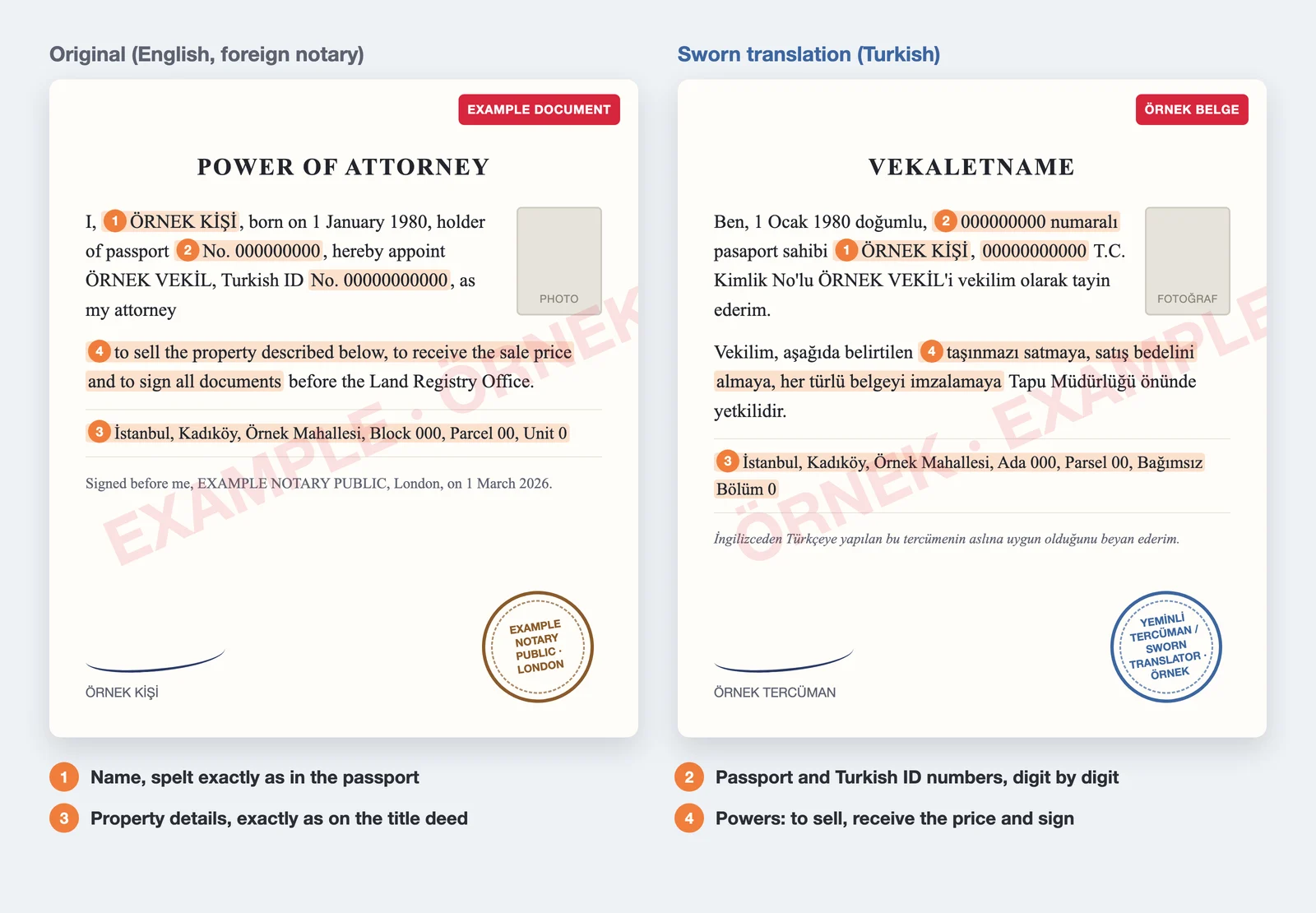
Personal details are where a POA most often runs into trouble. The land registry or the bank compares the name, ID number and date of birth on the POA with its own records. A single letter out of place can stop the transaction.
A careful power of attorney translation keeps these points in view:
Names follow the official document. The principal's name stays exactly as it appears in the passport. Turkish letters (Ş, Ğ, İ) are kept as spelt on the Turkish ID card.
ID numbers are copied digit by digit. A Turkish ID number, passport number or foreigner ID number is never altered.
Dates use one format. Day, month and year stay in a consistent order; month names are written out where that avoids confusion.
Property details are complete. Province, district, neighbourhood, block, parcel and unit number are written exactly as on the title deed.
Powers are translated word for word. Set legal phrases, such as the power to sell and to receive the price, are rendered with their legal equivalents; the authority is never widened or narrowed.
A change of name needs attention too. If your name changed through marriage or a new citizenship, the new name must first be recorded in the Turkish registers. Consulates ask for the change to be registered before they issue the POA.
How Languvi prepares a power of attorney translation
You don't need to travel to Türkiye for the translation. The process works like this:
- 1
You upload a clear scan of every page of the POA, including the apostille or legalisation, on our order page.
- 2
You choose the language plus any steps such as notary certification or an apostille, and see the price and estimated delivery date within seconds, before paying.
- 3
The document goes to a sworn translator who knows legal texts. The translation is checked before delivery.
- 4
The translation carries the sworn translator's stamp and signature. If you chose notary certification, it's completed in Türkiye.
- 5
You receive it through your account, the mobile app, e-mail or WhatsApp. Signed and stamped originals are sent by courier when needed.
You can follow your order on the order tracking page. Languvi works in more than 180 languages. It is certified to ISO 17100 and ISO 9001.
Frequently Asked Questions
Does a POA issued at a Turkish consulate need translating?
A POA drawn up at a Turkish consulate is in Turkish. It's used in Türkiye without a translation or an apostille. The attorney can also obtain a copy of it from notaries in Türkiye.
Can I sell property in Türkiye with a POA from a foreign notary?
Under the TKGM circular this is possible, provided the POA is in the local language, carries your photo and was drawn up by the notary. It also needs an apostille or certification by the Turkish consulate, and goes to the land registry with a notarised Turkish translation.
Do I need to send the original POA to Türkiye?
A scanned copy is enough for the translation; we prepare it from that scan. The institution handling the transaction usually wants to see the original, though, so the original should reach your attorney.
Which language should my Turkish POA be translated into?
It's translated into the official language of the country where it will be used: German for Germany, Spanish for Spain, for example. Languvi works in more than 180 languages, and where that country's own sworn translator is required, it prepares the translation through its authorised translators abroad.
Is the apostille translated too?
Yes, the apostille is translated as part of the document. Stamps, seals and endorsements also appear in the translation.
Conclusion: The most direct way to give a POA from abroad for use in Türkiye is through a Turkish consulate. A POA made before a foreign notary needs an apostille or consular legalisation, followed by a notarised Turkish translation. In both directions, names, ID numbers and powers must be carried over exactly. Languvi translates your POA with sworn translators who know legal texts; notary certification and the apostille are completed in the same order. Upload your POA on our order page to see the price and delivery date within seconds.