Marriage certificate translation comes up when a wedding held in Türkiye has to be proven to an authority in another country. A spouse visa, family reunification, a residence permit or registering the marriage abroad are the usual reasons. Yet the Turkish marriage booklet itself does not always have to be translated; sometimes a different document does the job more easily.
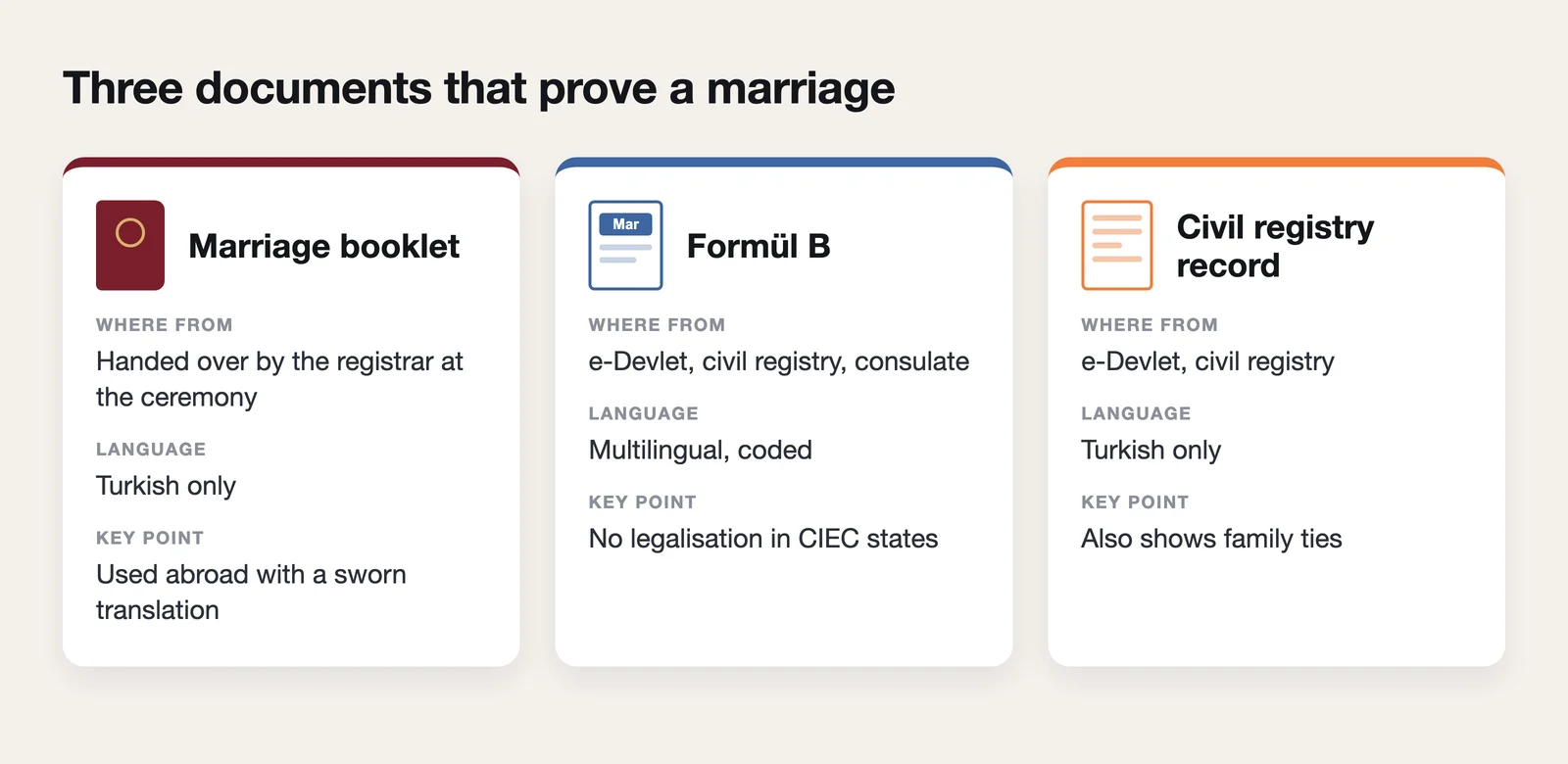
Three documents show a marriage registered in Türkiye: the marriage booklet (evlilik cüzdanı) handed over at the ceremony, the multilingual extract known as Formül B, and the civil registry record (nüfus kayıt örneği) that includes the marriage. Which one you use, and with which approvals, depends on the country it is going to.
This guide explains how the three documents differ and when a translation is needed at all. It also shows where the apostille and notarisation fit in. Finally, it covers what to watch for in spouse visa and family reunification applications.
Three documents that prove a Turkish marriage
The marriage booklet (evlilik cüzdanı)
The marriage booklet, also called the family booklet (aile cüzdanı), is handed to the couple by the marriage registrar as soon as the ceremony ends. Its serial number is entered in the marriage register. It shows both spouses' identity details along with the date and place of the marriage. Later pages are set aside for entries about children.
The booklet is written in Turkish only. When it is used abroad, a sworn translation of the whole booklet is prepared. Some authorities want every completed page translated, not just the page with the marriage details.
Formül B (the multilingual marriage extract)
Formül B is a multilingual extract of the marriage record, issued under Convention No. 16 of the International Commission on Civil Status (CIEC), signed in Vienna. Türkiye has been a party since 1985. The headings are printed in several languages, while dates and civil status details are shown with standard codes.
e-Devlet, the Turkish government portal, has a service called "Çok Dilli Evlenme Kayıt Örneği (Formül B) Sorgulama". You can also obtain the extract from a civil registry office (nüfus müdürlüğü) or from a Turkish consulate abroad. Its authenticity can be checked on e-Devlet as well.
The civil registry record (nüfus kayıt örneği)
The civil registry record shows a person's or a family's entry in the Turkish population register. Marital status, the date of marriage and the spouse's details all appear in it. It can be downloaded from e-Devlet with a barcode. The detailed version (vukuatlı nüfus kayıt örneği) also lists events such as marriages and divorces with their dates.
Which document for which purpose?
The table below sets the three documents side by side. What decides the choice is which format the receiving country accepts.
Document | Where to get it | Language | Typical use |
|---|---|---|---|
Marriage booklet | From the registrar at the ceremony | Turkish | Procedures in Türkiye; abroad with a translation |
Formül B | e-Devlet, civil registry office, consulate | Multilingual | European countries party to CIEC Convention No. 16 |
Civil registry record | e-Devlet, civil registry office | Turkish | Applications that also need family ties shown |
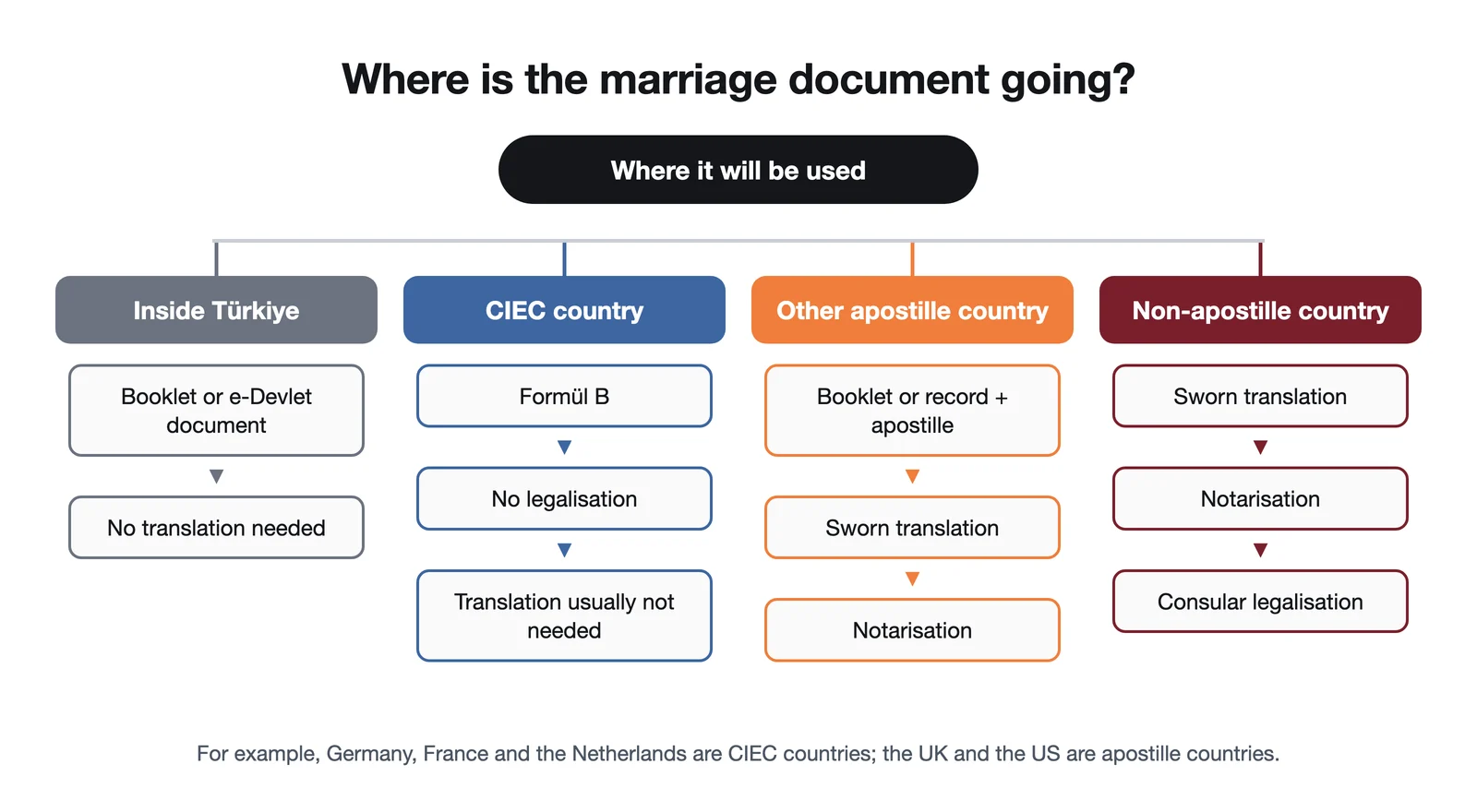
No translation is needed for procedures inside Türkiye; the booklet or an e-Devlet document is enough. When the document is going abroad, three questions settle the route:
- 1
Is the receiving country a party to CIEC Convention No. 16?
- 2
Is it a party to the Hague Apostille Convention?
- 3
Is the application going to a consulate or to an authority inside that country?
When Formül B makes things easier
The contracting states include Austria, Belgium, France, Germany, Italy, the Netherlands, Poland, Portugal, Spain and Switzerland. Under Article 8 of the convention, these extracts are accepted in contracting states without legalisation or any equivalent formality. The current list of parties is on the CIEC website.
The idea behind Formül B is that it can be read in the contracting states without a translation. So in these countries most applications go ahead with no apostille or translation. If an authority still asks for a translation into its own language, Languvi prepares it through its sworn translators.
There are cases where Formül B is not enough. Countries outside the convention, such as the United Kingdom, the United States or Canada, do not recognise the format. There, the document needs an apostille plus a sworn translation.
How marriage certificate translation works
If the document is going to a country outside CIEC, or the authority wants the booklet itself, the translation is prepared in this order:
- 1
Apostille: in Türkiye, apostilles on administrative documents are issued by provincial and district governorships (valilik and kaymakamlık). The apostille is placed on the marriage booklet or on a wet-signed record from the civil registry office. It is only valid in countries that are party to the Hague Apostille Convention.
- 2
Sworn translation: the whole document is translated into the target language, apostille included. Names are spelt exactly as in the passports.
- 3
Notarisation: a Turkish notary certifies the sworn translator's signature. For translations used abroad, this is a frequently requested step.
- 4
Apostille on the translation, if required: some countries also want an apostille on the notarised translation. Languvi completes this step within the same order.
For countries outside the Apostille Convention, consular legalisation replaces the apostille. On Languvi, sworn translation, notarisation, apostille and consular legalisation are all handled on one platform. Official documents are delivered with the sworn translator's stamp and signature.
Details that matter in the translation
Names, surnames and places of birth must match the Latin-script spelling in the passports exactly.
If a surname changed with the marriage, both the former and the new surname are rendered clearly.
Dates, register numbers, volume numbers and page numbers are carried over unchanged.
Seals, signatures and the apostille are described in the translation.
Spouse visas and family reunification
For spouse visas and family reunification, the marriage document is one of the core papers. If it is not in the language of the country you are applying to, a translation into that language goes into the file. Some countries work from Formül B; others expect the apostilled booklet or registry record.
UK Visas and Immigration asks for a full translation of every document that is not in English. In CIEC countries such as Germany, France and the Netherlands, Formül B is often the natural choice. For the United States and Canada, an English translation of the document is added to the file. If you are still planning the wedding in Türkiye, our page on translation for marrying in Türkiye covers the foreign partner's documents.
Some applications expect a recently issued marriage document. Obtaining Formül B or the registry record shortly before you apply therefore saves trouble. If your question is a legal one, such as whether a marriage is recognised in another country, it is best to consult a lawyer.
Frequently Asked Questions
Can a copy of the marriage booklet be translated?
Yes, the translation can be prepared from a photocopy or a scan. If an apostille is needed, it goes on the original booklet or on the wet-signed registry record. Uploading a scan of the apostilled document is all the translation needs.
Does Formül B need a translation?
Formül B is designed to be read without translation in the countries party to CIEC Convention No. 16. For other countries, or when an authority asks for one, a sworn translation is prepared. Languvi translates it into the language of the receiving country.
I live abroad. How do I get the translation done?
Upload your document through the order page. The notarised translation is prepared in Türkiye. Delivery is through your account, the mobile app, e-mail or WhatsApp. Signed, stamped originals are sent by courier when needed.
Into which languages can a marriage certificate be translated?
Languvi translates into more than 180 languages. Besides frequently requested ones such as German, English, French and Dutch, less common languages are covered too. Every document goes to a translator who knows the subject and is checked before delivery.
Which pages are translated?
Usually every completed page of the booklet is translated. Blank pages are noted in the translation rather than translated. Any entries about children are included as well.
Conclusion: Whether you need a marriage certificate translation depends on where the document is going. In CIEC countries, Formül B is often enough on its own; elsewhere, a sworn, notarised translation of the apostilled document is used. Languvi handles the translation, notarisation and apostille on one platform. Upload your document on our order page to see the price and delivery date within seconds.