Birth certificate translation comes up whenever an authority abroad asks you to prove your birth, or your child's. Visa or residence applications, school enrolment, citizenship files and marriages abroad are the usual reasons. The catch is that Türkiye does not issue one single document called a "birth certificate": the birth is recorded in the civil registry, and several documents are produced from that record.
What a foreign office calls a "birth certificate" is usually, in Turkish terms, either the multilingual Formül A or a civil registry record (nüfus kayıt örneği). Which one you need depends on the country receiving it. Once you have the right document, the translation and approval steps follow naturally.
This guide explains the Turkish documents that show a birth, which one is usually wanted abroad, and when a translation is still needed. It also covers the opposite direction: translating a foreign birth certificate into Turkish, for example to register a child born abroad.
The Turkish documents that show a birth
A birth is reported to the civil registry office (nüfus müdürlüğü) and entered in the population register. Every document that shows the birth is then issued from that entry. Three of them matter for use abroad.
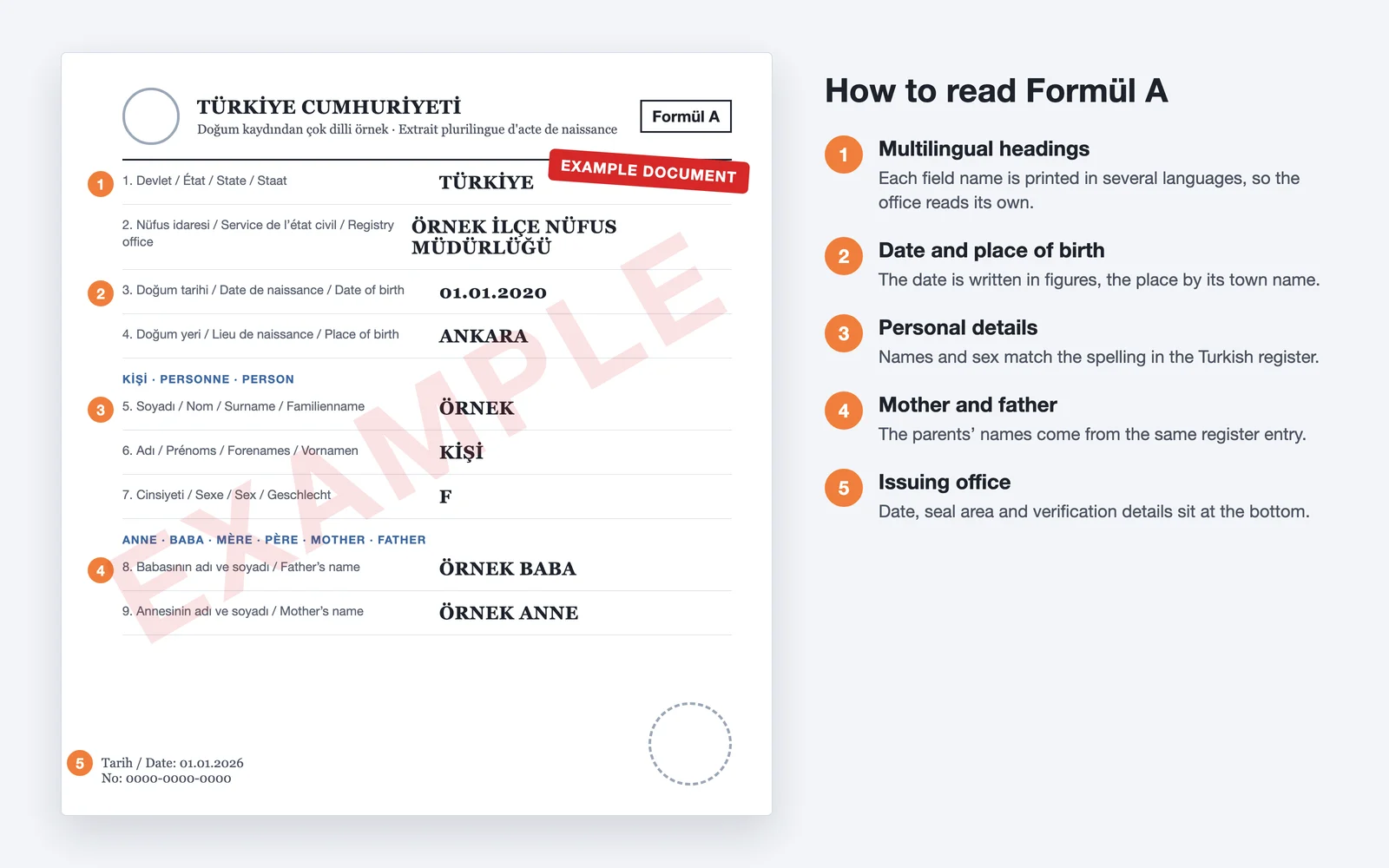
Formül A: the multilingual birth extract
Formül A is the multilingual birth extract issued under Convention No. 16 of the International Commission on Civil Status (CIEC), signed in Vienna. Türkiye has been a party since 1985. The headings on the form are printed in several languages, while dates and entries are shown with standard codes, so an official in another member state can read it without knowing Turkish.
e-Devlet offers a service called "Çok Dilli Doğum Kayıt Örneği (Formül A) Sorgulama", so you can download it online. Civil registry offices in Türkiye and Turkish consulates abroad issue it as well. Anyone receiving it can check that it is genuine through e-Devlet.
The civil registry record (nüfus kayıt örneği)
The nüfus kayıt örneği shows the person's date of birth, place of birth, plus the names of the mother and father. Because it proves the parent–child link, it is often requested when an application has to show a family relationship. There is a version for one person and a version showing the whole family, both available from e-Devlet with a barcode.
The extended version (vukuatlı nüfus kayıt örneği) also lists life events such as births, marriages or divorces, each with its date. Authorities dealing with family files sometimes prefer it, since it gives the full history in one document.
Identity card and passport
A Turkish identity card or passport shows the date and place of birth. Foreign authorities do not treat either as a birth certificate, though. When the parents' details are needed, Formül A or the civil registry record is added to the file.
Which document is usually asked for abroad?
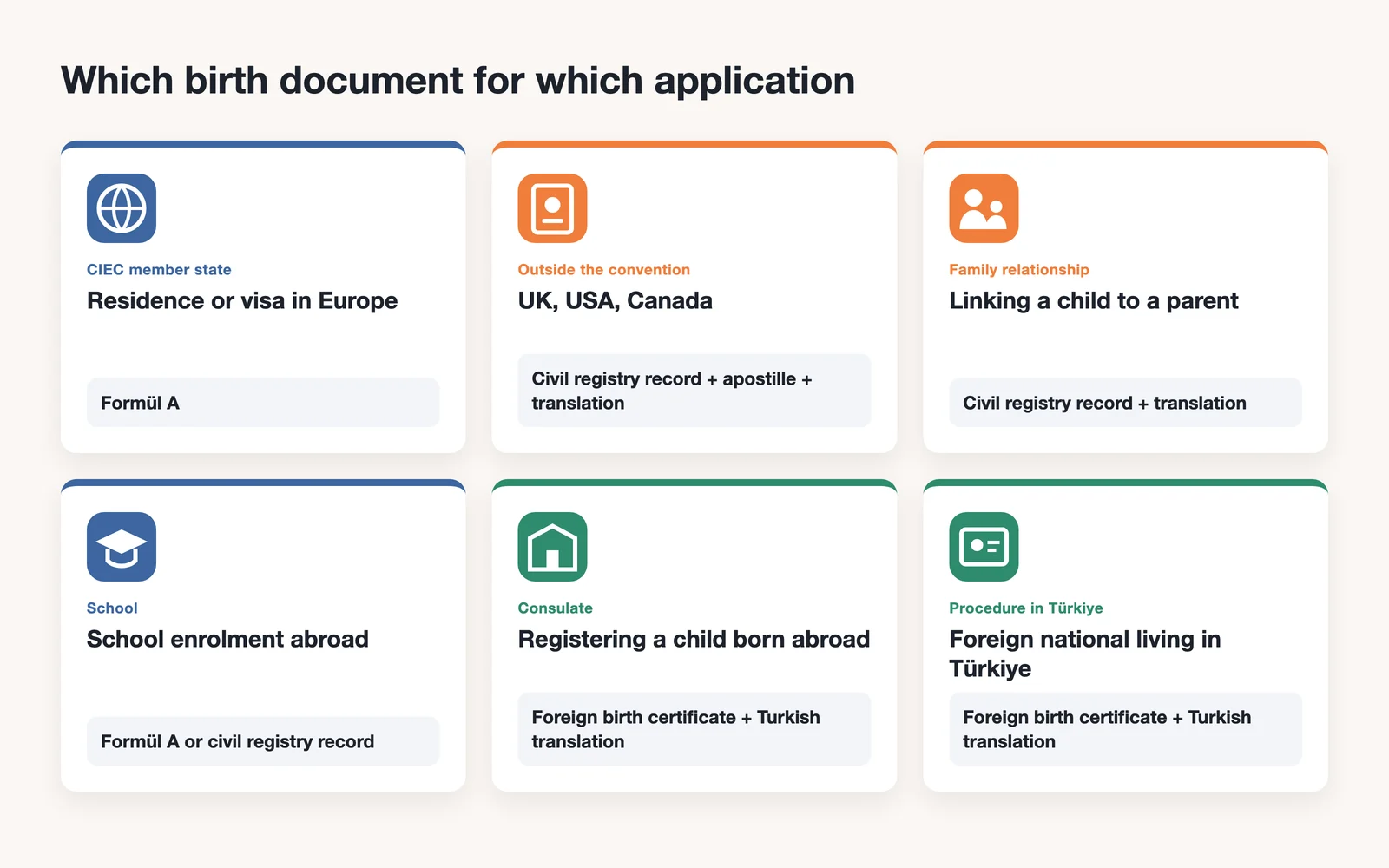
What decides it is the format the receiving country recognises. The table below sums up the most common situations.
Situation | Usual document | Translation |
|---|---|---|
Application in a CIEC member state in Europe | Formül A | Often not needed |
Application in the UK, USA or Canada | Civil registry record | Sworn translation, often with an apostille |
Proving the parent–child relationship | Civil registry record | Sworn translation |
Visa application at a consulate | The document on the consulate's list | Translation into the country's language |
The contracting states include Austria, Belgium, France, Germany, Italy, the Netherlands, Poland, Portugal, Spain and Switzerland. Under Article 8 of the convention, these extracts are accepted in member states without legalisation or any similar formality. You can see the current list on the CIEC website.
Countries outside the convention, such as the UK, the USA or Canada, do not treat Formül A as a special format. There, the usual route is an apostilled civil registry record with a sworn translation. The registry record is also the better choice whenever an office wants the parents' details shown clearly.
How a birth certificate translation is prepared
If the document is going to a country outside the CIEC convention, or the office wants a text in its own language, the translation is prepared in this order:
- 1
Get the document: download the civil registry record or Formül A from e-Devlet with its barcode, or collect it from a civil registry office.
- 2
Apostille: in Türkiye, governorships (valilik) and district governorships (kaymakamlık) apostille administrative documents. An apostille is only valid in countries that are party to the Hague Apostille Convention.
- 3
Sworn translation: the document is translated into the target language together with the apostille. The barcode and verification details on the document are noted in the translation too.
- 4
Notarisation: a notary certifies the sworn translator's signature. This step is often requested for translations used abroad.
- 5
Apostille on the translation if needed: some countries also want an apostille on the notarised translation. Languvi completes this step in the same order.
In countries outside the Apostille Convention, consular legalisation replaces the apostille. On Languvi, sworn translation, notarisation, apostille and consular legalisation are handled on one platform. Official documents are delivered with the sworn translator's stamp and signature.
Details a good translation gets right
Names and places of birth are spelled exactly as they appear in the Latin-script passport.
The mother's and father's names are carried over exactly as written on the document.
Dates as well as volume, household and entry numbers are kept unchanged.
Seals, signatures, barcodes and the apostille are described in the translation.
Turkish letters (ç, ğ, ı, ö, ş, ü) cause the most confusion. If the passport says "Ozturk", the translation uses the same spelling. That way the reviewing officer can see at a glance that both documents refer to the same person.
Birth certificate translation for a child born abroad
Sometimes the translation runs the other way. To register a child born abroad in the Turkish population register, the consulate usually asks for the birth certificate issued by the country of birth. If that document is not in Turkish, a Turkish translation goes into the file; some consulates also expect the certificate to carry an apostille.
The same applies to foreign nationals living in Türkiye. A residence permit, school enrolment or a marriage in Türkiye often calls for a Turkish translation of the foreign birth certificate. Our guide to getting married in Türkiye as a foreigner explains the documents for that case.
Languvi prepares these translations into Turkish through its sworn translators as well. If the birth certificate was issued abroad, uploading a scan of it is enough to get started. For legal questions about citizenship or parentage, it is best to consult a lawyer.
Frequently Asked Questions
Does Formül A need to be translated?
Formül A is designed to be read in CIEC member states without a translation. In other countries, or when an office asks for one, a sworn translation is prepared. Languvi translates it into the language of the receiving country.
Can a civil registry record from e-Devlet be translated?
Yes, a barcoded e-Devlet document is suitable for translation. If an apostille is needed, it is applied to the document itself, and the translation then covers the apostille too. Uploading a scan of the apostilled document is enough.
Which languages can a birth certificate be translated into?
Languvi translates in more than 180 languages. Besides the most requested ones, such as English, German or French, less common languages are covered too. Every document goes to a translator who knows the subject and is checked before delivery.
I live abroad. How do I get the translation done?
Upload your document on the order page. The notarised translation is prepared in Türkiye and delivered through your account, the mobile app, e-mail or WhatsApp. When a signed and stamped original is needed, it is sent by courier.
My baby's birth has just been registered. Which document should I translate?
Once the birth is entered in the register, both Formül A and the civil registry record are available from e-Devlet. For a CIEC member state, Formül A is often enough on its own. For other countries, a sworn translation of the civil registry record is prepared, and you can follow your order on the order tracking page.
Conclusion: Türkiye has no single birth certificate; abroad, Formül A or the civil registry record is normally used. In CIEC member states Formül A is often enough on its own. Elsewhere, an apostilled document with a sworn, notarised translation is the usual requirement. Upload your document on our order page to see the price and delivery date within seconds.