
Divorce decree translation comes up in two situations. The first is when a divorce granted in Türkiye has to be used abroad. The second is when you divorced abroad, yet the Turkish civil registry still lists you as married. Either way, the authority wants three things: a final decree, the right official certification, and an accurate translation.
For Turkish decrees, the finality annotation and the apostille matter most. Foreign decrees, on the other hand, can since 2017 be entered in the Turkish civil registry without a court case, through a population directorate or a Turkish consulate, provided they meet the conditions. Custody, maintenance and property orders follow a separate route.
Below we walk through both directions and show, with a sample decree, what a good translation has to cover.
When do you need a divorce decree translation?
You need one whenever you have to prove your marital status abroad or to the Turkish civil registry. The most common cases:
You divorced in Türkiye and plan to remarry abroad or change your surname there.
You need to prove the divorce in a residence permit, family reunification, visa or citizenship application.
You divorced abroad and want the divorce recorded in the Turkish civil registry.
A foreign decree contains custody, maintenance or property orders that need to take effect in Türkiye.
The document is always a court decision, but the chain of certification depends on which way it travels. The table below sets the two directions side by side.
Situation | Decree submitted | Official certification | Translation |
|---|---|---|---|
Turkish decree used abroad | Certified copy with the finality annotation | Apostille or consular legalisation in Türkiye | Sworn translation into the target language; notarisation and apostille where required |
Foreign decree used in Türkiye | Final decree, or a separate proof of finality | Apostille or consular legalisation in the issuing country | Turkish translation, notarised, certified by a Turkish mission or apostilled |
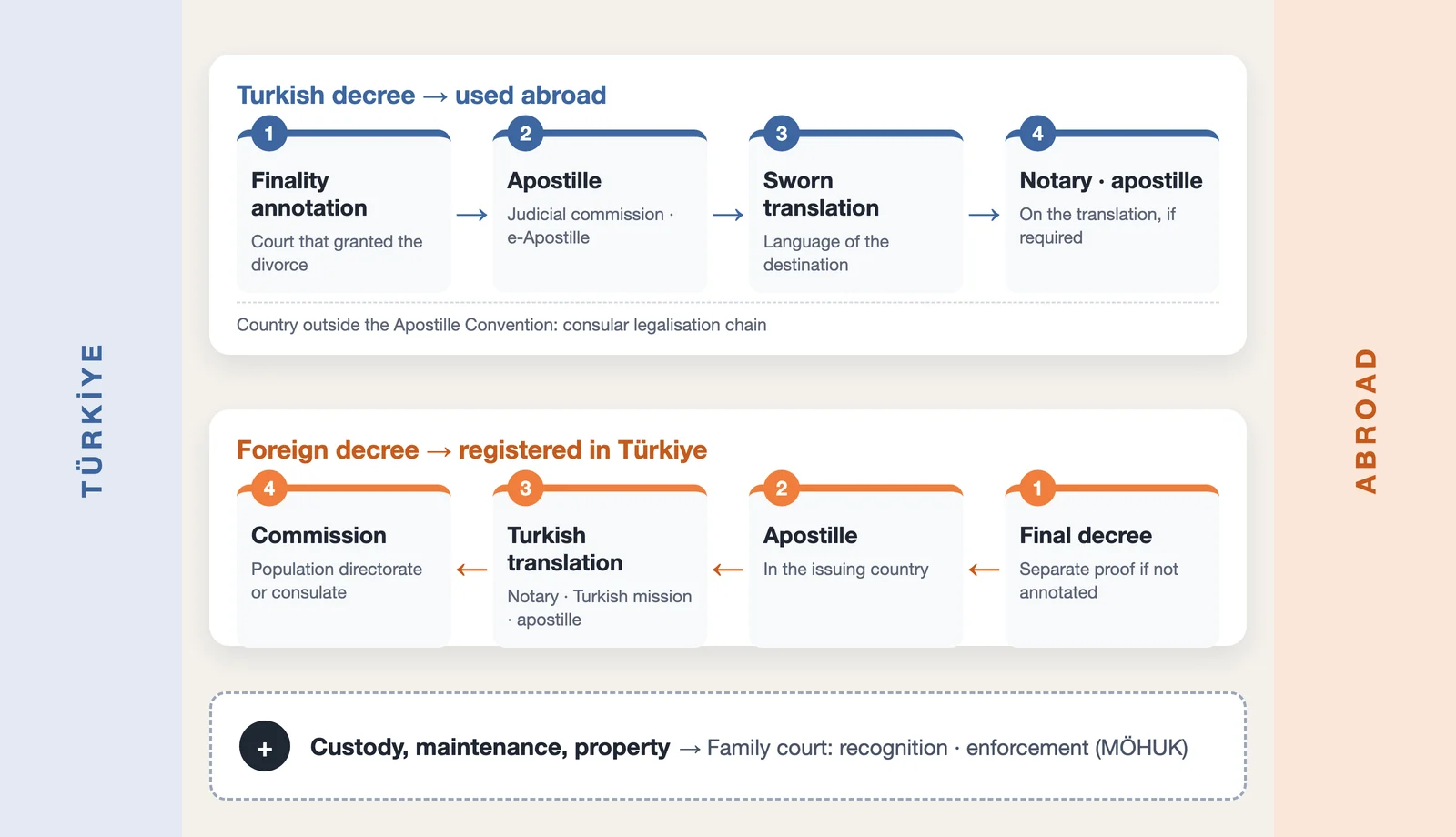
Using a Turkish divorce decree abroad
The finality annotation (kesinleşme şerhi)
A Turkish divorce decree does not become final on the day it is announced. Once the appeal routes are closed, the court adds an annotation stating that the decision is final. Foreign authorities look for it, as do apostille offices.
You obtain a certified copy bearing the finality annotation from the court that granted the divorce. The Turkish Ministry of Justice's e-Apostille guide lists a "non-final decision" among the reasons an apostille request is rejected. So before you send the decree for translation, make sure your copy carries the annotation.
Apostille or consular legalisation
In Türkiye, apostilles for court decisions are issued by the judicial commissions at courthouses that host a high criminal court. (see the Hague Conference's list of Türkiye's competent authorities). Electronically signed decisions can be submitted for an e-Apostille through PTT, the Turkish postal service; paper decisions are taken to the commission in person. Our guide on where to get an apostille in Türkiye covers the details.
If the decree is going to a country outside the Apostille Convention, consular legalisation replaces the apostille. In that chain the notary, the governorship, the Ministry of Foreign Affairs and the destination country's consulate certify the document in turn.
The translation
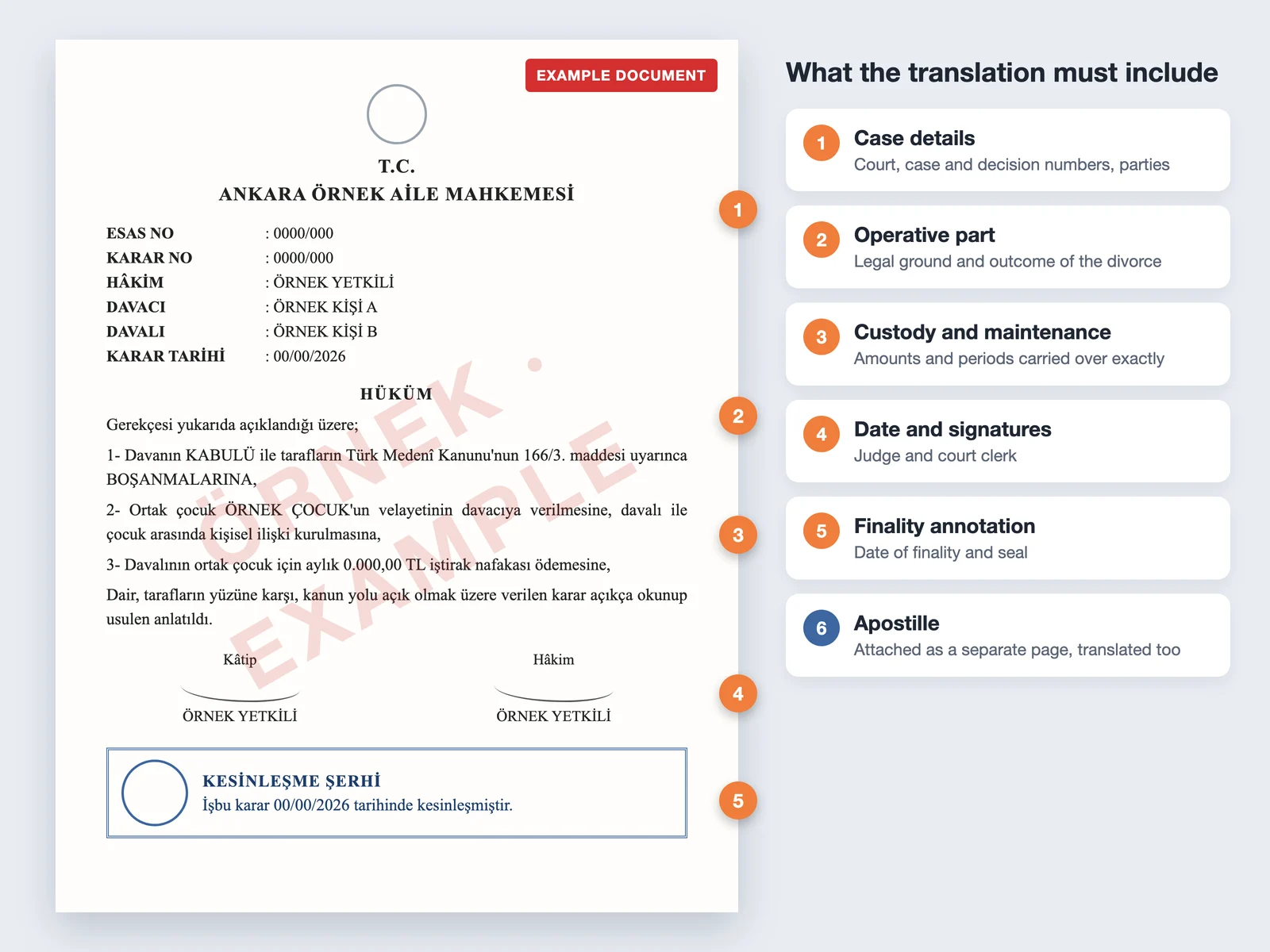
The foreign authority will want a sworn translation into its own language. It covers the parties, the operative part of the judgment, any custody or maintenance orders, plus the finality annotation. The apostille page is part of the document, so it is translated with it.
Some countries ask for the translation to be notarised, while others also want an apostille on the translation itself. Languvi prepares every one of these steps in a single order, so the sworn translation, the notarisation and the apostille move forward in one file.
Registering a foreign divorce in Türkiye
If you divorced abroad, your Turkish record does not update itself. Article 27/A of the Population Services Law No. 5490 allows such decisions to be entered in the civil registry without going to court. The law sets these conditions:
Both former spouses must apply. They may apply together, or separately no more than 90 days apart.
If the former spouse is a foreign national or has died, the Turkish citizen may apply alone.
The decision must come from a competent authority and be final under the law of the country that issued it.
It must not be clearly contrary to Turkish public order.
No case about the same decision may be pending, or already rejected, in a Turkish court.
Where to apply
You can apply to the Turkish embassy or consulate general in the country where the divorce was granted. In Türkiye, you apply to the provincial population and citizenship directorate where either party lives. For applicants with no address in Türkiye, the regulation lists 18 provincial directorates, including Istanbul, Ankara and İzmir.
A commission reviews each application. Once it approves, the divorce is entered in the family register.
Which documents are required?
Article 7 of the regulation on registering foreign decisions lists the following:
- 1
The application form.
- 2
The original decree, duly certified, with its Turkish translation.
- 3
If the decree has no finality annotation, a certified document proving it is final (in the US, for example, a Notice of Entry or a Letter of No Appeal) with its Turkish translation.
- 4
Copies of identity cards or passports; for a foreign spouse, a notarised Turkish translation of their identity card or passport.
- 5
For applications through a representative, a special power of attorney with a photo, issued by a notary.
The apostille or consular legalisation on the original decree is obtained in the country that issued it. For the Turkish translation, the regulation accepts three options: a translation notarised by a Turkish notary, one certified by a Turkish mission, or one apostilled by the issuing country's competent authority. If you are applying to a population directorate in Türkiye, a notarised translation is the practical choice.
Custody, maintenance and property: recognition and enforcement
Administrative registration records only the divorce itself. The regulation states plainly that custody, child maintenance, contact arrangements, matrimonial property and compensation orders have no effect through this route. For those, a case is brought before the family court under Law No. 5718 on Private International Law and International Civil Procedure (MÖHUK).
Recognition means the foreign judgment is accepted in Türkiye as final and binding. Enforcement goes one step further, making it possible to enforce the judgment, for example to collect maintenance through Turkish enforcement offices. The same court route is open if the commission refuses to register the divorce.
Under MÖHUK, the petition must include the certified decree and the proof of finality, each with a certified translation. Ask a lawyer how this applies to your own case; having the translations ready helps your lawyer file a complete case.
What a good divorce decree translation covers
A divorce decree carries more legal terminology than most official documents. A reliable translation gets these right:
Names: The names of the parties and children match the spelling in their passports.
Case details: The court's name, the case and decision numbers, and the decision and finality dates are reproduced exactly.
Legal terms: Concepts such as uncontested or contested divorce, child maintenance and spousal maintenance are rendered with their equivalents in the target legal system.
Annotations and seals: The finality annotation, apostille, seals, signatures and handwritten notes all appear in the translation.
Completeness: The whole decree is translated; most authorities do not accept a translation of the operative part alone.
At Languvi, your decree goes to a translator experienced in legal texts and is checked before delivery. Official documents are delivered with the sworn translator's stamp and signature. Our legal translation team works in more than 180 languages and prepares the decree in the language of the country you are sending it to.
Frequently Asked Questions
Do I need to send the original decree for translation?
A clear scan or photo is enough for the translation. When you apply, the authority will want the certified original, its apostille and the translation together, so keep the apostilled original safe.
Can a civil registry extract replace the divorce decree?
A civil registry extract shows that you are divorced, but not what the decree says. Details such as custody, maintenance or the date of finality appear only in the decree. If an authority asks for the decree, you need its translation; the two documents are often submitted together.
I divorced abroad but still appear as married in Türkiye. What should I do?
You need to have the decree registered in the Turkish civil registry. You can apply to the Turkish consulate in the country that granted the divorce, or to a provincial population and citizenship directorate in Türkiye. The core of the application is the apostilled original decree with its Turkish translation.
Can the divorce be registered if my former spouse won't take part?
The rule is that both parties apply, although they can do so separately, up to 90 days apart. If your former spouse is a foreign national or has died, the Turkish citizen can apply alone. If both of you are Turkish citizens and one will not apply, speak to a lawyer about a recognition case.
Should the translation be done abroad or in Türkiye?
The regulation accepts a Turkish translation that is notarised, certified by a Turkish mission or apostilled. If you are applying to a population directorate in Türkiye, having a sworn translator prepare it in Türkiye with notarisation is a practical route. You upload the decree from abroad; the notarised translation is prepared in Türkiye and sent by courier to the address you choose.
Will custody and maintenance orders take effect once the divorce is registered?
Registration records only the divorce. Custody, maintenance and property orders need a recognition or enforcement case under MÖHUK. That case requires certified translations of the decree and of the proof of finality.
Conclusion: The right route for a divorce decree translation depends on which way the decree is travelling. A Turkish decree goes abroad with its finality annotation and an apostille, while a foreign decree is filed with a population directorate or consulate as an apostilled original with a Turkish translation. Languvi handles the sworn translation, notarisation, apostille and consular steps on one platform. Upload your decree on our order page to see the price and delivery date within seconds.