
Court decision translation comes up whenever a judgment given in Türkiye has to be shown to an authority, a bank or a court in another country. It may be an inheritance, a custody order, an adoption, a change of name or a money judgment; in every case the receiving office looks for the same three things: a final decision, official certification of that decision, and a complete translation.
A court decision is not an ordinary official document. Its legal terms have to be rendered with their equivalents in the target legal system. The annotations, seals and handwritten notes on the page are part of the text too.
This guide walks through the parts of a Turkish decision, the annotation of finality and the apostille. It also shows how seals and stamps are translated.
When is a court decision translation needed?
Authorities abroad ask for a translation when they rely on the outcome of a Turkish case. The most common kinds of decision are:
Inheritance: proving that you are an heir to a bank account, a property or an insurance policy abroad.
Custody, guardianship, adoption: moving abroad with a child, enrolling them at school or applying for a passport.
Change of name or surname: getting the new name onto records in another country.
Debt, damages, commercial disputes: having a judgment recognised or enforced in another country.
Criminal cases: showing how a case ended in a visa, residence or citizenship file.
Divorce has its own guide: our article on divorce decree translation also covers registering a foreign divorce in Türkiye. The table below shows which document you need at each stage.
Stage | Issued by | What it does |
|---|---|---|
Certified copy of the decision | The court that gave it | The official copy of the judgment |
Annotation of finality | The first-instance court | Shows the decision can no longer be appealed |
Apostille or consular legalisation | Judicial commission, or the legalisation chain | Makes the decision an official document abroad |
Sworn translation | A sworn translator | Puts the decision into the target language; notarised and apostilled if required |
What does a Turkish court decision contain?
The structure of a Turkish judgment is set by law. Under Article 297 of the Code of Civil Procedure, a judgment is given "in the name of the Turkish Nation" and then sets out:
- 1
The court, with the names and registry numbers of the judge and the court clerk.
- 2
The parties and their identity numbers, plus the names and addresses of any counsel.
- 3
A summary of the claim and the defence, the evidence and the reasoning.
- 4
The operative part, with a numbered ruling on each request.
- 5
The costs, the available appeal route and its time limit.
- 6
The date, with the signatures of the judge and the clerk.
Every part appears in the translation. Most authorities will not accept the operative part alone, because the reasoning explains the ruling.
The annotation of finality
A decision is not final on the day the judge announces it. Under the Code of Civil Procedure, a party has two weeks from service of the reasoned decision to appeal to the regional court of appeal. Where a further appeal to the Court of Cassation is available, another two-week period runs from service of the appeal decision.
Once the appeal routes are closed, Article 302 requires finality to be written under or on the back of the decision. The court adds the date with its seal; the judge then signs. If the decision went through appeal, the first-instance court still makes this record.
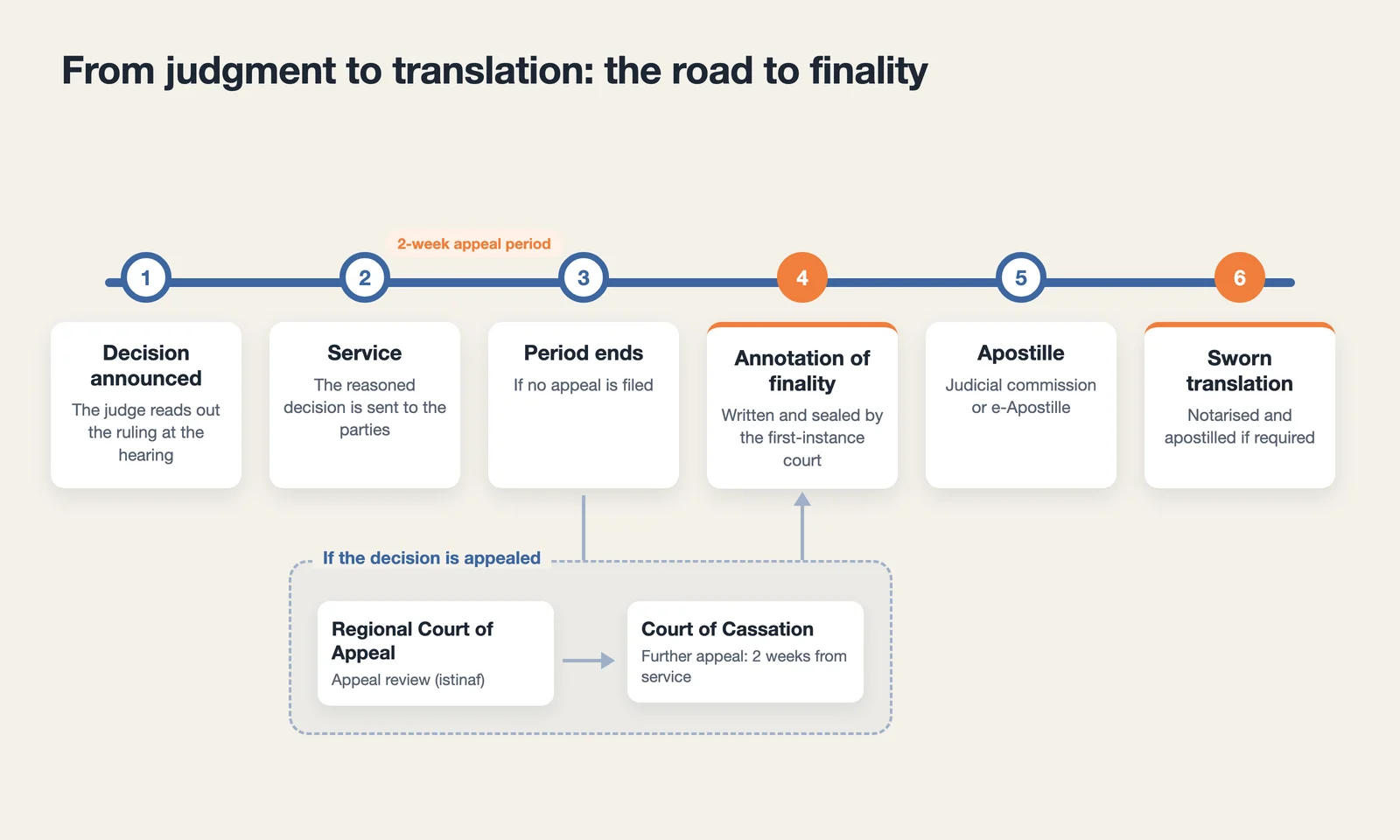
Authorities abroad want to see that the decision is final. The Ministry of Justice's e-Apostille guide also lists a decision that is not yet final among the reasons an apostille application is refused. Translating the certified copy that already carries the annotation saves you from having the same decision translated twice.
How to get an apostille on a court decision
In Türkiye, apostilles on judicial documents are issued by the presidencies of the judicial commissions in towns that have a high criminal court. The Hague Conference lists this on its page of Turkish competent authorities. Decisions signed electronically can also be apostilled through the e-Apostille service at PTT.
If the decision will be used in a country outside the Apostille Convention, the consular legalisation chain replaces the apostille. Our guide on where to get an apostille in Türkiye covers the application in detail.
The apostille is attached to the original decision and becomes part of it, so the translation covers the apostille page as well. If the receiving office wants the translation itself certified, the sworn translation is notarised and then apostilled in turn. Languvi handles all of these steps in a single order.
Why legal terminology matters
A legal term translated word for word can mean something different in another legal system. "Davalı" may be a defendant or a respondent depending on the kind of case. "İstinaf" and "temyiz" are two separate appeal stages; translating both simply as "appeal" hides which court the decision has already been through.
The table shows common English equivalents for the terms that appear most often:
Turkish term | English equivalent | Note |
|---|---|---|
Esas No / Karar No | Docket No. / Decision No. | Numbers are copied exactly |
Davacı / Davalı | Claimant / Defendant | Family cases often use Petitioner / Respondent |
Hüküm fıkrası | Operative part | The ruling itself |
İstinaf | Appeal to the Regional Court of Appeal | Second-instance review |
Temyiz | Appeal to the Court of Cassation | Review by the Yargıtay |
Kesinleşme şerhi | Annotation of finality | Confirms the decision is final |
Yargılama giderleri | Costs of proceedings | Amounts are copied exactly |
Consistency matters as much as accuracy. A term keeps the same equivalent throughout the decision, and names follow the spelling in the passport. At Languvi, your court decision goes to a translator experienced in legal texts and is checked before delivery.
How seals, signatures and annotations are translated
A decision carries information beyond its typed text. A sworn translation leaves none of it out; each mark is shown in a translator's note in square brackets:
Seals: legible wording inside a seal is translated, for example [Seal: Ankara Example Civil Court of First Instance].
Signatures: the position of each signature is marked [Signature], with the printed name below it copied as written.
Handwritten notes and stamps: certifications such as "Aslı gibidir" (true copy of the original) are translated; anything unreadable is marked [illegible].
Electronic signatures: decisions printed from UYAP, the Turkish judiciary's online system, carry a note that the document was signed with a secure electronic signature, plus a verification code. The note is translated; the code is copied exactly.
Apostille: every field on the apostille page is translated, including its number and date.
The UYAP citizen portal can verify a printed copy with this code, which is why it is kept intact.
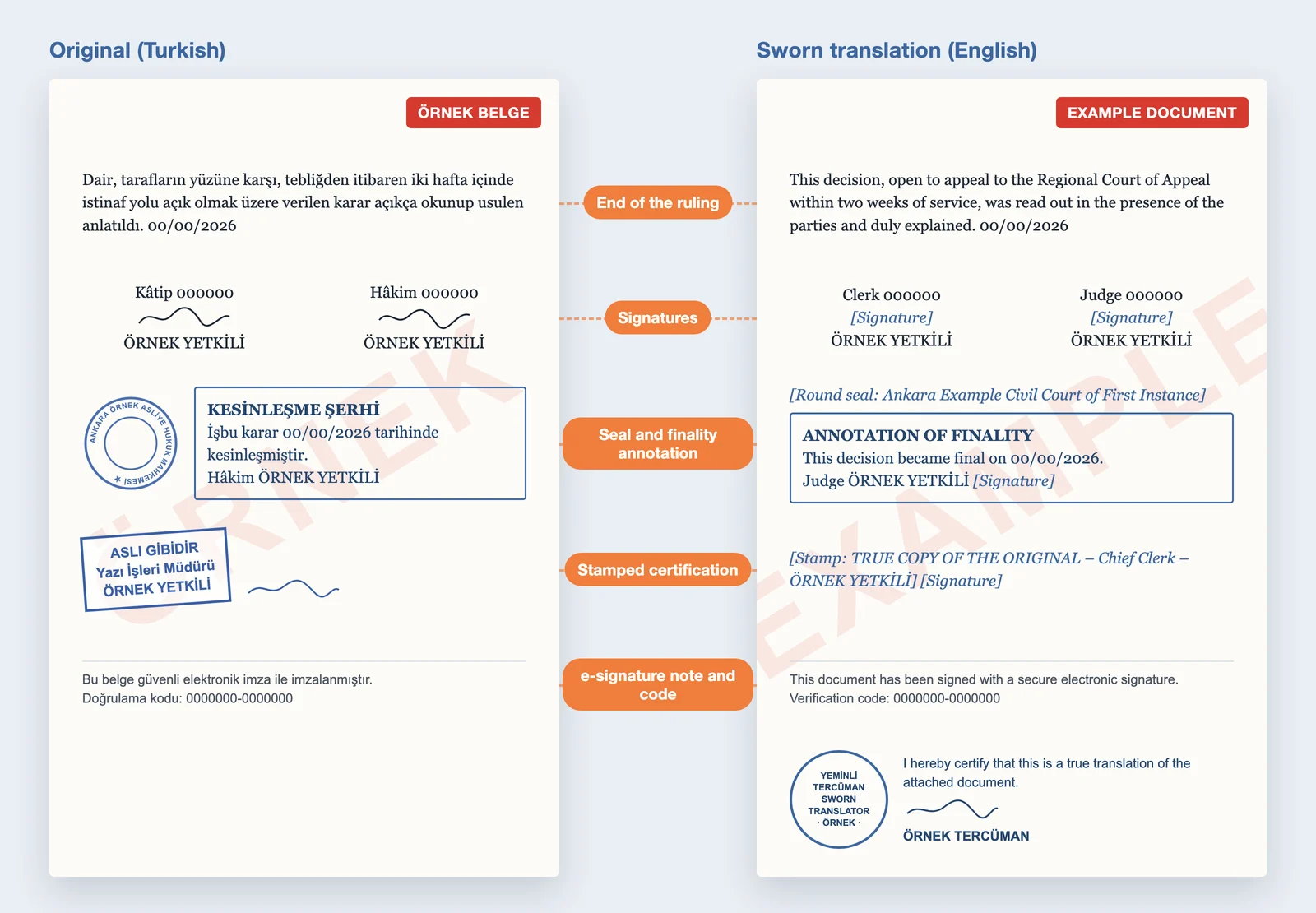
Official documents are delivered with the sworn translator's stamp and signature. Our legal translation team works in more than 180 languages and prepares your decision in the language of the country where you will use it.
Using a foreign court decision in Türkiye
Translation is needed in the other direction too. For a foreign judgment to have effect in Türkiye, a recognition or enforcement case is usually filed. Under the Turkish Code on Private International Law and International Civil Procedure, the petition must include the certified original decision with a certified translation.
A certified document showing that the decision is final is submitted with its certified translation as well. The apostille on the original is obtained in the country where the decision was given. Speak to a lawyer about your own case; having the translations ready makes a complete filing easier.
Frequently Asked Questions
Can I have only the operative part translated?
Most authorities ask for the full decision, because the reasoning explains why the ruling was made. A translation of the operative part alone reads like an extract. The annotation of finality and the apostille are included in the translation too.
Can a decision without an annotation of finality be translated?
It can be translated, but for official use offices look for a final decision. A decision that is not final cannot be apostilled either. Getting the annotated copy first means the decision only needs to be translated once.
Is an e-signed decision downloaded from UYAP enough?
An e-signed decision is an official document; the e-Apostille service exists for exactly these decisions. The translation renders the e-signature note and copies the verification code. Uploading the PDF is all you need to do.
Are seals and handwritten notes translated?
Yes, every mark on the decision is shown in the translation. Legible seal text is translated, while signatures and unreadable parts are marked in the translator's bracketed notes. The reader can see from the translation exactly which certifications appear on the original.
I live abroad. How can I get my Turkish court decision translated?
You upload the decision online. The sworn translation is prepared in Türkiye, then notarised and apostilled if needed. The translation is sent to your account, by e-mail or on WhatsApp. Signed and sealed originals are sent by courier to the address you choose.
Conclusion: The right order for a court decision translation is to get the certified copy with its annotation of finality first, then the apostille, then the translation. Legal terms are rendered with their equivalents in the target legal system, while every seal, annotation or signature is shown in full. Languvi handles the sworn translation, notarisation and apostille steps on one platform. Upload your decision on our order page to see the price and delivery date within seconds.