Translating documents for Sweden comes up in a residence permit, a work permit, university admission, a diploma evaluation, population registration or citizenship. What sets Sweden apart from many other countries is the choice of language: in most applications, Swedish authorities accept translations of documents in Turkish into Swedish or English. That makes an English translation a common route for Swedish applications.
This guide maps out the whole picture. It covers which office asks for which documents, how translations are submitted, and when notary approval or an apostille is added. It also explains how Languvi prepares a translation by a translator authorised in Sweden (auktoriserad translator) when an application asks for one.
Which language for translating documents for Sweden?
The Swedish Migration Agency, Migrationsverket, asks for documents in applications to be in Swedish or English. According to Migrationsverket's page on living with a partner in Sweden, documents in other languages are submitted with certified translations. A copy of the document in its original language goes with the translation.
Since both languages are accepted, the choice is yours. If you will submit the same document to Migrationsverket and to a university, an English translation makes things easier. On Languvi you choose the language in the order form, and your document is translated into it by a sworn translator.
Which office asks for which documents?
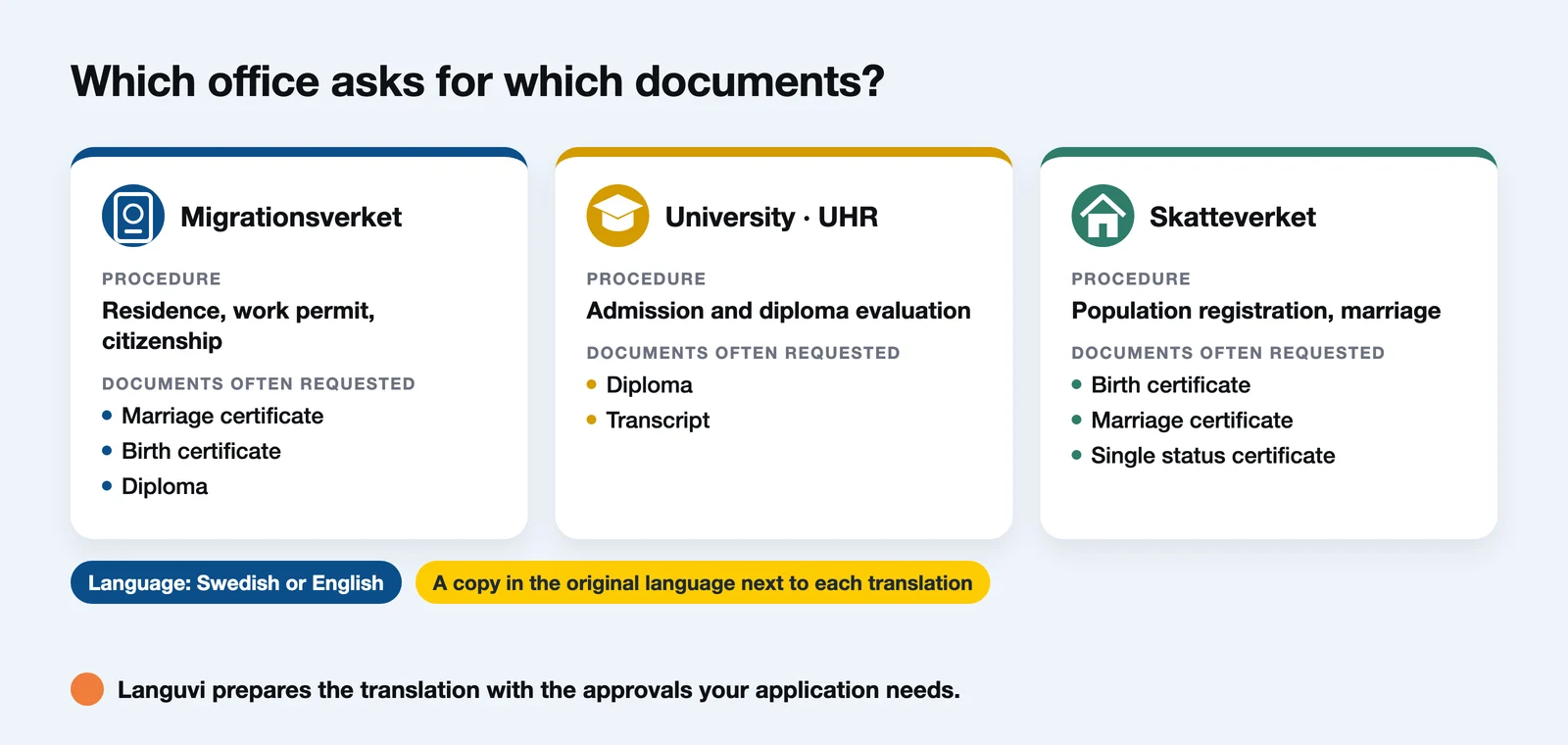
In Sweden, the office that asks for documents depends on the application. The three you meet most often are Migrationsverket, UHR and Skatteverket.
Residence and work permits (Migrationsverket)
People joining a spouse or family in Sweden provide documents that show the family tie. The marriage certificate and birth certificates are translated most often for these applications. Work permit applications often ask for a diploma and letters confirming work experience.
Applications are usually made online on Migrationsverket's website. The documents are uploaded to the application with their translations. You then visit a Swedish mission for the identity check.
University admission and diploma evaluation (UHR)
Swedish universities ask for certified English or Swedish translations of the diploma and the transcript. The Swedish Council for Higher Education, UHR, evaluates what a foreign diploma corresponds to in Sweden. Our transcript translation guide explains how course titles, credits and grades are handled.
Population registration and marriage (Skatteverket)
People who settle in Sweden register with the Swedish Tax Agency, Skatteverket (folkbokföring). This registration, or marrying in Sweden, often asks for a birth certificate, a marriage certificate or a single status certificate.
Citizenship
Swedish citizenship applications ask for documents that show your identity and family situation. Migrationsverket handles the application.
After living in Sweden for some time, you can apply for citizenship. The documents asked for at this stage largely overlap with those you submitted for the residence permit. Keeping the translations you prepared for the residence permit therefore makes later applications easier.
Office | Procedure | Documents often requested |
|---|---|---|
Migrationsverket | Residence permit, work permit, citizenship | Marriage certificate, birth certificate, diploma |
Universities and UHR | Admission and diploma evaluation | Diploma, transcript |
Skatteverket | Population registration, marriage | Birth certificate, marriage certificate, single status certificate |
When are notary approval and an apostille needed?
Türkiye and Sweden are both parties to the Apostille Convention. Official documents issued in Türkiye can therefore be used in Sweden with an apostille.
The type of application decides which approvals a Swedish application asks for. For Migrationsverket, what matters most is a certified translation together with a copy of the original document. If your application asks for notary approval and an apostille, you add these steps to the order. Languvi then prepares the translation with them.
In Sweden, translators are authorised by Kammarkollegiet. If your application asks for a translation by a translator authorised in Sweden, Languvi prepares it through its authorised translators; just write to us through the contact form.
Swedish missions in Türkiye
Sweden has an embassy in Ankara and a consulate general in Istanbul. After an online application to Migrationsverket, the identity check and the interview take place at these missions. Bringing the originals together with their translations to the interview is good preparation.
Languvi prepares your translation to match the type of application. Stating in your order which office the document goes to makes sure the translation arrives in the right language with the right approvals.
Preparing the documents step by step
Preparing documents for a Swedish application usually runs in this order:
- 1
Decide which office the application goes to: Migrationsverket, a university, UHR or Skatteverket.
- 2
Get the document list and a recent copy of each document.
- 3
Upload the documents to Languvi and choose Swedish or English as the translation language.
- 4
If your application asks for them, add notary approval and an apostille to the order.
- 5
Upload the translations to your application together with a copy of each original.
This order saves you from getting the same document twice. In online applications, uploading each document in the same file as its translation keeps the application complete.
Checks before you apply
Swedish applications are most often delayed by a missing copy or the wrong language. Keep these points in mind:
Remember to add a copy of the original document next to its translation.
For a Migrationsverket application, an English translation is a common choice.
Make sure the translation is certified; a sworn translation meets this requirement.
Keep the spelling of your name identical to your passport, so every translation uses it.
In online applications, upload clear scans of your documents.
Frequently Asked Questions
Do translations for Sweden need an apostille?
The type of application decides. For Migrationsverket, what matters most is a certified translation with a copy of the original. If your application asks for notary approval and an apostille, Languvi prepares the translation with them.
Can my documents be translated into English?
Yes. Migrationsverket asks for documents in Swedish or English, which is why English translations are common. You choose the translation language in the order form.
Which documents are translated for a residence permit based on family ties?
The marriage certificate and birth certificates are translated most often. If the list names another document, it needs translating too; you can add it to the same order.
Why is a copy of the original added to the translation?
Migrationsverket asks for the translation together with a copy of the document in its original language. That way the file clearly shows which document the translation belongs to. In an online application, just upload the two files side by side.
Do you also prepare translations by an auktoriserad translator?
Yes. If your application asks for a translation by a translator authorised in Sweden, Languvi prepares it through its authorised translators. Just write to us through the contact form.
Can documents from Sweden be translated into Turkish?
Yes. Documents issued in Sweden can be translated into Turkish for use in Türkiye. A notary approval can be added to these translations when it is needed.
Conclusion: Two choices decide how to go about translating documents for Sweden: the language of the translation and the approvals your application needs. Migrationsverket accepts Swedish or English translations, with a copy of the original document next to each one. On Languvi you upload your document, choose a sworn Swedish or English translation, and add notary approval or an apostille when needed. See our page on Swedish translation with apostille for Sweden, or upload your document now on the order page.