Translating documents for Italy comes up in almost every Italian procedure, from a visa or university enrolment to the recognition of a degree or a residence permit in Italy. Italian authorities usually want documents from Türkiye translated into Italian and formally approved. What sets Italy apart is the order of the approvals: in many procedures, an apostille goes on the original and on the translation as well.
This guide maps out the whole picture. It covers which documents are translated for which application, plus what the Dichiarazione di Valore and the CIMEA statement are for. It also explains the order of the translation, the notary approval and the apostilles. If you are preparing a student visa, the same rules apply, with the visa office's own checklist on top.
Where translating documents for Italy comes in
Applications for Italy go to the Italian missions in Türkiye, to Italian universities or to public offices in Italy. Each has its own document list, but the rules on translations and apostilles are largely shared.
Visas at Italian missions
Short-stay Schengen visas and long-stay national visas are applied for at the Italian missions in Türkiye. Tourist or business applications usually involve bank statements, employer letters and the SGK social security record. The missions accept some Turkish documents in English or Turkish, so check their list to see which documents need an Italian translation.
University admission
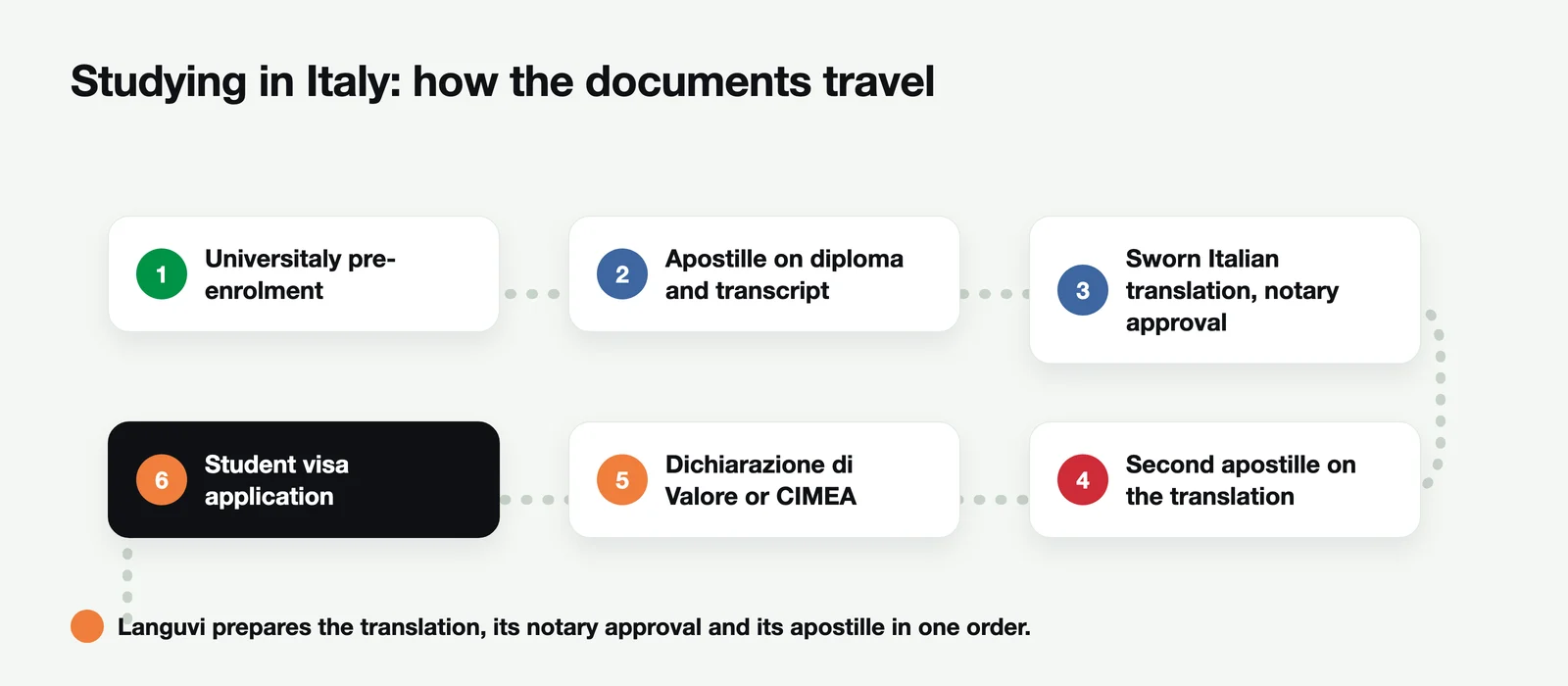
International students usually pre-enrol through the Universitaly portal. The school-leaving diploma, the transcript and, where relevant, university entrance exam results are translated into Italian. To show what the diploma is worth in Italy, a Dichiarazione di Valore or a CIMEA statement is also requested.
Degree recognition and professional recognition
Having a degree from Türkiye recognised in Italy, or getting permission to practise a profession there, involves separate procedures. These usually ask for apostilled Italian translations of the diploma, the transcript and any professional certificates. The competent authority depends on the profession.
Residence permits and citizenship
After moving to Italy, residence permit (permesso di soggiorno) procedures may involve civil records and proof of income. Citizenship applications often ask for an apostilled Italian translation of the birth certificate and the criminal record certificate. These procedures are handled by local authorities in Italy.
Marriage and civil status
Anyone marrying in Italy, or registering a birth or marriage there, may be asked for birth, marriage or single status certificates. Türkiye's multilingual civil status extracts sometimes need no translation. Ask the Italian office that will receive them before you rely on that.
The Dichiarazione di Valore and the CIMEA statement
A Dichiarazione di Valore (DV) is an official document describing what a foreign qualification means in the country that issued it. It is issued by the Italian mission in that country. A DV does not state which Italian degree your qualification equals; the university or office uses it to make its own assessment.
CIMEA is Italy's centre for academic recognition. Its statements of comparability and verification are accepted by many universities instead of a DV. The Italian Consulate General in Istanbul also says universities may rely on a CIMEA statement instead of a DV, but students must check with their university that it does.
Dichiarazione di Valore | CIMEA statement | |
|---|---|---|
Issued by | The Italian mission in the country of study | CIMEA in Italy |
What it shows | What the qualification is worth in its own country | A comparison or verification of the qualification |
Used for | Enrolment, recognition, public procedures | Universities and offices that accept it |
Watch out | Needs apostilled, translated documents | Ask your university whether it accepts it |
The order of translation and apostilles
The order of the approvals matters for Italy. According to the Italian Consulate General in Istanbul's guidance on university enrolment, the document is apostilled, translated into Italian, and then apostilled again. Many Italian offices expect a translation built this way. The apostille confirms the signature on the document, while the second apostille lets Italian offices verify the Turkish notary's approval too.
In practice the steps run like this:
- 1
Apostille on the original: the competent authority in Türkiye (the governor's or district governor's office for administrative documents) apostilles the original.
- 2
Sworn Italian translation: a sworn translator translates the document into Italian, including the apostille on it.
- 3
Notary approval: a notary approves the sworn translator's signature.
- 4
Apostille on the translation: the notarised translation is apostilled too.
Some Italian missions can also certify that a translation matches the original if you book an appointment with both documents. Check the page of the mission you are applying to for the route it uses.
Which documents are translated?
The documents translated most often for Italy are:
School-leaving diploma, transcript and university records
Civil registry record and birth certificate
Criminal record certificate
Bank statements, payslips and the SGK social security record
Marriage, divorce and single status documents
Housing documents such as a title deed or tenancy agreement
On a transcript, course titles, credits and grades are carried over in the original table layout. Our transcript translation guide goes into the detail.
Checks before you apply
Applications for Italy are most often delayed by a missing approval. Run through these points while you prepare:
If the translation needs an apostille, add it to your order; Languvi prepares the notary approval and the apostille with the translation.
Keep the spelling of your name identical to your passport, so every translation uses it.
Translate your diploma and transcript in one order, so the details stay consistent.
Make sure documents such as criminal records are recent.
If you need a DV, find out which documents the mission wants before you translate them.
Frequently Asked Questions
Do translations for Italy need an apostille?
In most procedures they do. The original is apostilled, and the notarised Italian translation is then apostilled as well. The receiving office sets the exact requirement.
What is the difference between a Dichiarazione di Valore and a CIMEA statement?
A DV is issued by the Italian mission in the country where you studied. A CIMEA statement comes from Italy's academic recognition centre. Many universities accept a CIMEA statement instead of a DV, so ask yours.
How is the apostille on the original done?
The apostille on the original is done by the district governor's office, the governor's office or the court. Languvi then prepares the translation, completing its notary approval and apostille in the same order.
Why is the translation apostilled a second time?
A notarised translation counts as an official document issued in Türkiye. For Italy to accept it, the notary's signature is confirmed with an apostille as well. That way both the original and its translation can be accepted by Italian offices.
Is an English translation accepted?
Some universities and missions accept certain documents in English. Public offices in Italy usually ask for Italian. Languvi prepares both Italian and English translations; just choose the language in your order.
Can documents from Italy be translated into Turkish too?
Yes. Documents issued in Italy can be translated into Turkish for use in Türkiye. A notary approval can be added to these translations when it is needed.
Conclusion: The key to translating documents for Italy is completing the approvals in the right order. In most procedures the original is apostilled, the document is translated into Italian, and the translation is apostilled again. On Languvi you upload your document, then choose a sworn Italian translation, notary approval or an apostille on one platform. See our page on Italian translation with apostille for Italy, or upload your document now on the order page.