Translating documents for Belgium comes up in a long-stay visa, family reunification, university admission, diploma recognition or citizenship. Belgium has three official languages: French, Dutch and German. The region or municipality where you apply decides which language your documents go into. So in Belgium, the right language depends on where the document is going.
This guide maps out the whole picture. It covers how the region decides the language, which documents are translated for which application, and where notary approval or the apostille goes. It also explains how Languvi prepares a translation by a sworn translator in Belgium (traducteur juré or beëdigd vertaler) when an application asks for one.
Which language for translating documents for Belgium?
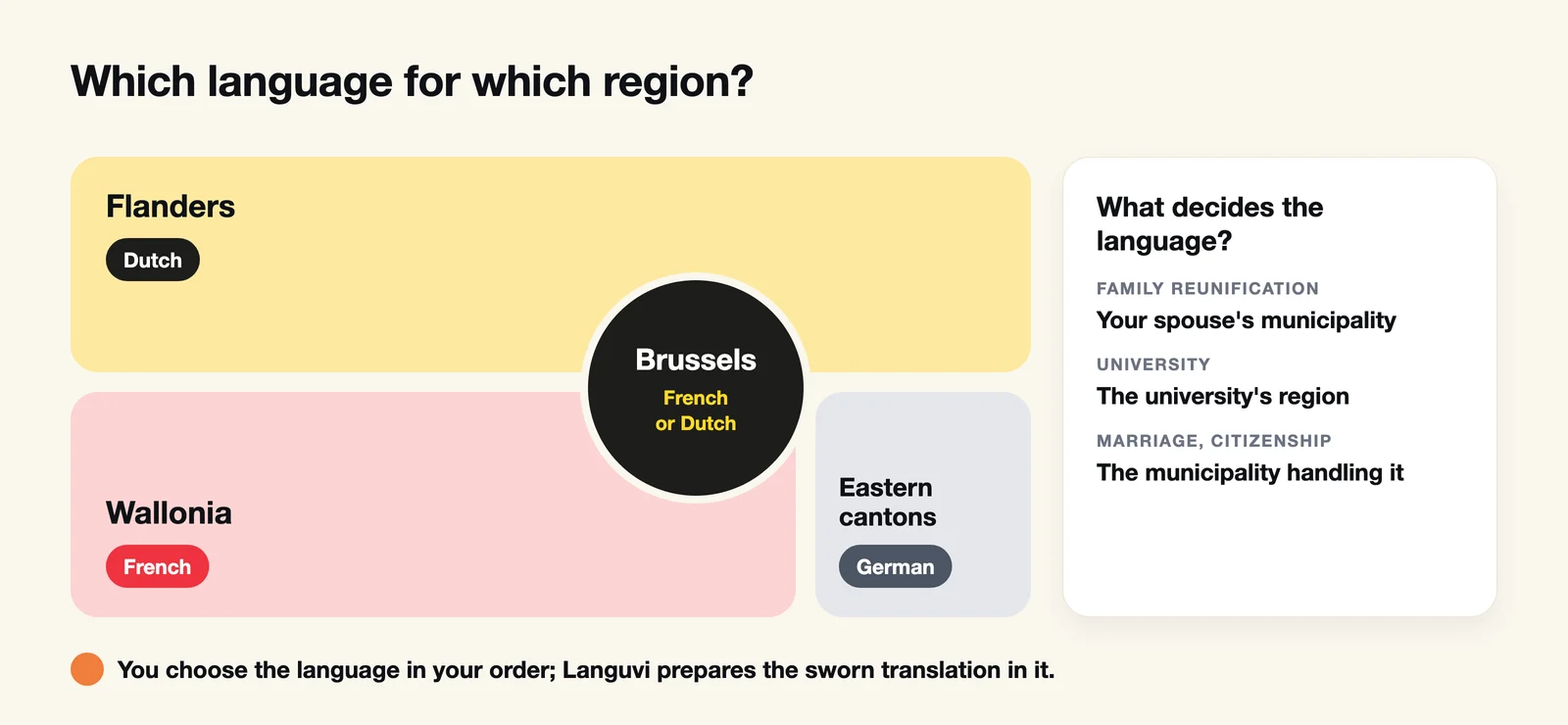
According to the Belgian Foreign Affairs page on legalising documents, documents in a foreign language that will be used in Belgium are translated into one of the country's official languages. Which one depends on the region:
Flanders: Dutch
Wallonia: French
Brussels: French or Dutch
The eastern cantons: German
The simplest way to choose is to think of the city where you will live or study. For family reunification, it is your spouse's municipality; for university admission, it is the university's region. On Languvi you choose the language in the order form, and your document is translated into it by a sworn translator.
Which applications need a translation?
Applications for Belgium are made at the Belgian missions in Türkiye or with municipalities and offices in Belgium. Each has its own document list.
Long-stay visa (Visa D)
People moving to Belgium to study or work apply for a type D visa. These applications often ask for a criminal record certificate and civil registry documents. The documents go to the visa centres authorised by the Belgian missions in Türkiye.
Family reunification (regroupement familial)
People joining a spouse or family in Belgium provide documents that show the family tie. The marriage certificate, the birth certificate and the criminal record certificate are translated most often. Apostilles on these documents matter for the file to be accepted.
University admission and diploma recognition
Belgian universities ask for the school-leaving diploma, the university diploma and the transcript. Diploma recognition is handled by NARIC Fédération Wallonie-Bruxelles in the French-speaking community and by NARIC-Vlaanderen in Flanders. Our guide on how to get a diploma translated explains the details.
Citizenship and marriage
Becoming a Belgian citizen or marrying in Belgium often asks for a birth certificate, the civil registry record and a single status certificate. Municipalities handle these procedures.
Application | Documents often requested | Translation language |
|---|---|---|
Long-stay visa | Criminal record, civil documents | The language of the region you apply to |
Family reunification | Marriage certificate, birth certificate, criminal record | The language of your spouse's municipality |
University and recognition | School-leaving diploma, diploma, transcript | The university's language |
Citizenship and marriage | Birth certificate, single status certificate | The municipality's language |
How the apostille and notary approval work for Belgium
Türkiye and Belgium are both parties to the Apostille Convention. Official documents issued in Türkiye therefore get an apostille on the original, from the district governor's office, the governor's office or the court.
Where the translation is made matters in Belgium too. A translation made abroad must also be approved. In Türkiye, that approval is notary approval followed by an apostille on the translation. An order opened from Languvi's Belgium page comes with both added.
Sworn translators in Belgium are listed with the Belgian courts. If your application asks for a translation by one of them, Languvi prepares it through its authorised translators; just write to us through the contact form.
Belgian missions in Türkiye
Belgium has an embassy in Ankara and a consulate general in Istanbul. Visa applications are received through visa centres authorised by these missions. Family reunification, study and work visas each have their own document list.
Languvi prepares your translation to match these lists. Stating the application type and the city in your order makes sure the translation arrives in the right language with the right approvals.
Preparing the documents step by step
Preparing documents for a Belgian application usually runs in this order:
- 1
Decide which region or municipality the application goes to, and get its document list.
- 2
Get recent copies of documents such as the civil registry record, the criminal record and the diploma.
- 3
Have the originals of official documents apostilled by the district governor's office, the governor's office or the court.
- 4
Upload the documents to Languvi and choose French, Dutch or German as the translation language.
- 5
Keep notary approval and the apostille for the translation in the order.
- 6
Add the translations to your file together with the originals.
This order saves you from getting the same document twice. Getting time-limited documents such as criminal records just before the apostille and translation keeps them current on the day you apply.
Checks before you apply
Belgian applications are most often delayed by the wrong language or a missing approval. Keep these points in mind:
Decide which region the application goes to and choose the translation language to match.
If you apply in Brussels, choose between French and Dutch based on the municipality's language.
Have the apostille put on the original; the translation gets notary approval and an apostille too.
Keep the spelling of your name identical to your passport, so every translation uses it.
Get documents such as criminal records close to the application date.
Frequently Asked Questions
Do translations for Belgium need an apostille?
Most applications do. A translation made in Türkiye is notarised first and then apostilled. An order opened from the Belgium page comes with both added; if your application does not need them, you can remove them.
Which language should my documents be translated into?
The language of the region you apply to: Dutch in Flanders, French in Wallonia, French or Dutch in Brussels, German in the eastern cantons. You choose the language in the order form.
Which documents are translated for family reunification?
The marriage certificate, the birth certificate and the criminal record certificate are translated most often. If the list names another document, it needs translating too; you can add it to the same order.
Which documents are translated for diploma recognition?
The diploma and the transcript are translated most often. Recognition applications use French documents in the French-speaking community and Dutch documents in Flanders. We can translate both documents in one order.
Do you also prepare translations by a sworn translator in Belgium?
Yes. If your application asks for a translation by a sworn translator in Belgium, Languvi prepares it through its authorised translators. Just write to us through the contact form.
Can documents from Belgium be translated into Turkish?
Yes. Documents issued in Belgium can be translated into Turkish for use in Türkiye. A notary approval can be added to these translations when it is needed.
Conclusion: Two choices decide how to go about translating documents for Belgium: the language of the region you apply to and the approval of the translation. The apostille goes on the original. A translation made in Türkiye gets notary approval and an apostille too. On Languvi you upload your document, then complete a sworn French, Dutch or German translation, with notary approval and an apostille, in one order. See our page on sworn translation with apostille for Belgium, or upload your document now on the order page.