
Translating documents for Spain is a core step in many applications, from a tourist visa or a national visa to degree recognition or residence procedures in Spain. Spanish authorities want documents in other languages translated into Spanish by a sworn translator. For official documents, they also look for an apostille or a consular legalisation alongside the translation.
This guide maps out the whole picture. It covers which documents are translated for which application, what a traductor jurado (a Spanish sworn translator) is, and which approvals make a translation made in Türkiye acceptable. It also touches briefly on how Spanish translations are used in Latin American countries.
Where translating documents for Spain comes in
Applications for Spain go to the Spanish missions in Türkiye, to Spanish universities or to public offices in Spain. The document lists differ, but the rules on translations and approvals are largely shared.
Schengen visas
Short-stay visas for tourism, business or family visits are applied for through the visa centres authorised by the Spanish missions in Türkiye. Bank statements, an employer letter, the SGK social security record and the civil registry record are requested most often. Each mission publishes its own current checklist, which always comes first.
National visas
People who want to stay in Spain longer apply for a national visa for study, work, non-lucrative residence or remote work. These applications usually ask for a diploma, a criminal record certificate, proof of income and health insurance. According to the requirements published by the Spanish Consulate General in Istanbul for the remote work visa, documents in other languages must come with a sworn translation into Spanish. Official documents issued by non-Spanish authorities must be duly legalised or apostilled.
The key documents change with the visa type. A student visa centres on the acceptance letter and proof of funds, while a non-lucrative residence visa centres on regular income. A remote work visa adds the employment contract or company documents. Each visa type has its own list on the mission's website.
After arrival: the NIE and the residence card
People who move to Spain on a national visa complete the foreigner identity number (NIE) and residence card steps after arriving. Spanish translations of some documents may be requested at this stage too. Preparing your documents before you leave Türkiye saves you from going back to Turkish offices later for an apostille.
Degree recognition (homologación)
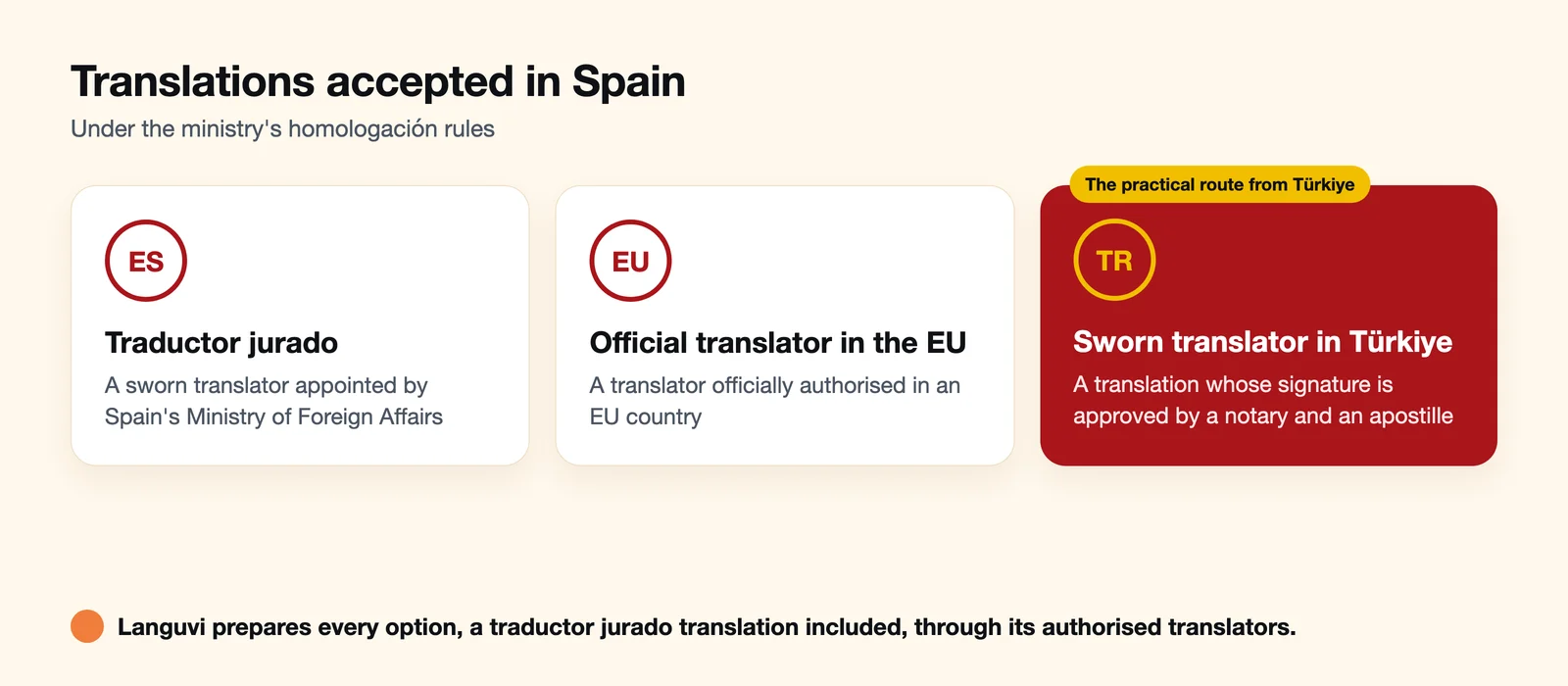
A degree from Türkiye is recognised in Spain through a homologación or equivalencia application. According to the translation rules of Spain's Ministry of Science, Innovation and Universities, accepted translations are those by a sworn translator appointed by Spain's Ministry of Foreign Affairs, by an official translator in an EU country, or by an official translator outside the EU whose signature has been duly legalised. The ministry also requires the translation to be complete and attached to the original. According to the ministry's page, these translations do not expire.
Citizenship, marriage and civil status
Procedures in Spain such as marriage, citizenship or registering a civil status event often ask for a birth certificate, a criminal record certificate and a single status certificate. These procedures are handled by offices in Spain, and they set their own translation requirements.
Which translations are accepted in Spain?
When Spaniards talk about an official translation, they usually mean a traductor jurado appointed by Spain's Ministry of Foreign Affairs. Offices in Spain accept these translators' signatures and seals directly. Where a traductor jurado translation is needed, Languvi prepares it through its authorised translators; just write to us through the contact form.
A sworn translation made in Türkiye can be used once the translator's signature is approved. In Türkiye that approval comes from a notary confirming the sworn translator's signature, followed by an apostille on the translation. For applications at Spanish missions in Türkiye, a notarised and apostilled translation is prepared. If the document is going to an office inside Spain and needs a traductor jurado translation, Languvi prepares that too.
In which order is the apostille done?
Türkiye and Spain are both parties to the Apostille Convention. Official documents issued in Türkiye are therefore used in Spain with an apostille. Some applications want an apostille both on the original and on the translation.
- 1
Apostille on the original: the district governor's office, the governor's office or the court apostilles the original.
- 2
Sworn Spanish translation: a sworn translator translates the document, including its apostille.
- 3
Notary approval: a notary approves the sworn translator's signature.
- 4
Apostille on the translation: if the office asks for it, the notarised translation is apostilled too.
Which documents are translated?
The table below sums up the most common applications. The receiving office's own list always has the final word.
Application | Documents often requested | What to watch |
|---|---|---|
Schengen visa | Bank statements, employer letter, SGK record | The mission's current checklist |
National visa | Criminal record, proof of income, diploma | Sworn translation with an apostille |
Homologación | Diploma, transcript | A translation with an approved signature |
Marriage and civil status | Birth certificate, single status certificate | Recent documents |
Citizenship | Birth certificate, criminal record | A traductor jurado translation if needed |
Spanish translations for Latin America
Spanish is also the official language of many Latin American countries. Documents for applications in countries such as Mexico, Argentina or Colombia are translated into Spanish as well. For these countries too, you simply choose the apostille country in your order.
Checks before you apply
Applications for Spain are most often delayed by a missing approval. Run through these points while you prepare:
If the translation needs an apostille, add it to your order; Languvi prepares the notary approval and the apostille with the translation.
Be clear whether the document goes to a Spanish mission in Türkiye or to an office in Spain.
Keep the spelling of your name identical to your passport, so every translation uses it.
Make sure documents such as criminal records are recent.
Rely only on official mission websites; the Consulate General in Istanbul warns about misleading sites.
Frequently Asked Questions
Do translations for Spain need an apostille?
Official documents need an apostille on the original. Some applications also want the notarised Spanish translation apostilled. The receiving office's document list sets the exact requirement.
What is a traductor jurado?
A traductor jurado is a sworn translator appointed by Spain's Ministry of Foreign Affairs. Offices in Spain accept their signature and seal directly. A translation made in Türkiye becomes usable through notary approval and an apostille.
Is a translation made in Türkiye accepted for degree recognition?
Spain's ministry for universities accepts translations by official translators outside the EU if their signature has been duly legalised. In Türkiye that is done with notary approval and an apostille. Languvi prepares this translation together with the notary approval and the apostille.
Does a translation expire?
For homologación, the ministry states that translations do not expire. The document being translated, such as a criminal record certificate, may still need to be recent. Check the receiving office's list for how recent it must be.
Do you translate for Latin American countries too?
Yes. Spanish translations are also made for applications in countries such as Argentina, Mexico and Colombia. You can choose the apostille country in your order.
Can documents from Spain be translated into Turkish too?
Yes. Documents issued in Spain or Latin America can be translated into Turkish for use in Türkiye. A notary approval can be added to these translations when it is needed.
Conclusion: Two questions decide how to go about translating documents for Spain: where the document will be used, and which approvals the office wants. For Spanish missions in Türkiye a notarised, apostilled translation is prepared, and where a traductor jurado is needed, Languvi provides that through its authorised translators. On Languvi you upload your document, then choose a sworn Spanish translation, notary approval or an apostille on one platform. See our page on Spanish translation with apostille for Spain, or upload your document now on the order page.